The rain in Manchester does not feel like the rain in Edinburgh.
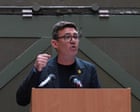
In Manchester, it slickens the pavement outside the St Peter’s Square tram stop, reflecting the yellow glow of the Bee Network buses. Here, the rain feels like fuel. It is the backdrop to a city that feels like it is finally grabbing its own steering wheel. For a commuter standing under an umbrella, watching a locally regulated bus pull up on time, the political abstract known as devolution has a face. It looks like Andy Burnham in a dark coat, standing at a podium, demanding that London let go of the purse strings.
But travel four hours north, past the invisible line where the tarmac changes color and the road signs sprout two languages.
In Edinburgh, the rain hits the volcanic rock of the Royal Mile with a different kind of weight. It carries the memory of a parliament reconvened in 1999, of decades spent building a distinct national identity within a fractured union. If you mention the Manchester mayor’s grand vision of a "devolution revolution" to a politician or a shopkeeper here, you will not get anger. You will get something far more lethal.
A shrug.
The Western world is currently obsessed with the idea of taking back control. From the Rust Belt of America to the industrial towns of northern England, the story is the same: distant capitals have sucked the life out of the provinces, and local leaders want their power back. But as England begins to experiment with its own version of local rule, a quiet, profound misunderstanding is hardening along its borders.
The political heavyweights in Scotland, Wales, and Northern Ireland are watching the English devolution debate with a mixture of exhaustion and skepticism. They do not see a rising tide that will lift all boats. They see an English politician building an English lifeboat, entirely oblivious to the fact that the Celtic nations are already sailing on a completely different ship.
The Illusion of the Shared Struggle
Consider a hypothetical commuter named Jack. Jack lives in Rochdale and works in central Manchester. For years, his life was dictated by timetables written in corporate offices in London. His trains were late. His local libraries closed. His town felt like an afterthought. When the metro-mayoral system gave Manchester the power to run its own transport and set its own skills agendas, Jack’s world changed in small, tangible ways.
To Jack, and to the political class in England, this is the blueprint. If it works for Greater Manchester, why shouldn't it work for the rest of Britain?
But this is where the logic breaks down.
When Andy Burnham pitches his vision of a rewritten British constitution—one where regional leaders sit in a reformed senate to challenge Whitehall—he is speaking to an English wound. He is trying to fix a system where London is the sun and every other English city is a cold, dependent planet.
Now look at Elen. She runs a small medical supply business in the valleys of south Wales. She does not look at London for her healthcare policy, her education system, or her environmental regulations. She looks to Cardiff. The Welsh Senedd already possesses primary legislative powers. It is not a super-sized county council; it is a national parliament.
When Elen hears English mayors talking about winning the right to control local bus routes, she feels a sense of historical vertigo. Wales solved that constitutional question twenty-five years ago.
The mistake is treating the Celtic nations as if they are simply large English regions with better scenery. Scotland is not Yorkshire with a tartan fringe. Wales is not Cornwall with its own language. They are historic nations with distinct legal, educational, and political structures.
The real problem lies elsewhere. The current push for English devolution is designed to fix mismanagement within England. But by framing it as a UK-wide awakening, its architects are accidentally insulting the intelligence of the leaders in Edinburgh, Cardiff, and Belfast.
The View from the Castles
The skepticism from Celtic leaders is not born of arrogance. It is rooted in arithmetic and authority.
In the corridors of Holyrood, the Scottish Parliament, the debate is not about how to get a seat at a table chaired by an English regional mayor. The debate is about fiscal autonomy, the right to borrow money on international markets, and the permanent tension of the Internal Market Act, which Edinburgh views as a Westminster power-grab wrapped in the language of trade efficiency.
To a Scottish minister, Burnham’s proposals look remarkably small.
A senior strategist within the Scottish political apparatus, speaking on the condition of anonymity, described the feeling during a recent constitutional summit.
"There is a fundamental difference between a mayor who is granted powers by a benevolent prime minister, and a parliament that derives its legitimacy from an act of national self-determination," the strategist said. "An English mayor can have their powers stripped away by a single vote in Westminster tomorrow. Our parliament cannot be dissolved so easily. We are playing an entirely different game."
This is the core of the friction. The Celtic leaders doubt Burnham's drive will cross their borders because the drive itself is built on an English misunderstanding of power.
Westminster has always preferred to deal with devolution as an administrative chore. It likes to give away specific tasks—managing a highway, upgrading a railway station, funding a local theater—while keeping the real levers of macroeconomic power firmly locked in a vault in London.
English mayors are generally content with this arrangement because it is an improvement on the absolute nothingness they had before. They are hungry for crumbs from the table.
But the Celtic nations have already eaten the crumbs. They are looking at the kitchen.
The Friction of the Treasury's Purse
The true measure of power is not what you are allowed to say; it is what you are allowed to spend.
Under the current UK system, the funding for Scotland, Wales, and Northern Ireland is determined by a complex mathematical formula known as the Barnett Formula. It is a dry, technocratic mechanism that calculates changes to the Celtic budgets based on spending decisions made for England.
It is a system that creates strange, unintended dependencies. If the UK government spends billions on a high-speed rail link that only runs between London and Birmingham, it has to decide whether that project benefits the whole UK or just England. If it is deemed an English-only project, the Celtic nations receive a financial payout to spend on their own infrastructure.
But when devolution becomes localized within England, the math gets messy.
If Greater Manchester wins the right to retain its own business rates or receives a single, block-grant funding pot from the Treasury, it alters the financial ecosystem of the entire island. Celtic leaders are terrified that a patchwork quilt of powerful English mayors will bargain directly with the Chancellor, cutting backroom deals that bypass the formal structures of the union.
Imagine a room where the Chancellor is trying to balance the demands of thirty different English metro-mayors, each representing millions of voters. In that chaos, the voices of five million people in Scotland or three million in Wales become faint.
The Celtic leaders do not fear Burnham’s success. They fear his distractions. They worry that the urgent, structural reforms needed to keep the United Kingdom from fracturing will be shelved in favor of a superficial PR campaign about regional empowerment.
The Ghost in the Northern Room
To understand just how fragile this conversation is, one must look across the Irish Sea.
Stormont, the home of the Northern Ireland Assembly, operates under a political physics that defies standard gravity. Power-sharing here is not about regional efficiency or economic productivity. It is a delicate, agonizingly negotiated peace treaty disguised as a bureaucracy.
When an English politician talks about creating an "English Senate" or a council of regional leaders to advise the Prime Minister, they are entering a room haunted by ghosts.
Northern Ireland's relationship with the rest of the UK is defined by international treaties, the legacy of conflict, and a unique economic status that places it simultaneously inside the UK internal market and the EU single market for goods. A commuter in Belfast faces challenges that cannot be solved by the structural models used to fix the trains in Leeds.
To suggest that a Northern Irish First Minister should sit around a committee table with the Mayor of the West Midlands to discuss the "devolution drive" is to misunderstand the existential nature of Irish politics. It assumes that every problem in the British Isles can be cured with a little more local management.
It cannot.
The Line in the Mud
Walk along the banks of the River Tweed, where the border between England and Scotland is nothing more than a slow-moving current and a stretch of mud.
On the southern bank, the talk is of renewal, growth deals, and the promise of a government that listens to the north of England. On the northern bank, the talk is of a stalling economy, the long shadow of Brexit, and the feeling that no matter who sits in Downing Street, the fundamental architecture of the state is broken.
The tragedy of the current moment is that both sides are right.
Andy Burnham is right to fight for his city. The centralization of power in London has starved the English regions of ambition, talent, and dignity for generations. The Bee Network is a triumph of local persistence over bureaucratic inertia.
But the Celtic leaders are also right to be distant. They know that you cannot fix a crumbling mansion by simply giving the tenants in the basement permission to repaint their doors.
The devolution drive will not cross the borders because it was never designed to. It is an English cure for an English sickness. Until the political class in London realizes that the United Kingdom is a union of voluntary nations, rather than a collection of regions waiting to be managed, the view from Edinburgh, Cardiff, and Belfast will remain exactly the same.
A cold, hard look across the water. And that slow, devastating shrug.


