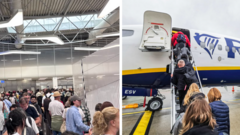
The fluorescent lighting of an international terminal at 2:00 AM has a specific, soul-crushing frequency. It hums. It vibrates against the optic nerve, amplifying the sour taste of stale espresso and the low-grade panic of a missed connection. For seventy-four passengers at Thessaloniki Airport in northern Greece, that hum was the soundtrack to a sudden, bureaucratic exile.
They had done everything right. They arrived early. They checked in digitally. They clutched their boarding passes for Ryanair Flight FR8073, bound for London Stansted. But none of that mattered because of a single, invisible bottleneck: a passport control queue that froze solid.
Travel, in our hyper-connected era, is sold as a friction-free dream. We buy tickets with a thumbprint. We glide through digital turnstiles. But this modern illusion relies entirely on a fragile chain of human infrastructure. When one link snaps, the entire illusion evaporates, leaving hundreds of people stranded in a concrete room, watching their plane back away from the gate through a glass pane.
This isn't just a story about a delayed flight. It is a glimpse into the hidden mechanics of modern travel, where a minor administrative hiccup can instantly derail lives.
The Anatomy of the Freeze
Consider a hypothetical traveler named Elena. She isn't real, but her situation represents dozens of people who were trapped in Thessaloniki that Sunday night. Elena had a presentation in London on Monday morning. She had calculated her timeline down to the minute. She factored in the security lines, the walk to the gate, even a brief stop to buy a bottle of water.
What she couldn't factor in was the sudden paralysis of the frontier booths.
When Elena reached the passport control zone, the line wasn't just long. It was dead. Only two of the six available desks were staffed. A massive influx of holidaymakers from three concurrent flights had descended upon the terminal simultaneously. The queue ballooned, wrapping around the stanchions, spilling out into the main concourse, and solidifying into a dense mass of exhausted humanity.
Minutes bled into hours. The digital clock above the gate ticked down with cold indifference.
Passengers pleaded with airport staff. They pointed at their watches. They showed their boarding passes, noting that their flight was already boarding. The responses were a mix of shrugged shoulders and defensive deflections. Airport security blamed the border police. The border police blamed the sudden surge in passenger volume. Ryanair staff, stationed firmly on the other side of the passport gates, could only watch as their passenger manifest remained half-empty while the departure time came and went.
Then came the finality of the announcement. Flight FR8073 was departing. Without them.
The Left-Behind
The immediate aftermath of a mass flight abandonment is not chaotic; it is eerily quiet. There is a collective intake of breath, a shared moment of disbelief, and then the slow, heavy weight of reality setting in.
People don't just lose a flight. They lose what the flight was carrying them toward.
In that crowd were parents whose children were waiting with babysitters in London. There were freelancers facing financial penalties for missing a contractual shift. There were tourists who had spent their last Euros on the cab ride to the airport, now forced to figure out how to survive in a transit hub with no local currency and a maxed-out credit card.
The airline’s automated systems kicked in, offering the standard, bloodless remedies. A text message. A link to a broken webpage. An option to rebook on the next available flight—which, due to the peak summer season, wasn't for another four days.
This is where the true friction of the budget travel model lays bare. When the machine works, it is a miracle of affordability. When it breaks, the customer is frequently left to navigate the wreckage alone. Ryanair’s standard operating procedure in these scenarios is legally insulated: if the passenger fails to present themselves at the gate before it closes, the airline considers it a "no-show," regardless of whether the passenger was trapped in a state-sanctioned queue fifty yards away.
The airport authority issued a statement the following morning, citing an "unprecedented operational spike" and "unforeseen staffing constraints at the state border checkpoints." It was a pristine piece of bureaucratic prose that managed to say absolutely nothing while absolving everyone involved.
The Illusion of Control
We live under the comforting delusion that our movements are governed by logic and contract. We buy a ticket; therefore, we are entitled to transit. But the reality of international travel is that we are always at the mercy of the gatekeepers.
The passport control queue is a unique psychological space. It is a legal no-man's-land. You have technically left the country of origin, but you have not yet been cleared to depart its airspace. In this zone, your rights are suspended, replaced by the absolute authority of the border agent. If they decide to work slowly, or if a scheduling shift leaves a booth empty, there is no appeal process. There is no manager to speak to. You simply wait.
For the seventy-four stranded in Greece, the night became a masterclass in survival. They slept on the linoleum floors, using their carry-on bags as pillows. They shared portable phone chargers. They formed an impromptu community born of shared misfortune, trading stories of what they were missing back home.
By Monday afternoon, the crowd had splintered. The affluent bought expensive, multi-stop tickets on legacy carriers to get back to the UK via Frankfurt or Athens. The broke remained, waiting for the airline to authorize hotel vouchers that arrived hours too late to be useful.
The terminal eventually cleared. The lights stayed on. The hum continued.
Somewhere over the Adriatic Sea, an empty aircraft flew toward London, its cabin quiet, its overhead bins open, carrying nothing but the fuel it burned to get there. Down below, on the tarmac of Thessaloniki, a single stray boarding pass blew across the concrete, a tiny paper monument to a Sunday that was entirely erased by a closed window.


