In a small wooden kitchen in the foothills of the Julian Alps, the scent of potica—a traditional walnut roll—competes with the sharp, metallic tang of a cold March wind. Marija, a grandmother whose hands are mapped with the wrinkles of seventy winters, ignores the television for a moment to check the dough. On the screen, two men are arguing about the soul of Slovenia. One speaks of walls and national purity, channeling the rhetoric of a distant Mar-a-Lago; the other speaks of European stability and the quiet maintenance of the status quo.
Marija doesn't care much for the term "geopolitics." To her, politics is the price of heating oil and whether her grandson will have to show a passport to visit his cousins across the Italian border. But as the polls open, she realizes that her kitchen is no longer a sanctuary. It is a microcosm of a continent pulling itself apart.
Slovenia is a tiny green sliver of land, yet it sits on the tectonic plates of European ideology. On one side stands the incumbent, a figure of liberal technocracy. He represents the "Brussels way"—measured, predictable, and firmly integrated into the European Union. On the other side is the challenger, a nationalist often dubbed the "Marshal" of his movement, a man who has openly modeled his campaign after Donald Trump’s populist insurgency.
The choice isn't just about a name on a ballot. It is a choice between two different versions of reality.
The Echo of the Atlantic
It seems strange that a country of just over two million people, nestled between Austria and Croatia, would be obsessed with an American political style. Yet, the populist challenger has successfully imported a specific brand of fire. He uses social media as a cudgel. He attacks the "corrupt media." He speaks of a "deep state" lurking in Ljubljana.
For many voters in the rural heartlands, this rhetoric feels like a long-overdue acknowledgement of their existence. They feel the urban elite in the capital have sold the country’s sovereignty for a seat at the big table in Belgium. They see the 180,000 migrants who crossed the Balkan route in recent years not as a humanitarian challenge, but as an existential threat to their forests and their village squares.
The statistics ground these fears in a hard, cold reality. While Slovenia’s GDP grew by nearly 3% last year, that wealth didn't trickle down to the mountain farms. The cost of living has spiked, with food prices rising by over 10% in some regions. When the nationalist candidate promises "Slovenia First," he isn't just shouting a slogan. He is offering a shield.
The Architect of the Middle Ground
Conversely, the incumbent offers a different kind of safety: the safety of being invisible. To him, Slovenia’s strength lies in its ability to be a "good student" of Europe. He points to the stability of the Euro and the importance of the Schengen Area, which allows for the seamless flow of goods and people.
Imagine a young entrepreneur in Maribor named Jakob. Jakob’s business relies on 3D printing components that he ships to Germany and France. For him, the nationalist’s talk of "sovereignty" sounds like a threat to his livelihood. If the borders harden, his lead times double. If the country pivots away from the EU’s core values, his investors disappear.
Jakob and Marija represent the two halves of a fractured nation. One looks at the world and sees a series of connections to be maintained; the other looks at the world and sees a series of threats to be guarded against.
The Invisible Stakes
The media often frames this as a "race," a word that implies a finish line. But in Slovenian politics, the finish line is just the beginning of a messy, complicated dance. Because of the country’s proportional representation system, winning the most votes rarely means you get to rule. You must build a coalition.
This is where the human element becomes a game of mathematical chess. To form a government, a party needs a majority in the 90-seat National Assembly. In the last cycle, it took five different parties coming together to keep the nationalists out of power. It was a fragile alliance, held together by nothing more than a shared "no."
This time, the stakes are higher because the exhaustion is deeper.
The populist candidate has been clever. He has stopped talking exclusively about migration and started talking about "national dignity." He taps into a deep-seated feeling that Slovenians are being looked down upon by the "Old Europe" powers. It is a sentiment found in the rust-belt of America, the northern towns of England, and now, the valleys of the Sava River.
A Choice Between Two Fears
If you walk through the Prešeren Square in Ljubljana, you’ll see students drinking coffee and debating the climate crisis. They fear a future where the nationalist wins and pulls Slovenia into the "illiberal" orbit of Hungary’s Viktor Orbán. They see a slide toward authoritarianism, where the judiciary is cowed and the press is silenced.
But if you drive two hours into the mountains, the fear changes shape. There, the fear is of a world that has moved on and left the traditional Slovenian way of life behind. They fear a future where they are just a "province" of a European super-state, their language and customs diluted by a globalist monoculture.
Both sides believe they are the ones defending democracy. The liberal incumbent argues that democracy is found in the institutions, the laws, and the international treaties. The nationalist challenger argues that democracy is the will of the people, unburdened by the "interference" of unelected judges or foreign bureaucrats.
The data suggests a dead heat. Polling indicates that the margin of victory could be as slim as 20,000 votes. In a country this size, that is the population of a few small towns. Every conversation at a bus stop, every argument over a dinner table, carries the weight of the nation’s direction.
The Mirror of the West
Slovenia is a mirror. Looking into it, the rest of the world can see the primary conflict of the 21st century: the struggle between the open and the closed.
It is easy to dismiss this as a "small" election in a "faraway" place. But the tactics being tested here—the use of American-style grievance politics in a European context—will be the blueprint for elections in France, Germany, and beyond. If the pro-Trump nationalist wins, it signals that the wave of populism wasn't a fluke of the mid-2010s, but a permanent feature of the landscape.
If the liberal incumbent holds on, it suggests that the center can hold, provided it can prove that its version of the world still puts bread on the table.
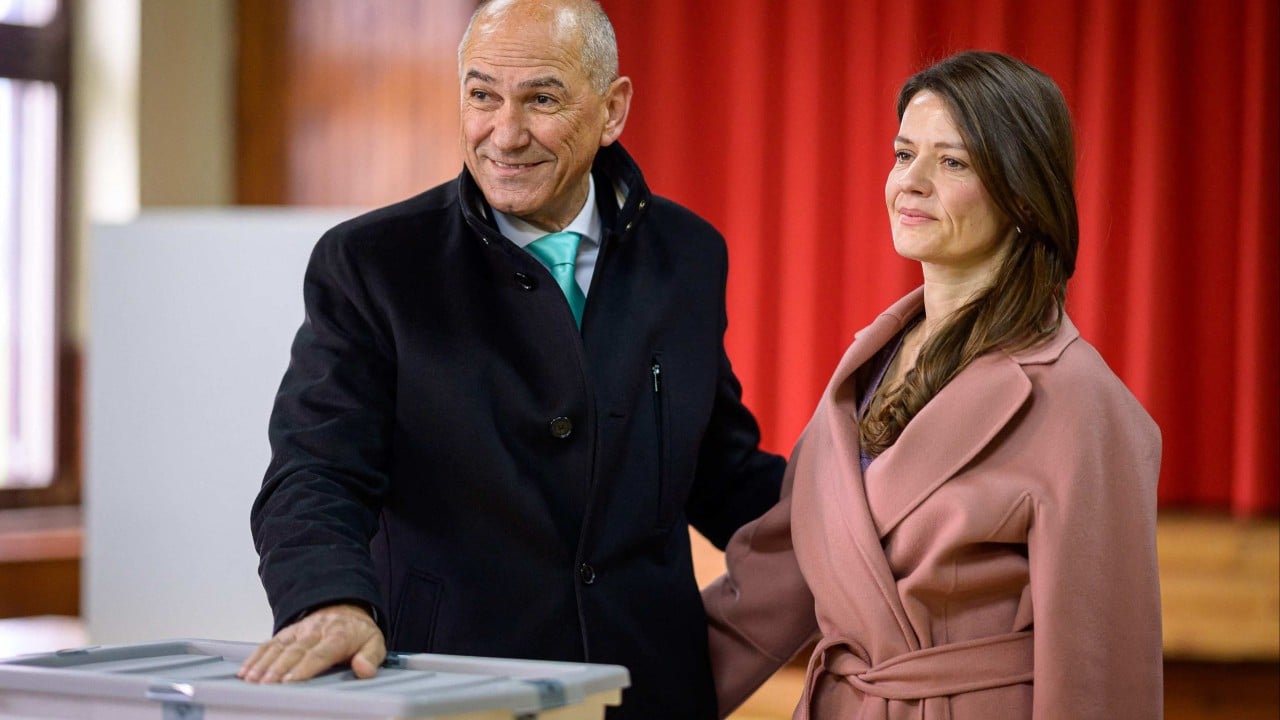
Back in the kitchen, Marija finally pulls the potica from the oven. The warmth of the bread fills the room, a brief comfort against the uncertainty of the night. She will go to the polling station in the village schoolhouse later this afternoon. She will take her pen and make a mark.
She isn't voting for a "nationalist" or a "liberal." She is voting for a version of the future where her grandson can still cross the border, but where the world outside that border doesn't feel quite so threatening.
The ballot is a small piece of paper, but as she folds it, she feels the immense, silent weight of the mountains leaning in to see which way she turns.
The wind outside hasn't died down. It is only gathering strength.