The water does not vanish quietly. It leaves a stain first.
Stand on the old stone banks of the Danube or the Rhine during a dry summer, and you will see it. The waterline drops, centimeter by stubborn centimeter, stripping away the green velvet algae to reveal a pale, scarred concrete wall. Then comes the smell. It is not the fresh scent of a moving current, but something ancient and stagnant. The smell of wet silt, forgotten iron, and things that were never meant to see the open sky again. Discover more on a similar subject: this related article.
Europe is thirsty. And as her great arteries shrink, they are spitting up their history.
Consider what happens when a river loses its memory. For centuries, these channels carried emperors, merchants, poets, and armies. They carved the borders of nations and filled the bellies of cities. We treated them as permanent fixtures of the earth, blue ribbons painted across an eternal map. But permanence is an illusion written in water. Further analysis by AFAR explores similar views on the subject.
Now, the mud is cracking. And inside that cracked mud lie the ghosts.
When the Stones Speak
In the Serbian port town of Prahovo, local fishermen do not need to look at tide charts to know the scale of the crisis. They look for the hulls.
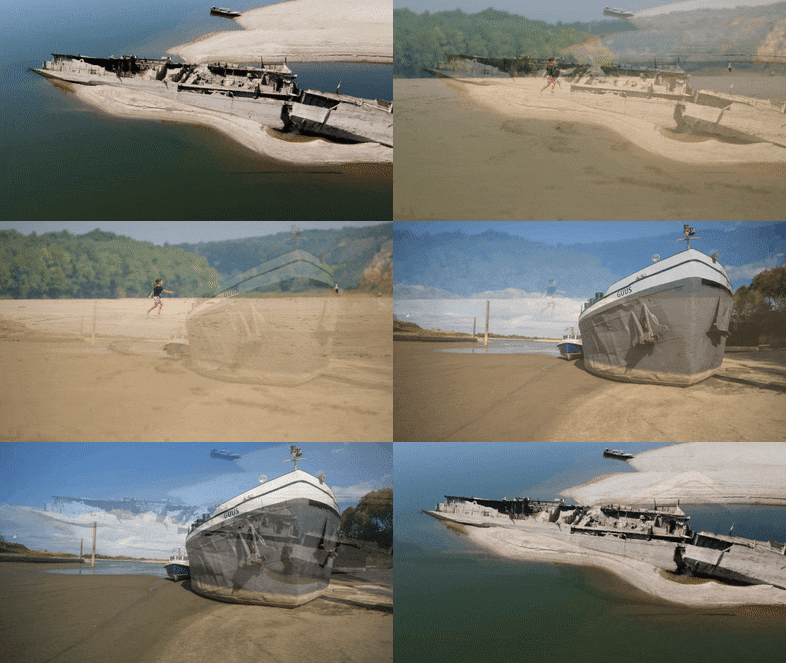
During the devastating droughts that have gripped the continent in recent years, the Danube dropped to levels not seen in nearly a century. When it did, more than twenty German warships emerged from the yellow depths. These were not romantic relics of ancient empires. They were ghosts of 1944, part of the Nazi Black Sea fleet scuttled by retreating forces to block the advancing Soviet army. They still carry their lethal cargo. Tons of unexploded ordnance, packed tight in rusted iron shells, sitting exposed in the baking heat of a receding riverbed.
Imagine walking across the damp earth of a river bottom that should be ten feet deep, only to kick your boot against a live torpedo.
This is the strange, jarring reality of the climate squeeze altering Europe’s waterways. The drying rivers are acting as planetary archeologists, unearthing the darkest chapters of the twentieth century while simultaneously warning us about the twenty-first.
In the Czech Republic, centuries-old boulders bear a chilling warning. Known historically as hunger stones, these petrified markers were carved by past generations during periods of extreme famine and drought. One famous boulder in the Elbe River bears an inscription chiseled in German: If you see me, weep.
When those words reappear above the surface, it is never a cause for celebration. It is a distress signal sent backward through time by ancestors who understood, better than we do, the terrifying fragility of a failed harvest. Today, those stones are surfacing with alarming regularity. They are no longer historical curiosities. They are recurring nightmares.
The Invisible Engine Stalls
We look at a river and see scenery. Barges see a highway.
Europe’s inland waterways are the invisible circulatory system of its economy. When the Rhine drops below a critical threshold, the massive container ships that ferry coal, grain, chemicals, and manufactured goods can no longer load to full capacity. They have to lighten their loads by half, or a quarter, just to scrape over the submerged gravel bars.
Suddenly, a journey that cost hundreds of euros per ton becomes prohibitively expensive. Factories in Germany run low on raw materials. Power plants struggle to get the coal they need to keep the grid stable. Cargo is forced off the water and onto the asphalt, clogging already fragile highways with thousands of additional semi-trucks, burning more diesel, worsening the very atmospheric conditions that caused the drought in the first place.
It is a vicious loop.
A river is a system of dependencies. When the snowpack in the Alps melts too early in the spring, it rushes down the valleys all at once, leaving nothing behind for the scorching weeks of August. When the rainfall patterns shift just a few hundred miles to the north, the headwaters starve.
We talk about supply chain disruptions as if they are abstract failures of global logistics. But at its root, a supply chain is often just a river with enough water in it to float a boat. Break the water, and the chain snaps.
The Face in the Silt
Meet Elena. She runs a small vineyard perched on a steep slate slope overlooking the Moselle, a winding tributary of the Rhine. Her family has harvested these grapes for four generations. The terroir—that mystical combination of soil, sun, and moisture—is everything.
Last summer, Elena watched the leaves on her oldest vines curl inward, crisping at the edges like old paper. The grapes shriveled before they could swell with juice. The river below, usually a deep, cooling presence that moderated the valley's microclimate, shrank to a narrow, sluggish creek. Without the cooling moisture rising from the water, the valley trapped the heat like an oven.
"The land is losing its voice," she told me, her hands calloused and stained purple from the early harvest. "We used to read the weather by the river mists. Now the mists are gone. We are farming in a vacuum."
Elena’s story is repeated thousands of times across the continent. Hydropower plants in France and Italy are forced to shut down their turbines because there is not enough force to turn the blades. Nuclear reactors along the Rhône reduce their output because the river water used for cooling is already too warm, and pumping it back in at higher temperatures would sterilize the aquatic ecosystems downstream.
We are asking our rivers to do the impossible. We demand that they cool our cities, water our crops, carry our commerce, quench our thirst, and absorb our treated wastewater—all while shrinking under a relentless, atmospheric blowtorch.
The Anatomy of Loss
To understand why this is happening, we have to look past the muddy banks and up into the atmosphere. The European continent is warming faster than the global average. High-pressure ridges, affectionately dubbed heat domes by meteorologists, park themselves over Western Europe for weeks at a time, deflecting rain-bearing Atlantic storms northward.
It is a meteorological blockade.
And underneath that blockade, the soil acts like a giant sponge that has been wrung dry. When the rare thunderstorms finally do break, the ground is so baked and compacted that it cannot absorb the water. Instead of soaking deep into the aquifers to recharge the underground springs that feed the rivers during dry spells, the rain runs off the surface in destructive flash floods, tearing topsoil away and leaving the landscape even more vulnerable than before.
We are breaking the water cycle. We have straightened rivers, paved over floodplains, built concrete embankments, and treated natural drainage basins as real estate development opportunities. We thought we could engineer nature into submission.
Nature is simply stepping back and letting us see the foundations we built upon.
The Silt Remembers
Back in the riverbeds, the receding waters leave behind more than rusted munitions and carved stones. They leave dead fish by the thousands, suffocating in warming pools where the dissolved oxygen has dropped to zero. They leave freshwater mussels baked open in the sun. They leave an eerie, unnatural silence where the steady, rushing roar of a healthy current used to be.
There is a profound psychological weight to this transformation. Rivers are the anchors of human settlement. Cities were founded on their banks because water meant life, connection, and survival. To watch them wither is to watch the slow unravelling of the geography we thought we owned.
Yet, the crisis is also forcing a radical reckoning.
Across Europe, engineers and ecologists are starting to undo centuries of hubris. They are blowing up obsolete dams. They are tearing down concrete walls and allowing rivers to spill out into their natural floodplains once more, giving them room to breathe, to meander, to sink deep into the earth instead of rushing uselessly out to sea. It is a desperate, necessary shift from control to accommodation. We are learning that the only way to save our rivers is to give them back their space.
The sun dips low over the dry bed of the Danube. The exposed iron of the sunken warship catches the last bruised orange light of the evening, glowing like a rusted ribcage in the mud. Somewhere upstream, a faint rumble of thunder promises rain. Whether it will be enough to wash the secrets back under, or whether it will simply slide off the crust of a thirsty earth, remains unwritten.
The water will return. It always does, in some measure. But the river will never look at us the same way again.