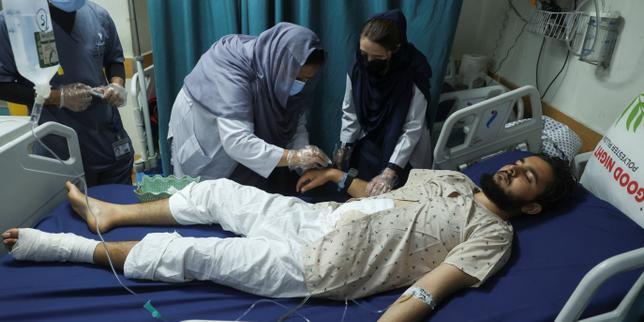
The Durand Line is bleeding again. While the international community remains fixated on global power shifts in Eastern Europe and the Middle East, a brutal reality is hardening along the 2,600-kilometer boundary between Pakistan and Afghanistan. Recent escalations have claimed the lives of at least 42 Afghan civilians, including women and children, marking a dangerous pivot from skirmishes between armed factions to the direct targeting of non-combatants. This isn't just a border dispute. It is the violent manifestation of a decades-long strategic miscalculation by Islamabad and the ideological intransigence of the Taliban.
For years, the Pakistani military establishment viewed a Taliban-led Afghanistan as a strategic necessity—a "depth" strategy designed to ensure a friendly neighbor to the west. That gamble has curdled. Instead of a compliant proxy, Pakistan now faces an empowered insurgent government that refuses to recognize the colonial-era border and provides, at the very least, a permissive environment for the Tehrik-i-Taliban Pakistan (TTP). The resulting friction is being settled with heavy artillery and airstrikes, leaving civilians caught in the crossfire of two states that cannot agree on where one ends and the other begins.
The Myth of Religious Solidarity
The central fallacy driving this conflict is the idea that shared religious identity would supersede nationalist interests. When the Taliban took Kabul in 2021, many in the Pakistani intelligence circles celebrated. They expected the border issues—specifically the dispute over the Durand Line—to vanish. They were wrong. The Taliban, regardless of their ideological leanings, are Afghan nationalists first. They view the fencing of the border by Pakistan as an illegal bisection of Pashtun lands.
The violence we see now is the physical rejection of that fence. When Pakistani forces attempt to repair or extend the barrier, Taliban fighters open fire. Pakistan responds with standoff weapons—airstrikes and long-range shelling. These strikes frequently hit residential areas in Khost and Kunar provinces. The victims are not "militants" in the traditional sense; they are families living in a geographic grey zone that neither side is willing to govern with anything other than lead.
Tactical Failures and Human Consequences
Military operations in these rugged terrains are notoriously imprecise. Pakistan’s reliance on aerial bombardment in the border regions is a desperate attempt to curb TTP incursions without committing ground troops to a meat grinder. However, the intelligence guiding these strikes is often flawed. In the most recent rounds of violence, the United Nations confirmed that the vast majority of casualties were civilians.
This creates a self-perpetuating cycle of radicalization. Every time an Afghan child is killed by a Pakistani shell, the TTP finds a dozen new recruits. The Afghan Taliban, meanwhile, uses these civilian deaths to bolster their domestic legitimacy, casting themselves as the only force capable of defending Afghan sovereignty against a "foreign" aggressor.
- Displaced Populations: Thousands of families are fleeing border villages, creating a localized refugee crisis that neither Kabul nor Islamabad is equipped to handle.
- Trade Paralysis: The Torkham and Chaman border crossings, the lifeblood of the regional economy, are frequently shut down, causing millions in losses for traders and starving local markets of essential goods.
- Security Vacuum: While the two states bicker, transnational groups like ISIS-K find pockets of lawlessness where they can regroup and plan attacks that target both sides.
The TTP Factor
Pakistan’s primary grievance is the TTP. Islamabad claims that the Afghan Taliban provides sanctuary to these militants, who have intensified their campaign of terror inside Pakistan over the last twenty-four months. The Taliban denies this, claiming the TTP is a homegrown Pakistani problem. The truth lies in the murky middle. The TTP and the Afghan Taliban share a common history, a common struggle, and a common worldview. Expecting the Taliban to militarily "neutralize" their brothers-in-arms for the sake of the Pakistani state was always a naive expectation.
The Afghan Taliban’s refusal to crack down on the TTP is a calculated move. Doing so would risk a mutiny within their own ranks, as many Afghan fighters feel more loyalty to their TTP comrades than to the diplomatic dictates of the leadership in Kabul. Consequently, Pakistan feels it has no choice but to take matters into its own hands, leading to the cross-border strikes that are now killing civilians in record numbers.
A Border Without a Future
The Durand Line was drawn in 1893 by a British civil servant and an Afghan Emir. It was never intended to be a permanent, hardened border between two modern nation-states. Today, it is a scar that refuses to heal. Pakistan’s attempt to turn it into a hard, monitored frontier with 800 miles of chain-link fence and surveillance towers is a direct affront to the Pashtun tribal structure that has existed for centuries.
The tragedy is that there is no diplomatic mechanism currently capable of de-escalating this. The Taliban are not recognized as a legitimate government by the international community, making formal border treaties nearly impossible. Pakistan is mired in its own internal political and economic chaos, leaving the military to dictate a heavy-handed border policy that prioritizes tactical deterrence over long-term stability.
The Strategic Blind Spot
Washington and Beijing are watching, but neither is willing to step into this quagmire. China wants stability for its CPEC investments, while the U.S. is content to let the region simmer as long as the violence doesn't spill over into a global terror event. This leaves the civilians of Khost, Kunar, and Paktika to fend for themselves. They are the collateral damage in a high-stakes game of "strategic depth" that has gone horribly wrong.
The civilian death toll will continue to rise as long as Islamabad believes it can shell its way to security and Kabul believes it can ignore the presence of militant groups on its soil. This is not a misunderstanding. It is a fundamental clash of state interests where the only currency is blood.
The next time a strike is ordered, the commanders will talk of "surgical precision" and "targeted threats." The reality on the ground will be the same as it has been for forty years: a cratered home, a grieving family, and a border that remains as contested and lethal as the day it was drawn. If you want to see the future of this conflict, look at the rubble in the border villages. It isn't going away. It's just getting louder.