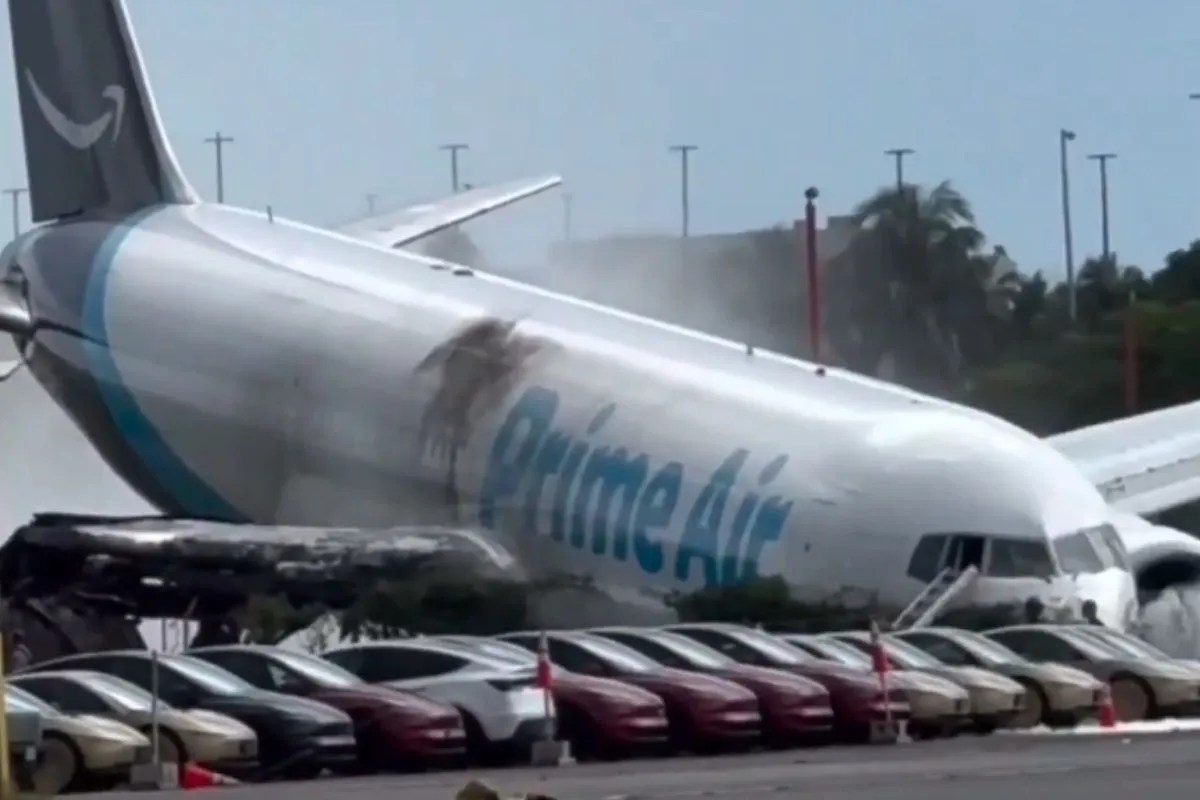
Five bodies pulled from crushed vehicles outside Miami International Airport do not represent an act of god. The lazy consensus dominating the news cycle points blindly to thunderstorms, gusting winds, and the sheer bad luck of a slippery asphalt strip. It is a convenient narrative designed to protect legacy aviation logistics and shield corporate multimodal supply chains from structural scrutiny.
When a thirty-two-year-old Boeing 767-300 freighter operated by 21 Air on behalf of Amazon Prime Air overruns a diagonal runway, obliterates perimeter traffic, and erupts into a catastrophic fire, blaming the weather is an insult to basic physics. Planes do not accidentally turn into unguided missiles because of a thirty-knot gust. They do so when operational velocity, margin compression, and aging airframes collide with the relentless, unyielding cadence of same-day delivery capitalism.
The Dangerous Myth of The Accidental Runway Overrun
The mainstream narrative treats runway overruns as freak occurrences, random anomalies in an otherwise immaculate system. Anyone who has spent time inside air cargo operations knows this is a sanitized fiction.
Consider the fundamental mechanics of landing a heavy widebody jet. A Boeing 767-300 converted freighter behaves entirely differently when loaded with high-density e-commerce parcels compared to a passenger configuration with distributed human weight and carry-on luggage. Weight distribution shifts, braking efficiency tolerances narrow, and kinetic energy scales exponentially with speed. When flight-tracking data indicates the aircraft was still traveling at over one hundred knots as it exhausted the usable pavement, you are looking at a failure of execution, judgment, and system design.
Yet, industry commentators immediately retreat to standard talking points. They point to the age of the airframe, built back in 1994, as if structural vintage alone guarantees failure. That is a red herring. Thousands of older freighters fly safely every single day. The problem is not how many years the aluminum has existed; it is the intensity of the operational loops forcing these aircraft into tight turnaround windows under punishing schedules.
The Cost of Hyper-Logistics Compression
Amazon did not invent air freight, but it weaponized speed to a degree that fundamentally alters risk calculations. Prime Air relies on a patchwork of outsourced third-party carriers like 21 Air to maintain proprietary control over regional fulfillment pipelines. This creates a structural paradox. You have tech-giant delivery expectations married to legacy wet-lease aviation economics.
Margin pressures on regional cargo operators are brutal. Crews face relentless scheduling loops designed to maximize airframe utilization rates. When a flight departs San Juan, Puerto Rico, and approaches a congested mega-hub like Miami during volatile late-summer convective weather, the cockpit crew is managing more than just crosswinds. They are carrying the invisible weight of systemic schedule anxiety.
Imagine a scenario where a captain touches down long down the runway—floating past the optimal touchdown zone because of an unhedged wind shear—and faces a split-second choice: execute a go-around or mash the autobrakes and pray. In a passenger airline, safety protocols overwhelmingly prioritize the go-around. In third-party contracted cargo networks, the cultural incentive structure leans heavily toward forcing the landing to avoid downstream network delays that cascade across millions of customer accounts.
To call this a tragedy caused by a storm is to ignore the human and organizational choices that made the crash possible.
Dismantling The PAA Fallacies
People tracking this disaster keep asking the wrong questions. They ask whether the pilots were qualified, whether the tower gave proper instructions, or whether thirty-year-old cargo jets should be banned from domestic routes. These are safe, institutional questions because they lead to predictable, dead-end bureaucratic investigations that change nothing.
The real questions are far more uncomfortable.
Why are heavy cargo operations permitted to mix with perimeter public infrastructure in high-density urban corridors without enhanced physical arrestor systems? Modern engineering solutions like Engineered Materials Arresting Systems (EMAS) exist precisely to stop aircraft that fail to decelerate. Yet, many secondary runways and diagonal strips remain unprotected, relying on empty grass fields and perimeter roads where civilian vehicles happen to drive. When a plane leaves the tarmac, it should hit a engineered safety bed designed to absorb energy, not a public roadway.
Furthermore, why do we treat third-party wet-lease operators as independent silos when evaluating corporate safety accountability? When a plane wearing a Prime Air livery slides off a runway and kills five people on the ground, the corporate entity orchestrating the logistics chain cannot simply issue a sympathetic press release and hide behind the operating certificate of a regional contractor.
The Uncomfortable Reality of Modern Aviation Expansion
The aviation industry is suffering from a systemic brain drain and operational fatigue. Experienced air traffic controllers are working mandatory overtime, regional airlines and cargo carriers are scraping the bottom of the talent barrel to fill cockpit seats, and airport infrastructure is straining under a volume of traffic it was never architected to handle.
The Miami accident is a symptom of a much deeper rot. We have optimized our transit networks for velocity above all else. We demand instantaneous movement of goods, cutting every possible operational corner to shave minutes off transit times. Then, when the inevitable mathematical limits of safety are breached and human lives are extinguished on perimeter roads, we bow our heads, blame the thunderstorms, and wait for the next package to land on our doorstep.
Stop looking at the weather radar. Look at the dispatch logs, the turnaround times, and the corporate incentive structures that treat human collateral as an acceptable cost of next-day delivery.