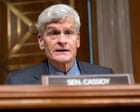
Bill Cassidy made a bet five years ago that the Republican party would eventually move past Donald Trump. He was wrong. Today, the Louisiana senator faces a brutal primary election that serves as a stark reminder of a simple rule in modern conservative politics: loyalty to the president isn't preferred; it's mandatory.
Cassidy is running for a third term, but he's doing it with a massive target on his back. Ever since he voted to convict Trump during the 2021 post-January 6 impeachment trial, a showdown was inevitable. Trump didn't forget. In January, the president effectively handpicked U.S. Representative Julia Letlow to challenge Cassidy, instantly upending what should've been a sleepy reelection routine for a well-funded incumbent.
If you want to understand where the GOP stands right now, don't look at Washington floor speeches. Look at Louisiana. Cassidy's struggle shows that legislative wins, deep pockets, and local roots don't mean much if you've crossed the leader of the movement.
The Impeachment Hangover That Never Faded
Most of the seven Republican senators who voted to convict Trump in 2021 are gone. They retired or got pushed out. Cassidy is one of the lonely survivors trying to prove that an independent streak can still exist in a deeply red state.
For many Louisiana primary voters, that 2021 vote wasn't an act of conscience. It was a betrayal. Cassidy has tried to shift the conversation back to his record, pointing to his position as chair of the powerful Senate health committee and his ability to bring federal dollars home. He has spent heavily to remind people that he's a solid conservative voice on judges, taxes, and energy.
But policy nuance knda gets crushed when the president is actively using his platform to torch you. Trump has framed the Republican Louisiana senator in tough primary terms as an act of political cleansing. The feud worsened recently when Trump blamed Cassidy for blocking his controversial surgeon general pick, Casey Means, who eventually had to withdraw. Trump publicly accused Cassidy of playing "political games" and explicitly told Louisianans to vote him out.
A Scrambled Three-Way Race
This isn't a simple head-to-head matchup. The primary ballot features a messy three-way scramble among Republicans, thanks in part to Louisiana's changing election rules. Voters are using separate party primaries instead of the old jungle primary system where everyone ran on one ballot.
- The Incumbent: Bill Cassidy, the veteran doctor who has dumped millions into advertising to save his job.
- The Trump Choice: Julia Letlow, a millennial congresswoman representing the 5th District who has run a campaign heavy on MAGA themes and presidential alignment.
- The Wildcard: John Fleming, the current state treasurer and former congressman who served in the Trump administration.
Fleming is the element that makes this race incredibly unpredictable. He's not a moderate alternative; he's a staunch conservative who actually appeals to voters who love Trump but might be wary of Letlow's lack of statewide experience.
Recent polling from Emerson College shows just how bad the situation is for the incumbent. Cassidy has consistently trailed in third place among likely Republican voters, with Letlow and Fleming running neck and neck at the top. Because Louisiana requires a candidate to secure more than 50% of the vote to win outright, the race is almost certainly heading to a June 27 runoff. Cassidy's entire strategy right now is just surviving long enough to make it into that second round.
Money Versus Momentum
On paper, Cassidy should be crushing this. He has the institutional backing and a massive financial advantage. Through mid-May, Cassidy's campaign and the super PAC supporting him, the Louisiana Freedom Fund, dropped over $21 million on ads.
By comparison, Letlow and her aligned groups have spent around $10 million, while Fleming's lean campaign has spent just $1.5 million.
In the old days of politics, outspending your opponents two-to-one was a guarantee of safety. Not anymore. Letlow has weaponized her lack of structural funding as proof that she's fighting the establishment. She even skipped high-profile House votes in Washington during the final week of the campaign to tour local businesses and clinics back home, betting that face-to-face retail politics in places like Lafayette would outvalue Cassidy's television blitz.
The Limits of Political Penance
Cassidy knew the storm was coming. For the last year, he tried to play a delicate game of political penance. He didn't become a Never-Trump resistance figure. Instead, he regularly touted the administration's policy goals and tried to show utility.
His most dramatic move came during the confirmation hearings for Health Secretary Robert F. Kennedy Jr. Even though Cassidy, a physician, openly sparred with Kennedy over his vaccine skepticism, he ultimately cast a crucial vote to confirm him. It was a clear signal to the base that he could work within the party framework.
It basically didn't matter. The base didn't care about the confirmation vote; they cared about the endorsement on Truth Social. Trump’s brand of politics is binary—you're either entirely with him or you're the opposition.
Some local voters are pushed away by this demand for absolute loyalty. There are agriculture and oil-industry voters in New Orleans and Metairie who say they prefer leaders who make their own decisions. But in a closed Republican primary, those independent-minded voters are often outnumbered by the hardcore base that turns out in high-volume areas like St. Tammany Parish.
What to Watch as the Tally Rolls In
If you're tracking the results, the path to a runoff depends on specific geographic strongholds.
Watch the margins in Jefferson Parish, where Trump has traditionally run up huge numbers. If Letlow dominates there, Cassidy's night will end early. Conversely, look at East Baton Rouge and Caddo Parishes. These are areas where Cassidy needs a strong showing among more traditional, business-oriented Republicans to keep his campaign alive.
The biggest wildcard is voter turnout. Historically, these standalone primaries draw a fraction of the electorate compared to general presidential cycles. In a low-turnout environment, the side with the most intense emotional motivation wins. Right now, that motivation belongs to the voters who want to settle an old score from 2021.
If Cassidy falls tonight or fails to make the runoff, it will solidify a reality that every congressional Republican already suspects: the modern GOP has no room for dissent, no matter how long you've served or how much money you bring to the table.