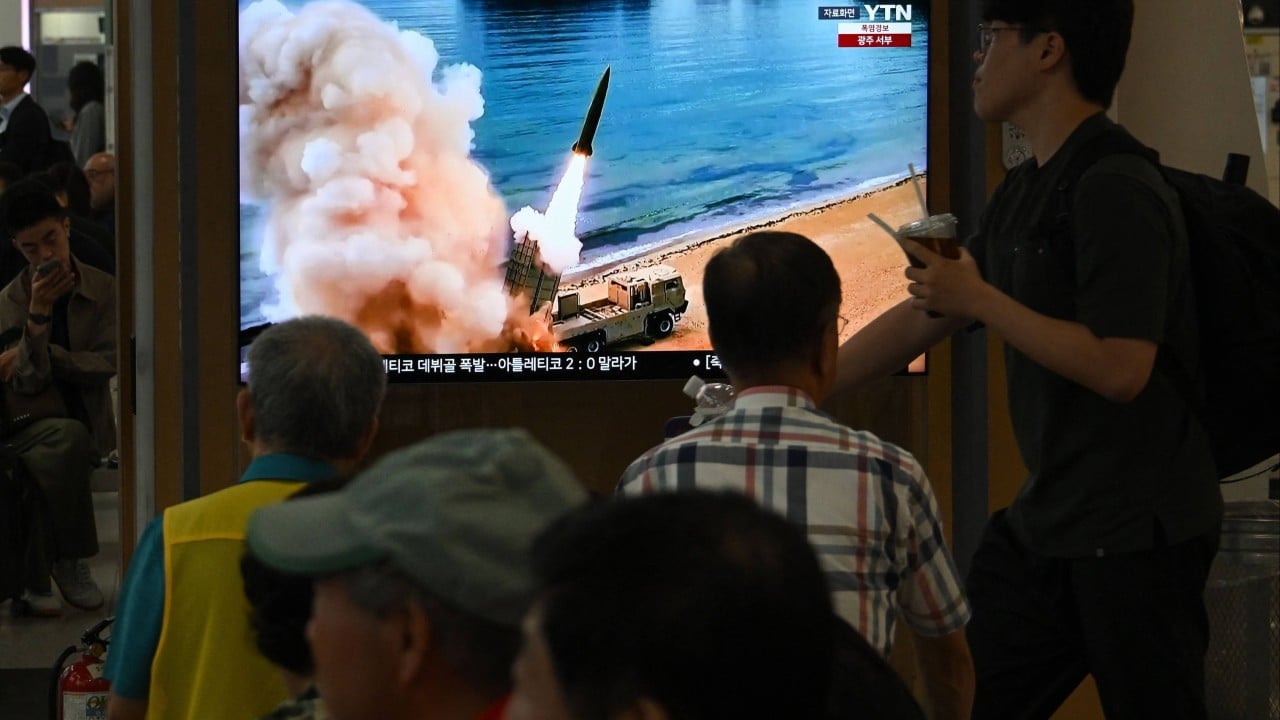
When North Korea fires another ballistic missile into the sea, Western capitals rush to microphones. Condemnations fly. Emergency Security Council meetings are called. Analysts breathlessly parse every syllable coming out of Washington, Seoul, and Tokyo, hunting for signs of a unified front. Then, everyone looks across the Yalu River. They wait for Beijing to drop the hammer, issue a stern reprimand, or at least pretend to care about regional stability.
Instead, they get silence. Or worse, a diplomatic shrug.
The standard Western media narrative treats this quiet diplomacy as a puzzle or a sign of lost leverage. That is a dangerous misreading of reality. China is not failing to control its erratic neighbor. Beijing is tolerating the provocations because a chaotic Korean peninsula serves a distinct, calculated strategic purpose.
To understand why Beijing’s response to North Korean missile tests is so routinely muted, you have to stop looking at the relationship through the lens of a traditional alliance and start viewing it as a calculated exercise in containment. North Korea functions as an effective, expendable wedge. It keeps the United States, South Korea, and Japan perpetually off-balance, draining their intelligence resources and forcing them to reinforce their eastern perimeter.
Decades ago, the relationship between Beijing and Pyongyang was described with a poetic flourish as being "as close as lips and teeth." Today, that anatomical metaphor is obsolete. The modern dynamic resembles something closer to a cold-eyed real estate transaction. China does not love what Kim Jong Un is doing. Nuclear proliferation on its doorstep introduces risks that Beijing’s military planners lose sleep over. Stray warheads, accidental escalations, and the permanent justification for American aircraft carriers operating just offshore are genuine strategic liabilities.
Yet, Beijing accepts these risks because the alternative is worse. If North Korea were to collapse tomorrow, the economic and humanitarian shockwaves would crash directly into China’s northeastern provinces. Millions of refugees would cross an unfortified border. More critically, a unified Korea aligned with Washington would place American troops directly on the Chinese frontier. From Beijing's perspective, a nuclear-armed buffer state that occasionally throws tantrums is infinitely preferable to a pro-Western democracy parked at its doorstep.
This structural reality explains the muted cadence of China's diplomatic reactions. When a missile arcs over the Sea of Japan, Beijing’s Ministry of Foreign Affairs trots out the standard, recycled boilerplate calling for "calm and restraint from all parties." Notice the deliberate framing. By treating Pyongyang and Washington as moral equivalents, Beijing achieves two goals at once. It avoids punishing its historical partner while actively undermining the American argument that global security requires a unipolar, rules-based order.
Behind closed doors, the enforcement of international sanctions tells a similar story. Western diplomats spend months negotiating tightened restrictions at the United Nations, only to watch enforcement along the Chinese border dissolve into porous inefficiency. Diesel fuel still flows north. Consumer goods and industrial components find their way through customs checkpoints. North Korean laborers continue to generate foreign currency inside Chinese territory, quietly bypassing financial blockades.
Beijing understands that total economic strangulation would force Pyongyang into a corner, potentially sparking the very regime collapse China fears most. Consequently, the sanctions regime operates like a leaky faucet. It provides just enough pressure to prevent North Korea from feeling entirely secure, but never enough to actually force a change in behavior.
Washington consistently misinterprets this dynamic as incompetence or a lack of leverage. American administrations repeatedly pressure Beijing to "rein in" its unruly neighbor, acting as though Xi Jinping holds a television remote control that can simply pause Pyongyang's nuclear program. This framing fundamentally misunderstands the limits of Chinese influence. Kim Jong Un remembers that his grandfather fought alongside Chinese forces, but he also remembers that Beijing has normalized diplomatic relations with Seoul and expanded its economic footprint across the capitalist world. Pyongyang does not take orders from Zhongnanhai.
In fact, North Korea’s aggressive posture creates a secondary benefit for Beijing that is rarely acknowledged in Western policy circles. Every time Pyongyang launches a missile, Washington is forced to redirect military assets, diplomatic capital, and intelligence focus toward Northeast Asia. American Aegis destroyers must patrol regional waters. Patriot missile batteries must be deployed and maintained. Strategic bombers must conduct rotational flights out of Guam.
This hardware and attention cannot be repositioned to the South China Sea or the Taiwan Strait. North Korea acts as a permanent, regional distraction machine. It binds American power to the northern edge of Asia, complicating Pentagon contingency planning for any future conflict over Taiwan. Beijing does not need to coordinate these missile tests to reap the geopolitical dividends. It merely needs to stand back, issue mild expressions of regret, and let the theater unfold.
South Korea and Japan bear the brunt of the physical anxiety. Tokyo watches the trajectories with growing alarm, using the persistent threat as political justification to steadily dismantle its constitutional constraints on military power and increase defense spending. Seoul swings wildly between engagement policies and hardline deterrence depending on who occupies the Blue House, never quite finding stable footing against a neighbor that refuses to play by conventional rules.
Through it all, China maintains plausible deniability. Beijing can tell Washington that it shares concerns about regional proliferation while simultaneously vetoing harsher UN measures or watering down multilateral responses. It is a masterclass in diplomatic judo. China absorbs zero direct cost for the missile tests while extracting maximum strategic value from the resulting regional tension.
The next time an intercontinental ballistic missile clears the horizon and Western commentators express bafflement at Beijing's quiet response, remember the core mechanics of the theater. There is no confusion in Beijing. There is only the cold, unyielding pursuit of national interest, executed with the patience of a state that measures its foreign policy not in election cycles, but in centuries.