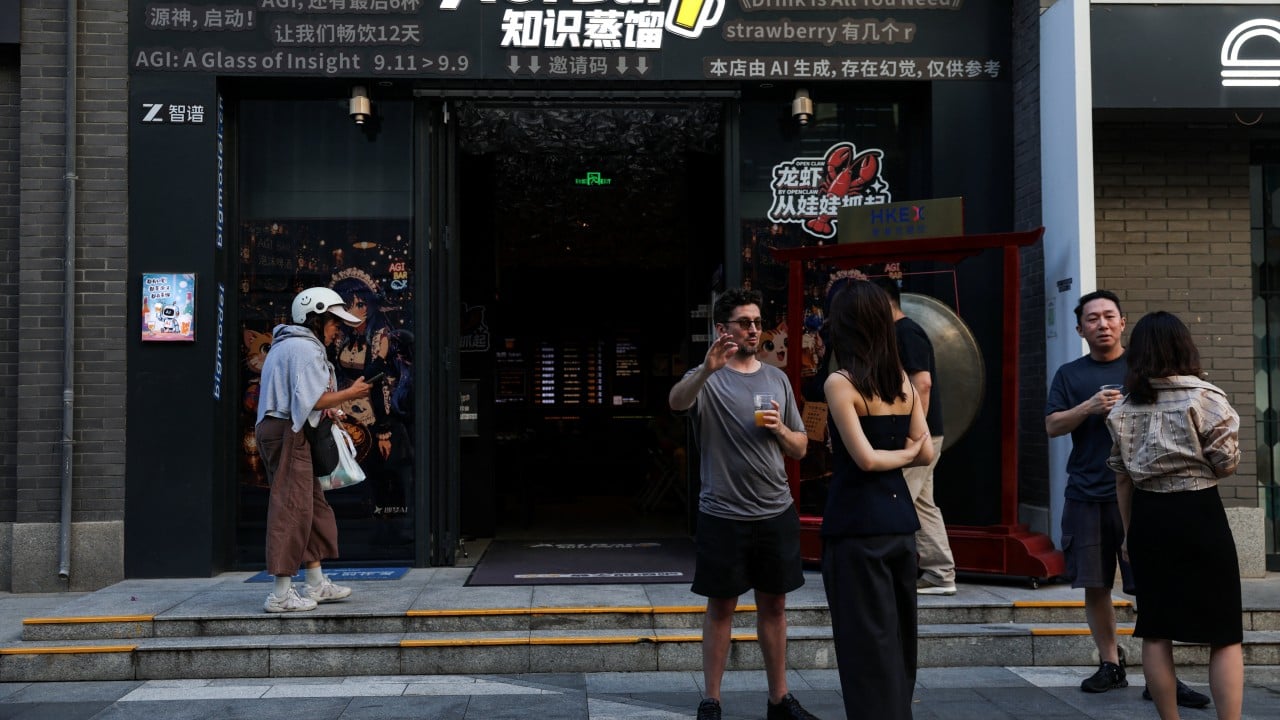
Walk down Inno Way in Beijing’s Haidian district, and you will find a neon-lit watering hole where patrons trade local currency for raw silicon output. Known simply as AGI Bar, this establishment has solved the modern developer's eternal dilemma: how to fuel a late-night debugging session when your local LLM credits run dry. For 9.9 yuan—roughly one dollar and fifty cents—customers order a signature foamy beverage and immediately authenticate into the venue's local network. That transaction grants unfettered access to a dedicated backend powered by two visible Nvidia hardware units, dishing out free, unlimited DeepSeek coding tokens.
The venue is the brainchild of independent developer Song De, operating right in the administrative shadow of Tsinghua and Peking universities. This patch of concrete has historically functioned as the crucible for Chinese technical enterprise, surrounded by the regional offices of domestic unicorns and multinational giants alike. Yet while the physical architecture mimics a standard startup incubator complete with corporate logos peeling across the drywall and a brass gong salvaged from a Hong Kong Stock Exchange listing, the economic engine operating under the floorboards reveals a starkly different reality.
Song admits without hesitation that the physical location operates at a heavy financial deficit. The volume of complimentary beverages distributed across the counter outpaces actual sales by a factor of ten. Patrons crowd around tables to swap model optimization notes, arguing over weights, biases, and prompt engineering strategies while nursing cheap foam, effectively turning a commercial lounge into a localized co-working charity.
The Mechanics of Silicon Hospitality
Strip away the novelty of the neon signage, and the operation exposes a calculated bet on local developer habits. The establishment runs its infrastructure locally. Two Nvidia DGX Spark rigs sit exposed behind glass inside the room, humming loudly enough to force patrons at nearby tables to elevate their voices. These machines host the open-weight models that local engineers use to bypass commercial rate limits imposed by cloud providers.
The backend automation goes far beyond handing out complimentary server calls. Song has wired the venue's physical infrastructure directly into custom application programming interfaces. Environmental controls, inventory tracking, membership authentication, and lighting arrays are managed autonomously by background agents. Human staff members are relegated to pouring drinks and managing physical anomalies that silicon cannot yet touch.
This automation obsession mirrors the broader cost-slashing trajectory of the domestic Chinese software ecosystem. Just as local labs have driven inference costs down to fractions of a cent through architectural tricks like Mixture of Experts and aggressive model distillation, the bar operates on a margin structure that would trigger immediate heart attacks among traditional hospitality veterans. The business model treats physical alcohol as a loss-leader to capture developer mindshare, effectively subsidizing local software builds with retail beverage sales.
A Microcosm of Market Pressures
The official registered Chinese name translates directly to knowledge distillation, functioning as a double entendre that bridges the technical process of compressing large neural networks into leaner architectures with the age-old tradition of patrons swapping ideas over draft pours. It captures the unique dual identity of Haidian district: an intellectual powerhouse driven by hyper-competitive engineering culture, yet constantly grappling with financial sustainability.
Operating an experimental tech hub in a cooling economic climate presents severe hurdles. The rush of venture capital that once flooded Zhongguancun has slowed to a measured trickle compared to the speculative peaks of the previous decade. Independent spaces survive by leaning heavily on community goodwill, open-source evangelism, and cross-promotional events hosted for rising artificial intelligence labs. When a local startup lists publicly, they ring the brass gong by the entrance; when they burn through their seed round, they sit in the corner booth debugging Python scripts until closing time.
Plans are already underway to expand the footprint, with a secondary branch operational in Shanghai and ambitions to introduce humanoid robotic servers to handle the floor operations. Whether automated service will stem the continuous financial bleeding remains an open question. For now, the room remains packed with engineers trading pennies for tokens, testing the limits of how far a single pint of beer can stretch in an oversaturated market.