Elena felt a quiet pride whenever she looked at the bug hotel hanging from her garden wall. It was a charming little structure crafted from hollow bamboo reeds, pinecones, and drilled wood. Throughout the spring, she watched solitary bees and lacewings check into its small chambers, believing she had built a sanctuary for the delicate, unseen machinery of her suburban Munich neighborhood.
Then came the giants.
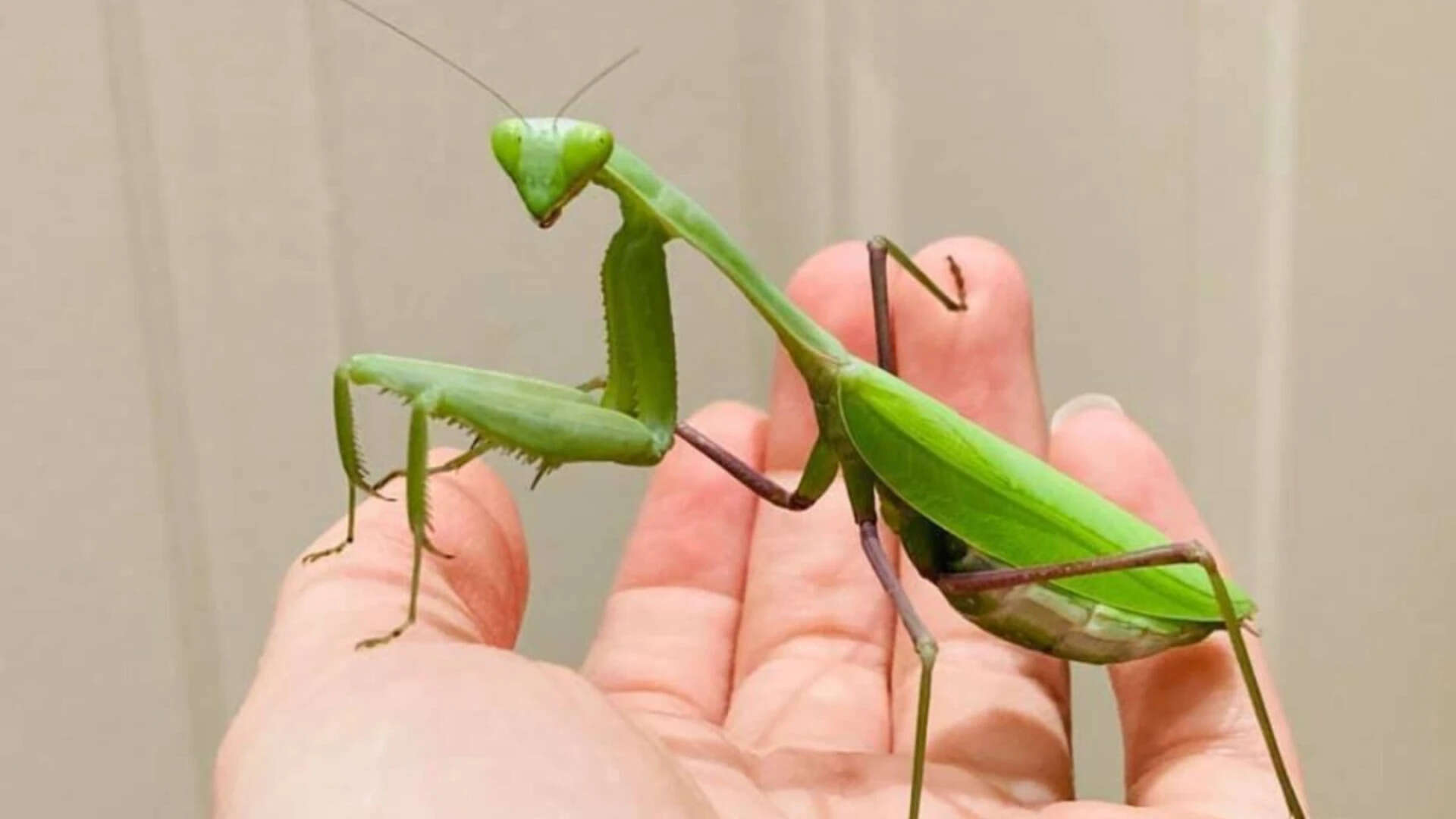
They sat atop the wooden roof like tiny, emerald deities. They had triangular heads that turned with an eerie, uncanny intelligence and forelegs folded in a posture of permanent prayer. When Elena first saw them, she didn't feel alarm. She felt wonder. They were beautiful, exotic, and remarkably calm when they walked across the palm of her hand. She took photos, uploaded them to social media, and celebrated the arrival of these charismatic new guardians of her roses.
She had no idea she was hosting a bloodbath.
The two species settling into Elena’s garden were Hierodula tenuidentata and Hierodula patellifera, commonly known as giant Asian praying mantises. Over the last decade, these massive insects have been quietly expanding their footprint across Europe. But a recent landmark study published in the Journal of Orthoptera Research has formally stripped them of their welcome guest status. They are now officially classified as Invasive Alien Species. Far from peaceful garden helpers, these adaptable predators are dismantling local ecosystems from the inside out, turning the very things we build to protect nature into highly efficient killing floors.
The problem is that we are hardwired to love the wrong things. We look at a ladybug or a praying mantis and we feel a sense of kinship. They have faces we can recognize. They eat the pests that ruin our tomatoes.
But evolution does not care about our aesthetics.
To understand why scientists like Roberto Battiston, the lead author of the study, are sounding the alarms, you have to look at the numbers. The native European mantis, Mantis religiosa, has lived in balance with the continent’s ecosystems for millennia. A native female lays an egg case—an ootheca—that produces a modest generation of offspring. Survival is tough. The world is cold.
The Asian invaders operate on a completely different scale of production.
A single egg case from a giant Asian mantis drops roughly 200 young into the world. That is nearly double the reproductive output of the native European variety. In the insect world, childhood is usually a brutal game of survival where siblings routinely consume one another. Not so for these new arrivals. The young nymphs display an unusual tolerance for their peers, drastically lowering their early mortality rates. More babies hatch. More babies survive.
The mathematical compounding of this survival rate is staggering. A few isolated sightings quickly explode into dominant local populations.
But it is the way they hunt that turns this biological success story into a quiet tragedy for European wildlife.
Imagine a native male European mantis flying through the cool evening air of an Italian park or a French garden. He is tracking a scent, a specific cocktail of pheromones released by a female of his own kind. His internal radar locks onto a signal. He lands on a low-hanging branch of a walnut tree, believing he has found a partner to ensure the survival of his lineage.
Instead, he finds a giant.
The chemical signals released by the invasive Asian females are close enough to the native scent to deceive the local males. The attraction is irresistible. The male approaches, driven by an evolutionary urge millions of years in the making. But as he draws near, the illusion vanishes. The female Hierodula is larger, stronger, and entirely unconcerned with his genetic legacy.
She grabs him with spine-lined forelegs that snap shut like steel traps.
The encounter ends not with the continuation of a species, but with a meal. By luring native males into these fatal mismatches, the invasive mantises are systematically draining the breeding pool of Europe’s native mantises, which are already struggling to cope with habitat loss.
And their appetite does not stop with their cousins.
Most insects specialize in their diet. They eat aphids, or they drink nectar, or they target specific beetles. The giant Asian mantises are generalists of the most aggressive order. They wait in ambush on the flowers of lavender and rosemary, waiting for the heartbeat of the garden: pollinators. Honeybees, wild bumblebees, and hoverflies are snapped out of the air mid-flight, their bodies hollowed out and dropped to the ground.
When the insects run low, the mantises simply aim higher up the evolutionary ladder. Scientists have now documented these predators successfully attacking and consuming protected small vertebrates. A common wall lizard basking on a warm stone, or a tiny tree frog resting on a damp leaf, can quickly become prey for a fully grown female mantis.
It is easy to blame the changing climate for this northern migration, and to a degree, the science supports it. Rising global temperatures are erasing the invisible thermal boundaries that used to keep southern Europe distinct from the frozen north. The winters are softer now. The frost doesn't bite deep enough to kill the overwintering egg cases.
But if climate change opened the door, our own human architecture built the highway.
Consider the urban heat island effect. Cities are massive concrete heat sinks, trapping the sun's energy during the day and radiating it back out into the night. This artificial warmth allows the Asian mantises to remain active, hunt, and reproduce much later into the autumn and winter than they ever could in a natural forest.
Then there are the well-intentioned elements of modern eco-conscious living. The insect hotels we mount on our suburban fences, intended to give declining solitary bee populations a fighting chance, act as a beautifully concentrated buffet. The mantises simply park themselves outside the entrances of these structures, waiting for the residents to return home with pollen.
Even our beloved pets are entangled in this ecological web.
When researchers analyzed how these invasive mantises die, they uncovered a surprising data point: domestic cats are the leading vertebrate predators of Hierodula in Europe, accounting for 45% of all recorded successful attacks on them. At first glance, this might seem like a solution—a natural army of feline defenders keeping the invader in check.
But a cat does not read scientific journals. A cat does not know the difference between the invasive Hierodula and the threatened native Mantis religiosa. When felines roam suburban gardens, they strike down both species with equal indifference, adding even more pressure to an ecosystem already tilting off its axis.
It is tempting to look at this crisis and feel a sense of paralyzing helplessness. The scale feels too vast, the insects too small, the march northward too inevitable.
Yet, the very thing that allowed this invasion to happen—our human presence—is also the key to slowing it down.
Because these insects are large, vibrant, and visually striking, they don't blend into the background the way a invasive fungus or a microscopic beetle might. They stand out. Over the last few years, a massive citizen science initiative spearheaded by researchers like William di Pietro and Antonio Fasano has gathered more than 2,300 verified reports from ordinary people who spotted these creatures in their yards.
This crowdsourced data map is the frontline of the defense. It tells scientists exactly where the frontlines are moving, allowing conservationists to target their efforts before a local population becomes completely entrenched.
The immediate temptation for many homeowners, once they learn the truth, is to go into the garden with a pair of shears and destroy every papery, brown egg case they can find attached to their stone walls and tree branches. But even here, our human eagerness can cause unintended harm. The egg cases of the invasive giants look remarkably similar to those of Europe's native mantises to the untrained eye. Snapping them off without verification risks wiping out the very creatures we are trying to save.
The solution requires a slower, more deliberate kind of care. It requires taking a photograph first. It requires consulting an expert or using a citizen science app to confirm the identity of the organism before deciding its fate. It requires recognizing that our backyard is not an isolated sanctuary, but a small node in a massive, fragile web that stretches across the entire continent.
Elena still looks at her bug hotel every morning, but she looks at it differently now. She no longer sees a passive decoration. She sees a responsibility.
The giant green predators still appear from time to time, sitting motionless among the lavender leaves, their heads pivoting slowly as they scan the horizon for their next meal. They are still beautiful. They are still marvels of natural engineering. But the illusion of their innocence is gone, replaced by the realization that sometimes, the greatest threats to the world we love arrive wrapped in the most breathtaking packages.