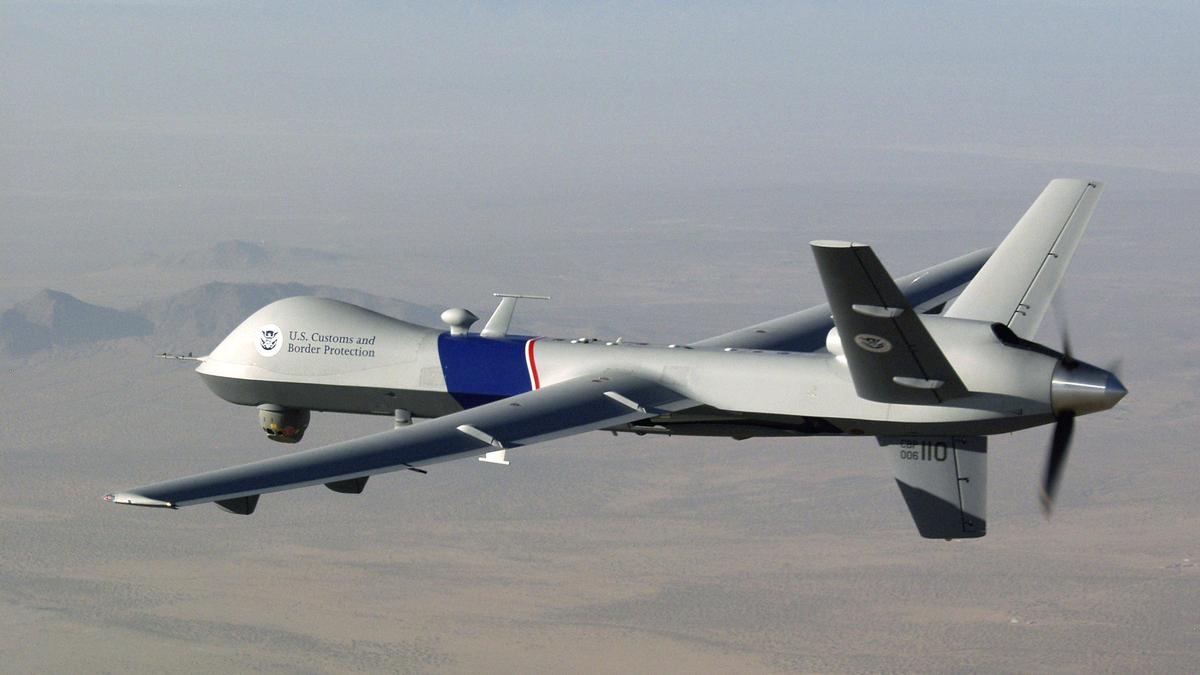
The desert near McAllen, Texas, doesn’t just get dark; it turns into a void. On a humid night in late 2024, the only thing cutting through that void was the steady, mechanical hum of a Customs and Border Protection (CBP) drone. It was a multi-million dollar piece of hardware, a silent sentinel tracking movements across the Rio Grande. Then, in a fraction of a second, the hum stopped. The feed went black. The sentinel didn't crash because of a mechanical failure or a gust of wind. It was erased from the sky by a ghost.
That ghost was a high-energy laser, fired not by a foreign adversary or a high-tech cartel, but by the United States military.
This wasn't a mistake in the traditional sense. It wasn't a "friendly fire" accident born of incompetence. Instead, it was the first public, jarring evidence of a friction point that has been smoldering in the halls of the Pentagon and the Department of Homeland Security for years. We are entering an era where our own defenses are becoming so automated, so instantaneous, and so lethal that they can no longer distinguish between the "us" they are protecting and the "us" that is doing the protecting.
The Invisible Executioner
To understand what happened, you have to stop thinking about lasers as the glowing red streaks from Saturday morning cartoons. Real-world Directed Energy Weapons (DEW) are terrifying because they are invisible. There is no beam to see, no projectile to track, and no sound upon impact.
Imagine a hypothetical operator—let’s call him Specialist Miller—sitting in a climate-controlled trailer hundreds of miles away, or perhaps stationed at a mobile defense unit near the border. Miller isn't looking through a window; he’s looking at a screen filled with data points. His job is to protect sensitive airspace from "uncrewed aerial systems" (UAS). In modern warfare, drones are the primary threat. They carry cameras, they carry signaled jammers, and increasingly, they carry explosives.
When a blip appears on Miller’s radar that doesn't broadcast the correct "Identification Friend or Foe" (IFF) signal, the window for decision-making is thinner than a razor blade. If he waits to confirm, a potential threat could reach its target. If he fires, the laser travels at the speed of light. It strikes the drone’s housing, heating the composite material to thousands of degrees in an instant. The electronics melt. The structural integrity vanishes. The drone becomes a brick.
In the Texas incident, according to briefings later shared by concerned lawmakers, the U.S. Army was testing these very capabilities. They saw a drone. They engaged. They destroyed. The problem was that the "threat" was a CBP drone performing its daily duties. The right hand of the American security apparatus burned the left hand off.
The Speed of Light vs. The Speed of Thought
The sheer physics of the event is what should keep us awake at night. In traditional ballistics, there is a delay. A missile has to travel. A bullet has to fly. That transit time provides a final, desperate heartbeat for a human to intervene, to see a marking, or to receive a radio transmission and hit the "abort" button.
Directed energy removes that heartbeat.
When you pull the trigger on a laser, the target is hit at $299,792,458$ meters per second. There is no "undo." This incident exposes a terrifying lag in our bureaucratic integration. While our weapons have moved to the speed of light, our inter-agency communication is still moving at the speed of a government email.
Lawmakers like Rep. Tony Gonzales have pointed out that this wasn't just a loss of expensive equipment. It was a systemic collapse. If the Army is deploying counter-drone lasers in the same airspace where CBP is flying surveillance missions, and those two entities aren't synced in real-time, the border becomes a shooting gallery where the shooters are blindfolded.
A Symptom of the Drone Swarm
Why are we suddenly seeing lasers on domestic soil? The answer lies in the democratization of flight. A decade ago, a drone was a military asset. Today, you can buy a high-performance quadcopter at a hobby shop for $800. Cartels use them to scout paths for smuggling. Bad actors use them to drop contraband into prisons. Adversaries use them to probe the perimeters of military bases.
The military’s response has been to "lean forward." They are desperate to prove that they can defend against "swarms"—dozens of cheap drones attacking at once. A traditional missile battery like a Patriot system is useless here; you don't use a $4 million missile to take down a $500 drone. It’s bad math.
Lasers, however, offer "deep magazines." As long as you have electricity, you have ammunition. The cost per shot is measured in dollars, not millions. This efficiency is the siren song that led the Army to deploy these systems quickly. But in that rush for efficiency, they neglected the human reality of the Texas border: it is one of the most crowded, complicated, and contested airspaces in the world.
The Ghost in the Machine
Consider the psychological toll on the pilots who weren't even in the air. The CBP drone pilots are seasoned professionals. They are used to navigating the complexities of wind, battery life, and high-stakes surveillance. To have your aircraft—your eyes in the sky—simply cease to exist without warning creates a new kind of battlefield trauma. It is the trauma of being hunted by your own side's ghosts.
This incident wasn't just about a broken drone. It was about the erosion of trust between agencies. If a CBP pilot can't trust that the U.S. Army won't vaporize their aircraft, they can't do their job. They fly tentatively. They avoid certain zones. They leave gaps in the surveillance net. The very technology meant to harden the border ended up creating a hole in it.
The complexity of the modern battlefield is no longer just about "us" vs. "them." It is about managing the overlapping layers of our own technology. We are layering AI-driven surveillance on top of autonomous strike systems, all while operating under the jurisdiction of multiple, often-competing federal agencies.
The Cost of Perfection
We often talk about "precision" in modern warfare. We are told that lasers are the ultimate precision tool. They don't have "splash damage." They don't leave unexploded ordnance on the ground. They are clean.
But the Texas incident proves that "precision" is a lie if the intent is flawed. You can have the most precise weapon in human history, but if the data feeding that weapon is siloed or outdated, it is just a more efficient way to make a mistake. The laser did exactly what it was designed to do: it destroyed a drone in restricted airspace. It was technically perfect and strategically disastrous.
Members of Congress are now demanding answers about the "Rules of Engagement" (ROE) on the border. They want to know who authorized the use of a DEW system in an area where civilian and law enforcement aircraft are known to operate. They want to know why the "kill chain"—the process from detection to destruction—failed to verify the owner of the target.
The answers will likely be buried in classified reports, but the truth is visible to anyone who looks at the scorched remains of that CBP drone. We are building systems that outrun our ability to govern them.
The New Frontier of Friction
This is the hidden cost of the technological arms race. We focus on the "cool" factor of the laser—the sci-fi reality of light-based weaponry—while ignoring the boring, essential work of radio frequency deconfliction and inter-service data sharing.
As we move forward, the border won't just be a line in the sand. It will be a dense thicket of invisible beams, electronic jamming, and autonomous sensors. If we don't find a way to make these systems talk to each other, we will continue to see millions of taxpayer dollars vaporized in the Texas heat.
The most dangerous thing in the desert that night wasn't a cartel drone or a foreign spy. It was the lack of a shared map. We have mastered the art of destruction at the speed of light, but we are still struggling to master the art of talking to our neighbors.
The next time a blip appears on a radar screen over the Rio Grande, a finger will hover over a button. In that millisecond, the entire weight of American defense policy will rest on whether a computer in an Army trailer knows what a computer in a CBP station is doing. If they don't, the sky will stay dark, and the only thing we will have defended is our own right to be blind.
The desert is silent again, but the silence feels different now. It feels like a warning.
What happens when the next "mistake" isn't a drone, but a manned helicopter that forgot to update its transponder? What happens when the ghost in the machine decides that the target is too close to wait for a human to say "yes"?
We are no longer waiting for the future of warfare. It’s already here, it’s invisible, and it’s firing at us.
Would you like me to analyze the specific legislative responses to this incident or explore the current state of Directed Energy Weapons in other branches of the military?