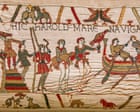
Nearly seventy meters of stitched linen just crossed the English Channel for the first time in nearly a thousand years. If you managed to snag a ticket for the blockbuster exhibition at the British Museum, you are looking at an object that insured for nearly a billion euros and triggers arguments among historians faster than almost any other medieval artifact. Most people think they know the story: King Harold takes an arrow to the eye, William the Conqueror wins the day, and England gets a completely new management team.
Reality is far stranger. This isn't actually a tapestry at all. It is an embroidery, crafted using colored wool yarn on bleached linen, functioning more like an eleventh-century graphic novel than a solemn historical record. Recently making waves in this space: The Last Bottle of Cool Elegance.
The Craft and Construction of a Medieval Masterpiece
Forget what you picture when you hear the word embroidery. Workers used just ten distinct shades of wool to bring hundreds of figures and over two hundred horses to life. Blues, greens, yellows, and dark red russets create depth through simple, brilliant outlines.
The physical scale demands attention. Stretching approximately sixty-eight meters long and fifty centimeters high, the linen strip moves through fifty-eight distinct scenes. For decades, visitors in France viewed it wound around mechanical cylinders or hung in tight loops. Seeing it laid out completely flat in a custom-built gallery changes the viewing experience entirely. You can track the narrative cadence at the speed the makers intended. More details regarding the matter are detailed by The Spruce.
Makers utilized the borders as creative real estate long before modern comic book artists played with panel margins. When William's fleet crosses the channel, the wind-filled sails break right out of the central frame. When the Battle of Hastings gets brutal, fallen soldiers and severed limbs spill downward into the lower decorative border.
Propaganda, Politics, and Missing Pieces
Scholars still argue over who commissioned the work and where it was stitched. Most recent evidence points toward English workshops in places like Canterbury rather than French studios. If English hands crafted it under Norman rule, the piece carries a fascinating psychological undertone. It tells the conquered population that Harold was a legitimate king they were right to follow, but the new reality under William is absolute.
The exhibition also highlights what is missing. Roughly three meters of the original fabric vanished centuries ago. Nobody knows for certain what the final panels depicted, though experts suspect they showed William's Christmas Day coronation in Westminster Abbey.
Then there is the famous eye injury. Generations of school children learned that Harold died from an arrow piercing his eye. Up close, restoration work reveals that the pointed object might originally have been a spear held vertically by a charging knight, altered during nineteenth-century touch-ups.
What You See When You Look Closer
The best details happen away from the main battle lines. Look for the small, quiet moments embedded in the margins. A servant eavesdrops on a private conversation. Someone carries a hunting dog across the surf so the animal's paws stay dry. Peasants plow the fields while armies march overhead, offering a poignant reminder that ordinary life continues no matter who sits on the throne.
As the exhibition runs through July 2027 before the artifact returns to France for permanent housing in a newly renovated museum, expect the queues to remain packed. Plan your visit carefully, arrive early, and spend your time looking at the corners. That is where the real eleventh-century life lives.