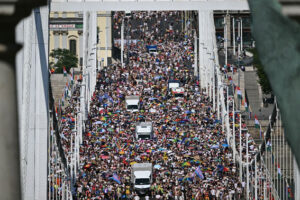
The modern Pride march has a glaring identity crisis. What started as a literal riot against state-sanctioned police brutality has, over the decades, been sanitized, packaged, and sold back to the public as a brightly colored corporate parade. But the glitter is wearing thin. Underneath the rainbow-branded floats sponsored by multinational banks and defense contractors, a fierce tug-of-war is happening. Activists are demanding a return to Pride’s radical roots as a protest, while festival organizers and corporate sponsors fight to keep it a sanitized, family-friendly consumer holiday.
This tension is not new, but it has reached a boiling point. As legislative attacks on LGBTQ+ rights escalate globally, the contrast between corporate celebration and grassroots survival has never been more stark.
The Hijacking of a Riot
To understand why Pride is fracturing, you have to look at how it began. The Stonewall Riots of 1969 were not a parade. They were a violent, multi-day clash between marginalized people—led largely by trans women of color, drag queens, and street youth—and the police who routinely brutalized them. The early marches that followed were political demonstrations demanding basic human rights, decriminalization, and survival.
By the late 1990s and early 2000s, a shift occurred. As social acceptance grew, major corporations realized the LGBTQ+ community represented a massive, untapped market.
This realization birthed "rainbow capitalism."
Suddenly, companies that had spent decades firing queer employees or funding anti-gay politicians were buying multi-thousand-dollar slots in Pride parades. They handed out cheap plastic beads and branded hand fans.
For a time, many in the community welcomed this. Corporate sponsorship felt like validation. It meant safety, visibility, and mainstream acceptance. But that acceptance came with a price tag. To keep those lucrative corporate dollars flowing, Pride organizers began policing their own marches. They restricted radical messaging, banned controversial signs, and worked hand-in-hand with law enforcement to secure parade permits and manage crowds.
The riot had been successfully commodified.
The Cost of the Corporate Rainbow
Today, the financial entry barriers to participate in major metropolitan Pride parades are staggering. In cities like New York, San Francisco, and London, grassroots community organizations are often priced out of the very events they created.
A small, local nonprofit advocating for queer homeless youth might face registration fees running into hundreds or thousands of dollars. Meanwhile, a global financial institution can easily write a check for tens of thousands to secure a prime spot, complete with a massive, motorized float and a troupe of paid dancers wearing matching corporate t-shirts.
This is not just about logistics. It is about who gets to set the agenda.
When a march is funded by banks, pharmaceutical giants, and military contractors, the message of the march is naturally diluted. You cannot easily protest pharmaceutical price-gouging on HIV medication when the company manufacturing those drugs is the headline sponsor of the festival. You cannot effectively march against systemic police violence when local police departments are marching in uniform right behind the corporate floats.
Activists argue this commercialization has turned Pride into a distraction. It creates an illusion of progress and safety that does not match the lived reality of many queer people, particularly trans individuals and people of color who face disproportionate levels of violence, housing insecurity, and healthcare discrimination.
The Grassroots Backlash and the Rise of Queer Liberation Marches
In response to this corporate takeover, a quiet rebellion has been growing. Across the globe, alternative marches are popping up, designed specifically to bypass the corporate-approved parade format.
The Queer Liberation March in New York City is a prime example. Founded by the Reclaim Pride Coalition, this march runs on the same day as the official, highly commercialized NYC Pride March, but it operates under vastly different rules.
There are no corporate sponsors.
There are no floats.
There is no police escort or barricades separating the marchers from the public.
Instead, thousands of people take to the streets in a traditional protest format, carrying handmade signs addressing urgent political issues, from trans healthcare access to racial justice and global human rights.
Similar alternative marches have emerged in cities like San Francisco, Boston, and London. These events deliberately reject the festival atmosphere in favor of political urgency. They prove that a significant portion of the community no longer feels represented by a parade that feels more like a commercial block party than a civil rights demonstration.
The Sponsor Double Standard
The hypocrisy of corporate involvement becomes glaringly obvious when looking at political donations. Many of the companies that paint their logos in rainbow colors every June are simultaneously donating massive sums of money to politicians who sponsor and vote for anti-LGBTQ+ legislation.
Data consistently shows that major corporations play both sides of the culture war. They court the pink dollar in progressive urban centers while funding conservative lawmakers in state capitals to secure favorable tax cuts and deregulation.
For these corporations, Pride is simply a marketing campaign with a high return on investment. It is a shield against criticism, a practice often referred to as "pinkwashing."
When the commercialized parade becomes the dominant face of Pride, it makes it incredibly easy for corporations to buy allyship without doing any of the actual, difficult work required to protect queer lives. Real allyship requires risk. It requires pulling funding from hostile states, fighting discriminatory laws in court, and protecting employees' healthcare rights. Putting a rainbow flag on a plastic bottle of vodka does none of these things.
Navigating the Divide
This leaves the LGBTQ+ community at a crossroads. Can the mainstream, corporate-funded Pride festivals be reformed from within, or must they be abandoned entirely in favor of grassroots protest?
Some organizers argue that corporate money is a necessary evil. Security, permits, sanitation, and stage production for events that draw millions of people cost massive amounts of money. Without corporate sponsorships, they argue, these large-scale celebrations of queer visibility simply could not exist. They believe that visibility itself is a political act, and that providing a safe, joyful space for queer people to gather publicly is still incredibly valuable, especially for youth who may not have supportive families.
But others counter that this safety is an illusion. A Pride march that requires a heavy police presence and corporate permission to exist is not truly free.
The future of Pride likely lies in this ongoing friction. The tension between celebration and protest is not a defect of the movement; it is the movement itself. As long as queer people face systemic inequality, the urge to turn the parade back into a protest will only grow stronger. The glitter cannot hide the cracks in the pavement forever.