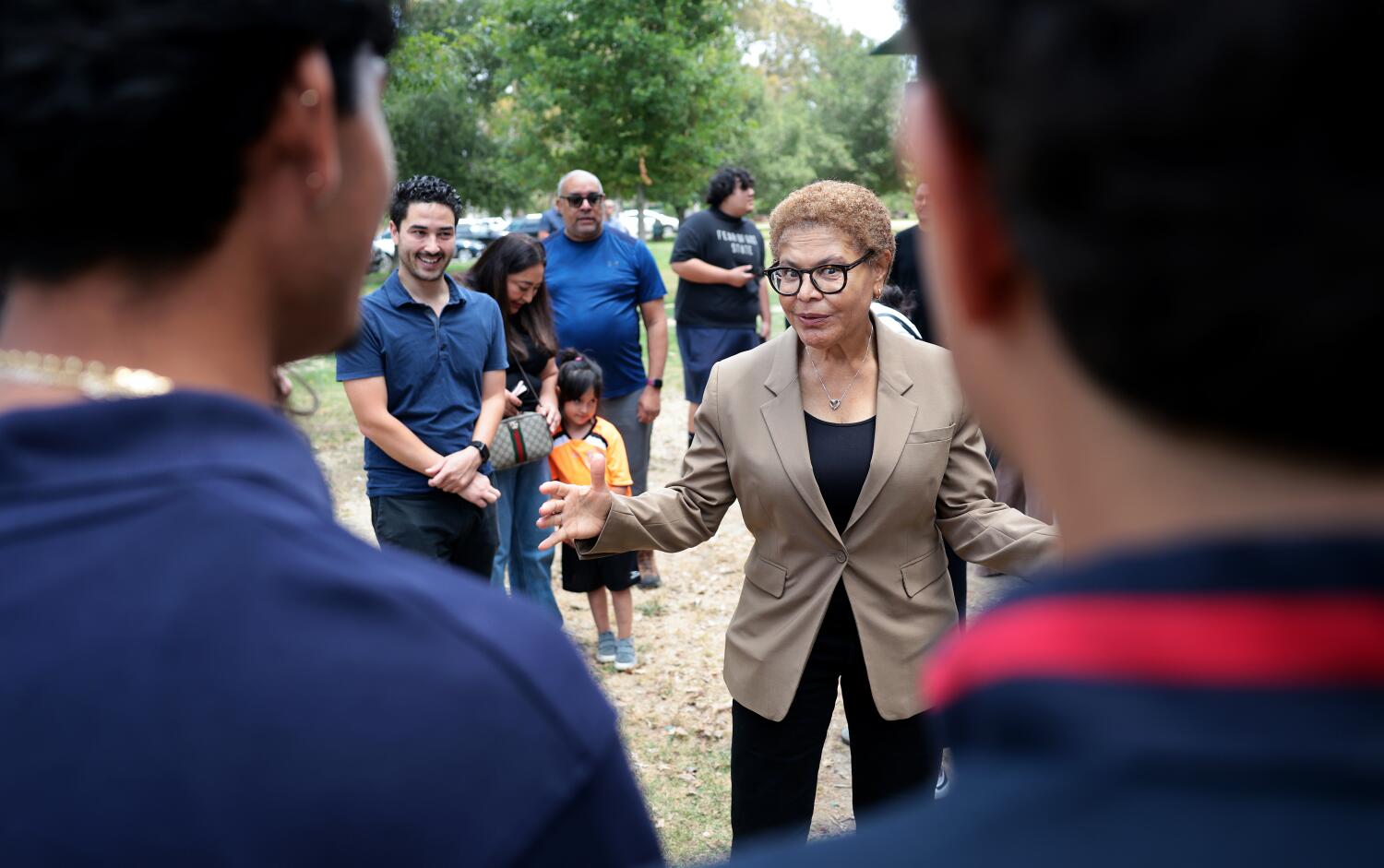
The road to City Hall runs directly through the Eastside and the San Fernando Valley. In the high-stakes chess match for the Los Angeles mayoralty, the Latino vote remains the ultimate prize, yet it continues to be the most misunderstood demographic in California politics. While Karen Bass maintains a statistical lead over challengers like Kevin de León or Nithya Raman in early polling cycles, that edge is built on fragile alliances. Candidates often treat the Latino community as a single, predictable voting bloc. This is a tactical error that ignores the deep generational and economic divides separating a homeowner in Eagle Rock from a renter in Boyle Heights.
Understanding the current power struggle requires looking past the surface-level endorsements. The demographic shifts in Los Angeles have created a fragmented electorate. You have older, more conservative Catholic voters who prioritize public safety and small business stability. On the other side, you have a surging population of young, progressive voters who view housing affordability and climate change as existential threats. The candidate who wins isn't the one who speaks the best Spanish; it is the one who successfully bridges the gap between these conflicting economic realities.
The Cracks in the Democratic Machine
For decades, the Los Angeles political establishment relied on a reliable pipeline of labor union support and Democratic Party loyalty to secure the Latino vote. That machine is breaking down. We are seeing a significant rise in "no party preference" registrations among younger Latinos. These voters are not interested in historical party loyalty. They want to know why their rent consumes 50% of their paycheck and why the homelessness crisis persists despite billions in approved bond measures.
Karen Bass has spent years cultivating ties with black and brown coalitions, a strategy that served her well in Congress. However, the mayoral office is a different beast. In a city where 48% of the population identifies as Hispanic or Latino, "coalition building" can sometimes look like pandering if the policy results don't hit the ground. Her lead is comfortable, but it is not impenetrable. It rests on her ability to convince the middle class that she can maintain order while convincing the activist wing she can deliver social reform. It is a tightrope walk over a very high drop.
The Geography of Discontent
In the San Fernando Valley, the conversation is about basic services. Residents feel ignored by a downtown-centric city government. When you talk to voters in Pacoima or Sylmar, the grievances are concrete. They point to unpaved alleys, slow police response times, and the encroachment of industrial zones on residential neighborhoods. This is where a challenger can make up ground. By framing the election as a battle between the "forgotten" neighborhoods and the political elite, candidates like Pratt or Raman attempt to siphon off voters who feel the current administration has failed to deliver on the basics.
The Eastside presents a different challenge. Gentrification has turned neighborhoods like Highland Park and Echo Park into ideological battlegrounds. Here, the Latino vote is split between the families who have owned homes for three generations and the newcomers who are struggling to stay. The political rhetoric that works for one group often alienates the other. A promise to increase police patrols might soothe a long-term homeowner worried about property crime, but it may strike a younger voter as an aggressive expansion of a broken system.
The Economic Reality of the Ballot Box
Money speaks louder than any campaign flyer. The Latino middle class in Los Angeles is shrinking, squeezed out by a cost of living that defies logic. When candidates talk about "equity," the working-class voter hears a buzzword. They want to hear about tax credits for small businesses, the streamlining of ADU permits, and the reduction of utility costs.
The divergence in priorities is startling.
- Safety vs. Reform: While activists call for budget shifts away from the LAPD, many Latino neighborhoods in high-crime areas are actually calling for more consistent police presence.
- Development vs. Preservation: There is a fierce debate over high-density housing. Some see it as the only way to lower prices; others see it as the death of neighborhood character and a precursor to displacement.
- Education: With the decline in LAUSD enrollment, parents are looking for candidates who support school choice and vocational training, moving away from traditional party lines on education.
The Influence of Labor and Faith
You cannot analyze a Los Angeles election without looking at the SEIU and the various building trades. These organizations provide the ground game—the door-knockers and the phone-bankers—that can swing an election by two or three percentage points. Historically, these unions have been the backbone of Latino political power in the city. But even here, the consensus is fraying. The interests of a construction worker in a trade union often clash with the interests of a service worker in the hospitality sector.
The Catholic Church and evangelical congregations also remain potent, if quieter, forces. These institutions still hold sway over the moral and social compass of a significant portion of the electorate. A candidate who ignores the influence of the pulpit does so at their own peril. This is particularly true for older voters who show up at the polls with more regularity than their younger counterparts.
The Failure of the "Latino Vote" Label
The biggest mistake a campaign can make is using the term "Latino vote" as a shorthand for a predictable outcome. A third-generation Mexican-American in San Pedro has almost nothing in common, politically or socially, with a recent arrival from Central America living in Westlake. Their needs are different. Their fears are different. Their vision for the city is different.
Rick Caruso’s previous run showed that a significant portion of Latino voters are willing to cross over to a more conservative, business-centric candidate if the messaging on crime and homelessness is sharp enough. He won several precincts that were historically deep blue. This suggests that the "edge" Karen Bass currently holds is based more on name recognition and the lack of a unified opposition than on a deep, unshakeable mandate.
If the challengers want to win, they have to stop fighting for the same 15% of progressive activists and start talking to the people waiting for the bus at 5:00 AM. Those are the voters who actually decide who runs Los Angeles.
The Machine vs. The Movement
We are witnessing a collision between the old guard of Los Angeles politics and a new, decentralized form of activism. The old guard plays by the rules of endorsements, donor dinners, and managed media appearances. The movement players use social media and community organizing to bypass traditional gatekeepers. This creates a volatile environment where an incumbent can be blindsided by a sudden shift in public sentiment.
Nithya Raman’s success in her council district was a warning shot to the establishment. She proved that a candidate could win by focusing on hyper-local issues and mobilizing a base that the traditional consultants had written off. If that energy can be scaled to the citywide level, the "Latino vote" will not be something that is "won"—it will be something that is redefined.
The candidates currently vie for the approval of power brokers, but the real power is held by a frustrated, diverse, and increasingly independent population that is tired of being treated as a demographic statistic. They aren't looking for a savior; they are looking for a city that works.
The data shows that turnout in Latino-heavy precincts often lags behind the more affluent, whiter neighborhoods on the Westside. This gap is the margin of victory. The candidate who figures out how to actually get people to return their ballots in the Northeast and the South isn't just winning an election; they are reshaping the political map of California for the next twenty years.
Los Angeles is at a breaking point. The homelessness crisis, the corruption scandals at City Hall, and the soaring cost of survival have created a cynical electorate. They have heard the promises before. They have seen the photo ops in the plazas. The "edge" held by any candidate right now is nothing more than a temporary lead in a race that is becoming increasingly unpredictable.
Victory will not go to the candidate who checks the most boxes on a diversity chart. It will go to the one who addresses the raw, unvarnished economic anxiety that keeps the city's majority awake at night.