The envelope sits on the kitchen table, waiting.
For Maria, a seventy-two-year-old retired nurse living just outside a sprawling rural county seat, that piece of paper is more than cardboard and postage. It is her voice, preserved when her aching joints and failing eyesight make the journey to the local precinct a daunting physical hurdle. She fills out the oval with a steady, deliberate hand, seals the flap, and signs her name across the back. It is a quiet ritual practiced millions of times across a vast nation. Yet, behind that quiet ritual, a high-stakes legal tug-of-war has been unfolding in federal courtrooms, determining whether Maria’s kitchen table remains a polling place or whether the path to civic participation suddenly grows much steeper.
Democracy is often pictured as a grand monolith, a soaring marble monument of ideals. In reality, it is plumbing. It is about pipes, pressure, and whether water actually reaches the end of the line. Mail-in voting has long served as one of those essential lines, carrying the franchise directly to citizens who might otherwise be cut off by geography, disability, or the relentless clock of a sixty-hour work week. But pipes can be pinched. Valves can be turned.
When a federal judge steps in to block a fresh set of restrictions on mail-in ballots, it is rarely just a dry exercise in procedural law. It is a tremor felt in the floorboards of everyday civic life.
Consider the mechanics of the restrictions themselves. Proponents argue for precision, for tightened security, for unambiguous deadlines designed to restore absolute public confidence in the tally. They speak of safeguarding the integrity of the count. On paper, the argument sounds neat, geometric, and orderly.
Drop into the reality of a Tuesday afternoon rush, however, and the geometry warps.
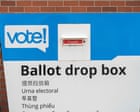
When mail-in rules are abruptly altered—when witness requirements multiply, or drop boxes vanish from municipal corners, or receipt deadlines shrink faster than postal routes can manage—the friction multiplies. A ballot mailed on a Monday might arrive on a Thursday under normal conditions. But what if a rural postal sorting facility experiences a staffing shortage? What if the deadline requires physical arrival rather than a timely postmark? Suddenly, the burden shifts entirely onto the voter, creating invisible tripwires.
This is where the recent courtroom battles take on their true weight. A second federal judge issuing an injunction against sweeping mail-in restrictions is not merely tossing out ink on paper; they are stepping between the voter and the tripwire.
To understand why these rulings matter so intensely, look back at how the landscape of American voting has evolved. For generations, the default assumption was physical presence. You went to the school gymnasium, the fire station, or the church basement. You waited in line beneath fluorescent lights. That model worked wonderfully for people with flexible schedules, reliable transportation, and robust local infrastructure.
It worked less wonderfully for the night-shift worker, the college student studying three states away, the active-duty military member stationed overseas, and the elder whose neighborhood polling place was closed down to consolidate municipal budgets.
As voting by mail expanded—dramatically accelerated by the public health imperatives of recent years—it revealed an appetite for convenience that could not be easily unlearned. Millions discovered that casting a ballot without disrupting a fragile household budget or arranging complex childcare felt less like a civic chore and more like an accessible right.
Naturally, political tides shifted in response. Whenever access expands, questions of control follow close behind.
The legal arguments in these latest cases trace a familiar, jagged fault line. On one side stand state officials defending their sovereign authority to set the rules of the road, arguing that administrative safeguards protect the electoral ecosystem from fraud and confusion. On the other side stand civil rights groups, voters, and legal advocates arguing that these rules disproportionately burden specific populations, effectively pricing them out of the democratic market through administrative exhaustion.
When the second judge blocked the restrictions, the ruling pointed directly to that burden. It signaled that the Constitution does not look kindly on rules that erect high walls around the ballot box under the guise of security, especially when those walls block some citizens far more effectively than others.
Yet, court orders are temporary shields, not permanent solutions. They freeze the board mid-game, holding back a wave of new limitations, but they do not resolve the underlying friction.
The tension between security and accessibility is as old as the republic itself. The founders argued over property requirements, literacy tests, and polling locations by district. Every generation redraws the boundary lines of who gets to participate and how easily they can do so. Today, that boundary is drawn right across the kitchen table, intersecting with the local post office and the sorting machine.
For Maria, the legal briefs and judicial opinions remain distant background noise, filtered through evening news anchors and the front pages of newspapers. She doesn't know the docket numbers or the names of the attorneys arguing before the bench.
She only knows whether her ballot arrives. She only knows whether her voice will be counted.
As the legal battles wind their way toward higher appellate courts, the broader question remains hanging in the air like autumn frost. How a society designs its voting rules is the ultimate mirror of its values. It reveals whether it views participation as a universal invitation or a tightly guarded privilege.
The courtroom door swings shut for today, pausing the restrictions and leaving the mail carriers to finish their rounds. But the larger story—the ongoing tug-of-war over who gets to speak in the democratic chorus—is far from over. The envelope waits on the table, and the clock keeps ticking toward the next election day.