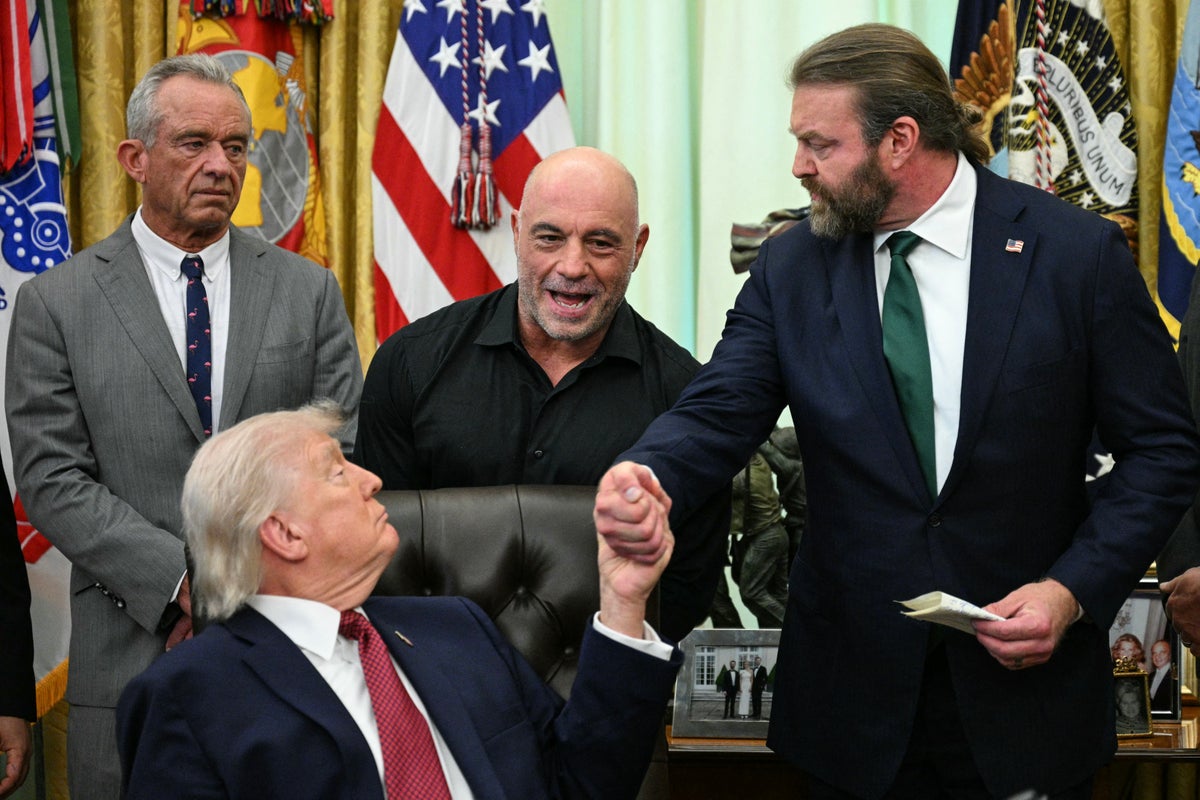
Donald Trump recently sat in a wood-paneled studio in Austin, Texas, and allowed a former martial arts commentator to dismantle his stance on foreign intervention. For nearly three hours, the man who once demanded total loyalty from the GOP sat passive as Joe Rogan challenged the foundational neoconservatism of the old guard. Yet, while Trump remains deferential to the kings of the podcasting world, he has shown an increasing willingness to engage in public friction with traditional religious hierarchies, most notably the Vatican.
This is not a lapse in judgment. It is a calculated pivot. The Republican party is trading the pews for the octagon. The political weight of the "Jesus vote" is being eclipsed by the "bro vote," a demographic that values raw authenticity and anti-establishment defiance over theological dogma.
The Rogan Clearance
For decades, Republican candidates sought the blessing of the pulpit. They would travel to Liberty University or the Moody Bible Institute to prove their moral fitness. That world is gone. In its place is the long-form podcast, where the litmus test isn’t your stance on scripture, but your ability to survive a three-hour unscripted interrogation without retreating into talking points.
When Rogan pushed Trump on the nuances of the Iranian conflict, the former president didn't react with his signature "you're fired" bluster. He listened. He pivoted. He treated Rogan with a level of respect he rarely affords heads of state. This wasn't just about reaching Rogan’s 15 million subscribers. It was a recognition of where the new cultural authority resides. Rogan represents a base that is skeptical of institutional power—whether that power is the federal government, the mainstream media, or the Catholic Church.
By allowing Rogan to "torch" him on policy, Trump signaled to the young, male electorate that he is one of them. He is willing to be challenged. He is willing to exist in a space that doesn't have a teleprompter. This is the new currency of trust.
Displacing the Pope
Contrast this with Trump’s historical and ongoing friction with Pope Francis and the broader legacy of Catholic social teaching. While he courts the "Manosphere," he has been remarkably comfortable dismissing the critiques of the Holy See regarding immigration and climate change.
The logic is simple. The modern "bro" base, which skews younger and more secular than the Reagan-era religious right, views the Vatican as just another globalist institution. To this demographic, the Pope isn't the Vicar of Christ; he’s a European bureaucrat in a fancy robe. When Trump pushes back against the Church, he isn't losing his base—he’s reinforcing his brand as an outsider who answers to no one.
We are witnessing the secularization of the American Right. The moral framework that once defined the GOP—centered on traditional family values and religious devotion—is being replaced by a libertarian-leaning, "alpha" male ethos. In this world, strength is the primary virtue and perceived weakness is the only sin.
The Demographic Math of the Bro Base
The numbers tell a story that traditional pollsters are still struggling to map. The "bro" demographic—loosely defined as men aged 18 to 45 who consume content via YouTube, Rumble, and Spotify—is moving toward the Right not because of religious conviction, but because of a shared sense of alienation.
- Institutional Distrust: They believe the systems of higher education and corporate HR are rigged against them.
- Economic Anxiety: They see the traditional path to homeownership and family-building as increasingly blocked.
- Cultural Fatigue: They are tired of being told that their natural interests are "toxic."
Trump’s strategy is to capture this energy by appearing on platforms like Bussin' With The Boys or the Nelk Boys. These aren't political shows. They are lifestyle brands. By embedding himself in these spaces, Trump bypasses the moral gatekeepers of the past. He doesn't need a priest to tell his followers he’s a good man; he needs a podcaster to show his followers he’s a "cool" man.
Why the Pulpit is Losing Its Power
The decline of the religious vote as the GOP’s primary engine is partly a matter of biology. The old-school evangelical leaders are aging out, and their children are not joining the fold in the same numbers. More importantly, the internet has decentralized moral authority.
In the 1980s, Jerry Falwell could reach millions through a single television broadcast. Today, a 22-year-old with a camera and a gym membership can exert more influence over the political leanings of young men than a bishop. This shift has created a vacuum that Trump has filled with a secularized version of populism. It’s a politics of the locker room, not the sanctuary.
The Pope’s critiques of capitalism or border walls fall flat with this group because they don't recognize his authority to speak on those issues. They see it as "virtue signaling," a phrase that has become a lethal accusation in the digital age. When Trump ignores the Pope but humbles himself before Rogan, he is aligning himself with the people who his base actually listens to.
The Risk of the New Orthodoxy
This pivot is not without its dangers. By abandoning the moral scaffolding of religion, the GOP risks becoming a party of pure grievance. Religion, for all its flaws, provides a set of universal principles that can occasionally act as a check on power. The "bro" base is more transactional. Their loyalty is tied to performance and the maintenance of a specific aesthetic of strength.
If Trump appears weak or becomes "cringey" to this audience, they will move on to the next avatar of defiance. There is no "eternal life" in the world of podcast metrics. You are only as relevant as your last episode.
The Death of the Evangelical Veto
For forty years, the Evangelical Veto was the most powerful force in Republican politics. If a candidate didn't pass the "values" test, they were finished. Trump didn't just break this test; he burned the grading sheet. He proved that you can have multiple divorces, a checkered business past, and a loose relationship with the truth, as long as you fight the right enemies.
The "bro" base doesn't care about the candidate’s personal life in the way the Moral Majority did. In fact, they often see a "wild" personal life as a mark of authenticity. They aren't looking for a preacher. They are looking for a gladiator.
This is why the conflict with religious leaders like Pope Leo (in the historical sense of the papacy's moral weight) or the current Francis doesn't hurt Trump. To the new base, the Church is the "Establishment." Rogan is the "Resistance."
The Infrastructure of the New Right
The shift is also visible in the media infrastructure being built. Outlets like The Daily Wire or Barstool Sports have created an ecosystem where politics, sports, and culture are blended into a single stream of consciousness. This is where the modern voter is being formed.
In this ecosystem, the traditional divide between "sacred" and "profane" has vanished. A host can discuss the merits of a tax cut in one breath and tell a crude joke in the next. This is the language of the "bro" base. It is informal, aggressive, and deeply skeptical of anyone who claims to hold the moral high ground.
Trump’s willingness to be "torched" by Rogan is a tactical masterstroke in this environment. It shows he is "game." It shows he can take a punch. In the world of the Barstool Reformation, that is worth more than a thousand endorsements from the clergy.
The political landscape has been permanently altered. The pews are emptying, but the gyms and the comment sections are full. The GOP is no longer the party of the "Old Time Religion." It is the party of the Unfiltered Stream.
The Future of the Bro Vote
As we move toward the next election cycles, expect to see more candidates attempting to mimic this "bro-whisperer" strategy. They will skip the Sunday morning news shows to go on gaming streams. They will trade their ties for quarter-zips and talk about UFC results before they talk about the GDP.
But this strategy requires a specific kind of charisma that many politicians lack. You cannot fake "bro." If a candidate looks like they are trying too hard to be one of the guys, the audience will smell it instantly. Trump’s advantage is that he has always inhabited this space—the world of casinos, beauty pageants, and professional wrestling. He didn't have to learn the language; he helped invent it.
The Church, meanwhile, finds itself in an awkward position. It is trying to speak a language of nuance and sacrifice to an audience that has been conditioned to value disruption and self-assertion. The friction between Trump and the Vatican is a preview of a much larger cultural divorce.
The "bro" base is now the most politically potent force in the conservative movement. They are younger, more digitally savvy, and less inhibited than the religious voters of the past. They don't want a sermon. They want a show. And as long as Trump is the lead actor, they will keep watching.
Stop looking for the next Billy Graham to save the Republican party. He isn't coming. The new kingmaker is wearing a headset and sitting in a studio, asking questions about aliens and ice baths, while the leader of the free world nods along, hoping to capture just a fraction of that digital lightning.


:strip_icc()/pic2513216.jpg)