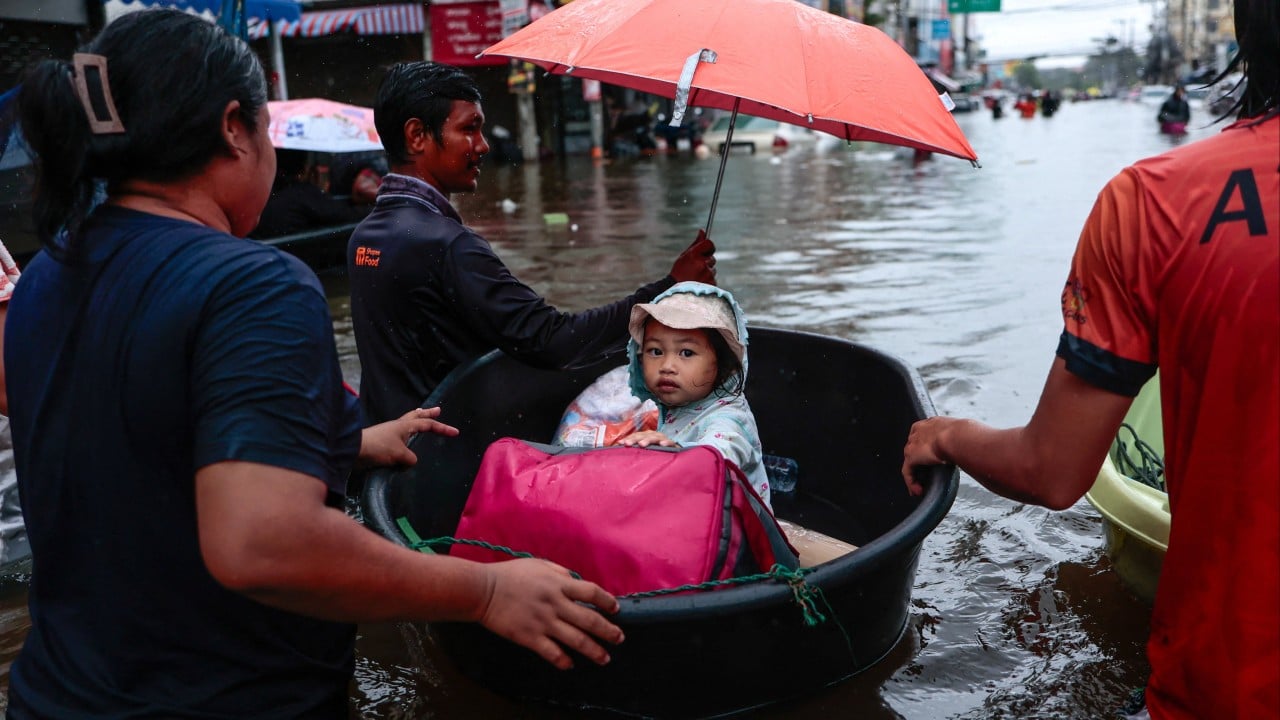
The Failure Mode of Urban Hydrology
When a major metropolitan center experiences a 15-year flood peak accompanied by widespread public friction over delayed warnings, the failure is rarely meteorological. It is structural, systemic, and rooted in information latency. Severe weather forecasting in mainland Southeast Asia operates under high epistemic uncertainty due to microclimatic flash points, monsoon variability, and dense urban canopy interference. Yet, the primary bottleneck during the recent Bangkok flood events was not the raw velocity of incoming precipitation or the volume of Mekong and Chao Phraya basin runoff; it was the institutional lag between data ingestion, threshold crossing alerts, and civic dissemination.
Urban flood management functions as a closed-loop control system. Sensors measure water surface elevation and volumetric flow rates, telemetry relays the data to central monitoring nodes, algorithms project inundation curves, and authorities issue advisories. If the time required to process and broadcast an alert exceeds the travel time of a flood pulse through a drainage bottleneck, the warning system becomes an autopsy rather than a preventive control. Meanwhile, you can find related events here: Where the Air Smells of Ash and Bread.
Analyzing the Bangkok flood warnings reveals three distinct failure vectors: sensor-to-bureaucracy latency, institutional risk aversion in threshold declaration, and last-mile communication decay. Addressing these vectors requires dismantling the existing bureaucratic triage and replacing it with automated, decentralized telemetry distribution.
The Three Pillars of Inundation Vulnerability
Urban flood resilience is governed by three interdependent variables: topography, drainage capacity, and response latency. In low-lying delta cities like Bangkok, topography is an immutable constraint. Much of the metropolitan region sits at or below sea level, reliant on a legacy network of canals, known locally as khlongs, alongside industrial pumping stations and floodwalls. To explore the complete picture, check out the detailed article by BBC News.
When heavy monsoon downpours coincide with high astronomical tides in the Gulf of Thailand, gravity drainage halts entirely. Water must be pumped mechanically.
[Rainfall / Upstream Runoff]
        ↓
[Legacy Canal Network (Khlongs)]
        ↓
[Tidal Lock / Gulf of Thailand Backpressure]
        ↓
[Inundation Breakthrough / Pumping Bottleneck]
This mechanical dependency creates a narrow margin of error.
The first pillar, hydrological topography, ensures that any delay in staging heavy drainage assets results in immediate street-level pooling. The second pillar, system capacity, dictates the maximum volumetric throughput the municipal pumps can sustain before electrical failure or fuel depletion occurs. The third pillar, operational response latency, dictates whether citizens and commercial operators receive actionable evacuation data before arterial roads submerge.
During the worst flood event in 15 years, the breakdown occurred almost entirely within the third pillar. While hydrologists tracked rising water levels in northern provinces days in advance, the downward transmission of risk-weighted alerts was throttled by bureaucratic verification loops. Officials delayed public declarations to avoid premature economic panic or miscalculated evacuations, effectively trading precision for timeliness. In crisis management, a delayed, high-confidence warning has a lower utility value than a timely, probabilistic alert.
The Cost Function of Late Information
To understand why late warnings generate catastrophic economic and social friction, one must examine the cost function of emergency preparation. Individual and commercial actors operate on finite liquidity and logistical timelines. Moving inventory from ground-level warehouses, elevating electrical infrastructure, or relocating vehicles requires lead time.
$$\text{Total Loss} = \text{Unmitigated Inundation Damage} \times (1 - \text{Preparedness Factor})$$
When warning latency approaches zero hours, the preparedness factor collapses toward zero. Businesses absorb maximum inventory depreciation, municipal transit networks lock up with stranded vehicles, and emergency services find their own mobility impaired by flooded arterial corridors.
Furthermore, late warnings erode public trust in future institutional advisories. When citizens receive warnings after water has already breached their doorsteps, subsequent alerts are ignored or heavily discounted. This behavioral degradation compounds vulnerability in subsequent weather events, creating a feedback loop of civic cynicism and inadequate preparation.
Structural Interventions for Future Flood Events
Preventing a recurrence of delayed institutional responses requires moving away from manual, committee-driven escalation protocols toward automated telemetry triggers.
The first required shift is the decentralization of alert authorities. Relying on a single centralized agency to evaluate upstream data and clear public announcements introduces unacceptable political and administrative delays. Municipal sub-districts and local drainage nodes must be empowered to issue localized, threshold-based warnings automatically when water gauges cross defined danger marks.
The second shift involves modernizing last-mile distribution architectures. Relying on traditional media broadcasts and institutional websites fails to reach vulnerable populations swiftly. High-density urban centers require localized cell-broadcast systems that bypass app-based sign-ins to push geofenced telemetry alerts directly to mobile devices within threatened flood zones.
Finally, urban planners must re-evaluate the threshold definitions that dictate emergency declarations. Current models often wait for physical observation of flooding before escalating alert levels. Predictive hydrological modeling must be integrated into the warning criteria, treating forecasted volumetric convergence as sufficient cause for early-stage public mobilization.
Urban flood management cannot eliminate natural geography, but it can eliminate administrative hesitation. By treating warning latency as the primary enemy, municipal authorities can transform crisis response from a reactive scramble into an engineered defense.


