Ink dries quickly on paper, but fear stains longer.
Consider a small kitchen in Donetsk, the air thick with the metallic scent of stale tea and distant concussions. Outside, the streetlights flicker through a frame stripped of glass, replaced by heavy plastic sheeting that rattles every time the artillery shifts in the gray distance. A woman sits at the table. Her hands are rough, calloused from decades of working in local textile mills, but right now, they tremble slightly as she holds a small, rectangular card. You might also find this similar article interesting: Shadows In Rio Inside The Manhunt For A Disguised Predator.
An election card.
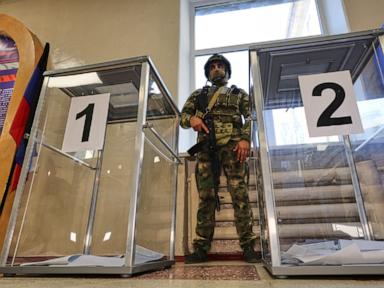
In Moscow, thousands of miles away across time zones draped in state-controlled bulletins, officials speak of integration, administrative duty, and the sacred right of civic participation. They call it a parliamentary vote. They speak of ballot boxes arriving in armored trucks, escorted by soldiers whose rifles carry bayonets gleaming under pale autumn light. But here, inside the kitchen, the translation is entirely different. Participation is not a celebration of democracy. It is a measurement of visibility. If you stay inside, hiding behind locked doors while election workers march down your corridor with clipboards and armed guards, you are invisible. And in a war zone, invisibility can quickly be misread as defiance. As highlighted in detailed coverage by The Guardian, the implications are worth noting.
We must understand what happens when a border is redrawn not by treaties signed on polished mahogany tables, but by the jagged edge of shrapnel.
Since the annexation of Crimea and the subsequent territorial shifts of 2022, millions of Ukrainians living under occupation have found their daily routines colonized. Streets have been renamed. Curfews are enforced with ruthless precision. Ruble banknotes have replaced the hryvnia in local shops, where the cost of bread climbs higher with every passing week. Yet, the most insidious weapon deployed in these territories is not artillery. It is the forced normalization of the abnormal.
By staging Russian parliamentary elections in these occupied regions—spanning Donetsk, Luhansk, Zaporizhzhia, and Kherson—the objective is psychological rather than legal. International law treats these votes as nullities. The United Nations General Assembly has repeatedly condemned them, pointing out that elections held at gunpoint inside a sovereign nation's active combat zone violate every fundamental tenet of self-determination. But international declarations do not stop the men with clipboards from knocking on apartment 4B.
Let us step inside the hypothetical world of Dmytro, a retired schoolteacher living in a coastal village in the Kherson region. Imagine his perspective. Dmytro spent forty years teaching children the structure of Ukrainian grammar, the rhythm of Taras Shevchenko’s poetry, the geography of the Dnipro River. Now, the school library has been purged. The Ukrainian textbooks were hauled out into the courtyard last winter and burned to keep a makeshift stove warm.
When the local election commission members—some of them former neighbors who chose a different flag when the wind changed—arrive at his gate, Dmytro faces a terrifying calculus. If he refuses to vote, his name goes onto a list. A red mark next to a name in an occupied town rarely leads to a polite conversation. It leads to midnight interrogations in municipal cellars, accusations of subversion, and the sudden disappearance of familiar faces.
So Dmytro walks to the polling station. He takes the ballot. He makes a mark. He walks home in silence.
To an observer sitting safely in a television studio in Western Europe or North America, looking at a graphic on a screen, this might look like voter turnout. It might be quantified as a percentage point in a state-media broadcast designed to prove that the population has embraced its new reality. But that statistic is built on coercion. It is a house of cards constructed over a sinkhole.
The mechanics of these elections reveal their true nature. Mobile voting booths travel through neighborhoods accompanied by military escorts, stopping at apartment blocks and rural homesteads alike. Officials claim this is an accommodation for elderly or vulnerable citizens. In reality, it ensures maximum surveillance. When a ballot box is brought directly to your living room table while a soldier waits in the hallway with his finger resting near the safety of his rifle, the concept of a secret ballot ceases to exist. Your choice is exposed the moment you pick up the pen.
Why does Moscow invest so much effort into orchestrating these elaborate theatrical productions? Because legitimacy is currency. A military conquest can seize land, but it cannot manufacture belonging. By forcing citizens to participate in legislative elections, the occupying power attempts to launder its territorial gains through the illusion of civic consent. If people vote in a Russian election, the argument goes, then the territory is practically and morally Russian.
It is a legal fiction written in blood and ink.
Consider the broader historical pattern. History is littered with empires that attempted to swallow neighbors whole, only to choke on the resistance of the people who refused to forget who they were. From the partitions of Europe in the nineteenth century to the annexation struggles of the twentieth, the playbook remains identical. Conquer the land, replace the administrators, rewrite the school curriculums, and stage elections to prove the population is content.
Yet, human memory is remarkably stubborn.
In these same occupied towns, beneath the surface of enforced compliance, a quiet resistance persists. It does not look like partisan warfare or cinematic sabotage. It looks like an elderly woman whispering a Ukrainian lullaby to her grandchild. It looks like a shopkeeper who accidentally forgets how to speak Russian when an unfamiliar soldier walks through the door. It looks like the silent solidarity between neighbors who catch each other's eyes in the market, knowing the immense risk they share just by breathing.
The parliamentary votes held in these seized territories tell us less about the democratic health of the system conducting them and much more about the desperation of an administration trying to finalize a theft. You can occupy a city block. You can change the name on the street signs. You can drag voters to improvised polling stations under the watchful gaze of armed patrols.
But you cannot legislate a soul.
When the ballots are counted and the state television anchors smile into their cameras, announcing high turnout and overwhelming support, remember the kitchen in Donetsk. Remember the plastic sheeting rattling in the wind. Remember the quiet weight of a card held by hands that only want peace, holding out against a darkness that refuses to call itself by its true name.
The ink on the ballot will fade. The banners hung from lampposts will eventually be torn down by time or tide. But the truth of what happened in those rooms, under the shadow of the crossfire, remains etched into the collective memory of a people who were told they no longer existed, yet chose to endure anyway.