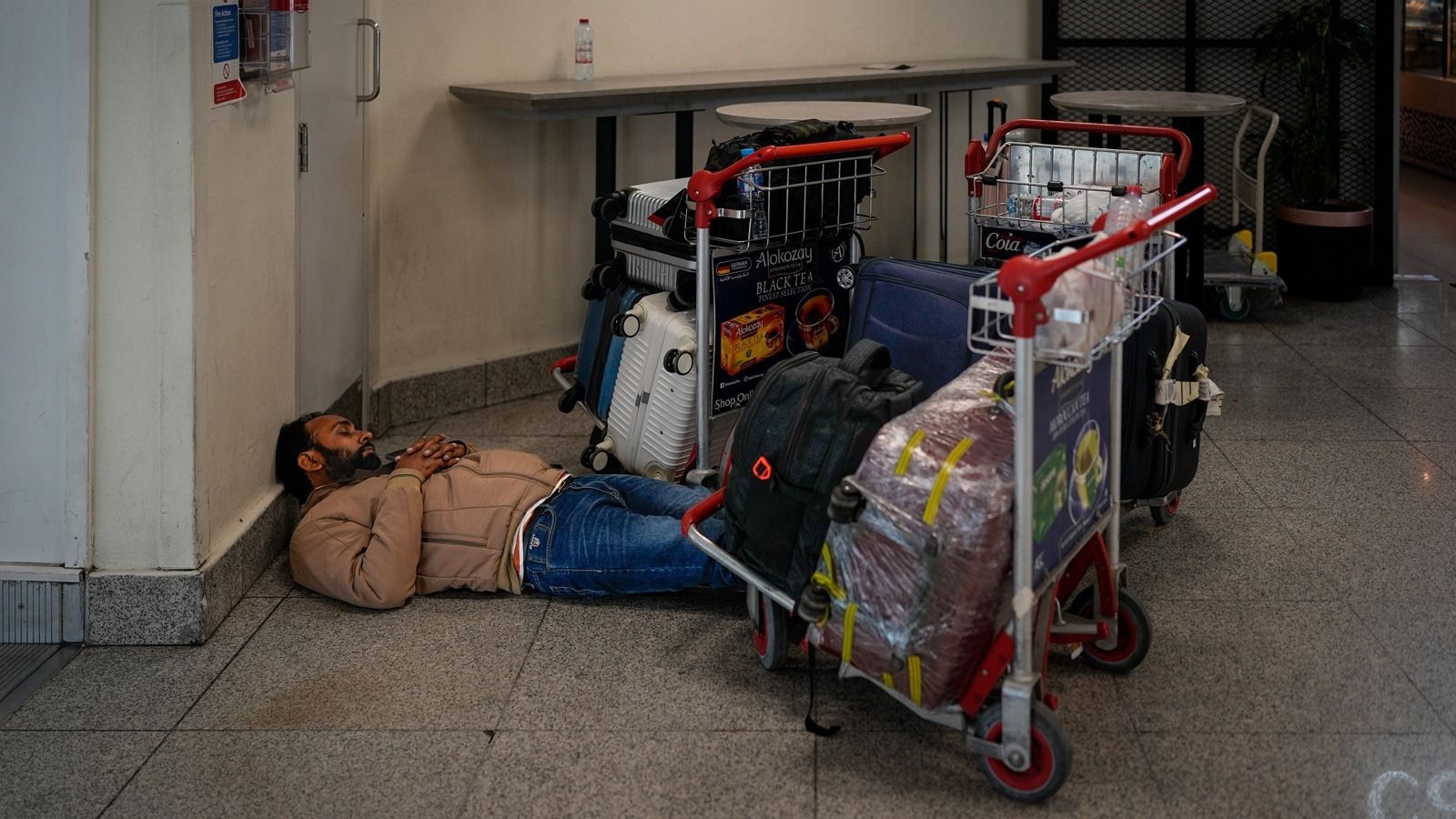
The surge in flight capacity between the United Arab Emirates and India during regional instability is not a simple reactive measure; it is a complex recalibration of aeropolitical risk and supply chain elasticity. When geopolitical friction in the Middle East disrupts standard flight paths, the Indian aviation sector—specifically the Air India Group—must transition from a commercial efficiency model to a strategic evacuation and repatriation framework. This shift requires the immediate synchronization of bilateral traffic rights, crew duty limitations, and hull insurance premiums that fluctuate in real-time based on proximity to active kinetic conflict.
The Triple Constraint of Emergency Aviation Logistics
Airlines operating in high-risk corridors manage three conflicting variables: regulatory compliance, operational safety, and financial solvency. In the context of the current Middle East crisis, the decision by Air India and Air India Express to maintain and expand operations into the UAE involves a calculated assessment of these factors.
1. The Regulatory Elasticity Factor
Standard international aviation is governed by Bilateral Air Services Agreements (BASAs), which dictate seat counts and frequency. During a crisis, these rigid structures are bypassed through "special humanitarian dispensations." The Indian Ministry of Civil Aviation (MoCA) acts as the primary coordinator, securing temporary landing rights that exceed standard quotas. This is not a market-driven expansion but a diplomatic intervention to prevent a bottleneck of stranded nationals.
2. Risk Premium and Insurance War Caps
Commercial aircraft operating near or through "war risk" zones face immediate escalations in insurance costs. Insurers typically apply a "Geographic Area Limitation" clause. To maintain operations when others might ground their fleet, Air India must absorb or offset a "War Risk Hull" surcharge. The logic for continuing operations rests on the high load factors (percentage of seats filled) which, in an evacuation scenario, often reach 95-100%, thereby amortizing the increased insurance overhead across a maximum passenger base.
3. Crew Utilization and Fatigue Risk Management
Safety in a conflict-adjacent zone is heavily dependent on the "Human Factor." Flight Duty Period (FDP) limitations become a critical bottleneck. If a flight is delayed due to airspace closures or additional security screenings, the crew may "time out," grounding the aircraft in a high-risk location. Air India’s strategy involves "slip-crewing" or positioning reserve teams in neutral hubs like Muscat or Mumbai to ensure that an aircraft can be turned around instantly without violating safety mandates.
Airspace Congestion and the "Great Circle" Deviation
The primary technical challenge is not the destination, but the path taken to reach it. When Iranian or Israeli airspace becomes restricted, the standard "Great Circle" routes—the shortest distance between two points on a sphere—are abandoned.
The deviation from these routes has a direct impact on the Fuel Burn Function:
$$F_b = (W_{ac} \times C_f \times T_d) + R_{res}$$
Where:
- $F_b$ is the total fuel burn.
- $W_{ac}$ is the aircraft weight (highly sensitive in evacuation flights with heavy luggage).
- $C_f$ is the consumption factor per engine.
- $T_d$ is the time displacement caused by rerouting.
- $R_{res}$ is the mandatory reserve fuel for holding patterns.
Rerouting often adds 45 to 90 minutes to a four-hour flight. For an Airbus A320neo or a Boeing 787, this increases the trip cost by thousands of dollars. The decision to add flights under these conditions implies a priority on "Network Resilience" over immediate "Unit Margin."
Structural Breakdown of the UAE-India Repatriation Market
The UAE serves as the primary node for the Indian diaspora, with over 3.5 million Indian nationals. The concentration of this population in Dubai, Abu Dhabi, and Sharjah creates a massive logistical demand when regional stability wavers.
- Point-to-Point Density: Unlike European routes which rely on "hub-and-spoke" transit, the UAE-India corridor is largely point-to-point. This allows Air India Express to utilize its narrow-body fleet (Boeing 737s) for high-frequency, short-turnaround cycles.
- The Vande Bharat Precedent: The operational DNA for these "extra flights" was coded during the COVID-19 pandemic. The airline uses a modular scheduling system where extra "ferry flights" (empty one way, full the other) can be inserted into the schedule without collapsing the existing commercial timetable.
- Pricing Caps vs. Yield Management: In a crisis, airlines face a reputational risk if they appear to engage in "price gouging." The Indian government often implements informal "fare ceilings" on these routes. This forces the airline to operate on a "Cost-Plus" model rather than a "Dynamic Pricing" model.
The Bottleneck of Ground Handling and Slot Allocation
Even if an airline has the aircraft and the crew, it cannot operate without a "slot"—a specific time allocated for landing and takeoff. In the UAE, particularly at Dubai International (DXB), slots are among the most expensive and scarce commodities in the world.
During a conflict, the "Slot Recovery" mechanism is activated. If Western carriers cancel flights due to risk assessments, those slots become temporarily vacant. Air India leverages its "Flag Carrier" status to secure these windows. However, this creates a secondary problem: ground handling congestion. If five extra flights arrive simultaneously to evacuate passengers, the check-in counters, baggage handlers, and security checkpoints at the UAE end become the limiting factor of the entire operation.
Displacement and Opportunity Cost
Every aircraft diverted to the UAE-India corridor is an aircraft removed from another profitable route. The "Opportunity Cost" of this strategy is measured by the lost revenue on stable sectors (e.g., Delhi to London or Mumbai to Singapore).
Airlines use a Resource Allocation Matrix to decide which routes to cannibalize:
- Low-Yield/High-Frequency: Domestic routes are usually the first to be trimmed to free up airframes.
- Maintenance Deferral: Aircraft scheduled for non-critical "C-Checks" may have their maintenance windows shifted (within legal safety limits) to maximize "Up-Time" during the crisis window.
- Wet-Leasing Potential: In extreme cases, the airline may "Wet-Lease" (renting the plane, crew, and insurance) from a third party to cover the surge, though this is rare for Air India given its current fleet expansion.
Communication Channels as Infrastructure
A critical failure in competitor reporting is the oversight of "Information Logistics." In a crisis, the physical flight is only 50% of the solution. The other 50% is the management of passenger flow to the airport.
Air India’s reliance on social media and diplomatic channels (the Indian Embassy in Abu Dhabi and the Consulate in Dubai) serves as a pre-filtering mechanism. By announcing "additional flights" through these channels, the airline prevents a "bank run" on the airport. It creates a structured queue, ensuring that only those with confirmed bookings arrive at the terminal, thereby maintaining the operational integrity of the airport hub itself.
Strategic Recommendation for Travelers and Stakeholders
The current operational posture of Air India and Air India Express indicates a transition from "Commercial Optimization" to "National Strategic Asset." For passengers, the logic dictates that booking on the "Flag Carrier" during a conflict provides a layer of protection that private, foreign LCCs (Low-Cost Carriers) cannot match, as foreign carriers are more likely to suspend operations entirely to protect their assets from sovereign risk.
Stakeholders should monitor the "CIRT" (Conflict Integrated Risk Tracking) data. If the deviation time for rerouting exceeds 120 minutes, expect a "Fuel Surcharge" to be implemented retroactively or a reduction in baggage allowances to compensate for the increased fuel-to-weight ratio required for longer flight paths. The current "additional flights" are a temporary buffer; should the conflict escalate to include direct threats to UAE terminal infrastructure, the "Air Bridge" will likely shift from commercial airports to military airbases (such as Al-Maktoum), necessitating a completely different logistical protocol.
The immediate tactical move for those stranded is to prioritize "Direct-to-Hub" flights (to Mumbai or Delhi) rather than secondary cities, as the airline will prioritize high-capacity wide-body aircraft to these nodes to clear the maximum number of passengers in the shortest time-frame.
Would you like me to analyze the specific fuel-cost impact of these reroutes on Air India’s quarterly earnings?