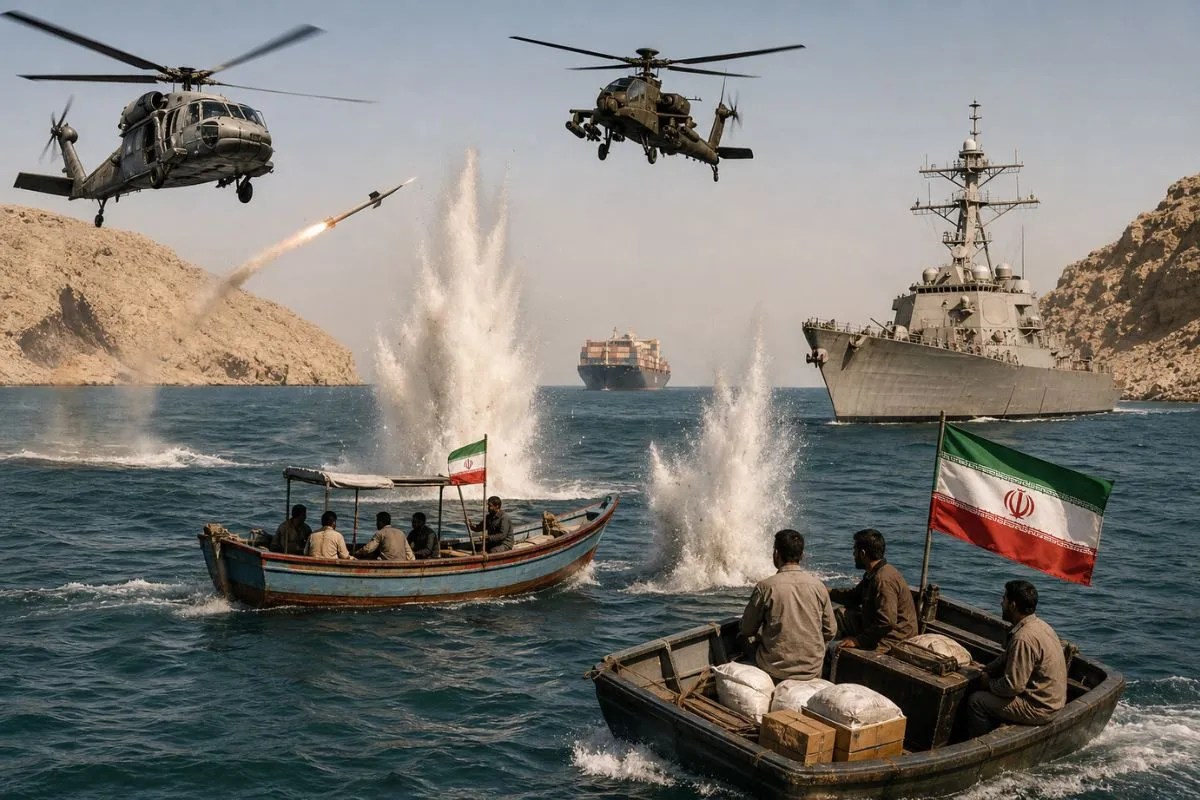
The strategic architecture of the Strait of Hormuz has shifted from a state of managed tension to one of active kinetic friction. Recent reports of U.S. strikes resulting in Iranian casualties represent more than a localized skirmish; they signify a breakdown in the established "gray zone" rules of engagement that have historically governed this maritime corridor. To understand the gravity of these events, one must move beyond the headlines and analyze the structural pressures involving naval doctrine, energy security, and the logistical realities of Persian Gulf shipping.
The Geopolitical Physics of the Strait
The Strait of Hormuz functions as a global economic choke point where approximately 21% of the world's total petroleum liquids consumption passes daily. This creates a specific set of operational constraints for both the United States and Iran. The current escalation can be deconstructed through three primary structural drivers.
1. The Interdiction Calculus
Iran’s naval strategy focuses on "asymmetric denial." Rather than matching the U.S. Fifth Fleet in raw tonnage or technology, Tehran utilizes a swarm-based doctrine involving fast attack craft (FAC), coastal missile batteries, and loitering munitions. The reported deaths of Iranian personnel suggest a moment where the U.S. shifted from a posture of "presence-based deterrence" to "active neutralization."
In this framework, the U.S. is not merely responding to a provocation but is recalibrating the cost function for Iranian interference. If the cost of harassing tankers remains low, harassment continues. By introducing lethal consequences, the U.S. military aims to re-establish a "red line" that had become blurred during years of proxy-led maritime incidents.
2. Proportionality vs. Deterrence
A critical tension exists between proportional response and effective deterrence. In international law and military doctrine, a response should theoretically match the scale of the initial threat. However, in the Strait of Hormuz, a proportional response is often insufficient to deter a state that views regional disruption as a primary lever of foreign policy. The reported strike indicates a transition toward "punitive deterrence"—where the goal is to inflict enough damage to alter the adversary's internal risk assessment.
3. The Proxy Feedback Loop
Much of the tension in the Strait is a spillover from land-based conflicts in the Levant and Yemen. When Iranian-aligned groups execute strikes elsewhere, the U.S. often views the Strait as the most effective theater to exert counter-pressure. This creates a feedback loop where maritime security becomes a secondary casualty of terrestrial geopolitics.
Structural Bottlenecks in Maritime Security
The tactical reality of the Strait of Hormuz is defined by its geography. At its narrowest point, the shipping lanes are only two miles wide in each direction, separated by a two-mile buffer zone. This lack of maneuverable space creates an inherent advantage for land-based or small-craft naval forces.
- The Detection Lag: Despite advanced radar and satellite surveillance, identifying the intent of small, fast-moving Iranian vessels among a sea of commercial traffic remains a significant challenge.
- The Rules of Engagement (ROE) Dilemma: Commanders on U.S. destroyers face a binary choice: wait for a clear act of aggression and risk the safety of the crew, or strike preemptively and risk a regional war.
- Logistical Fragility: Every kinetic event in the Strait immediately impacts global insurance premiums (Lloyd’s Market Association Joint War Committee rankings). A single strike can spike the "war risk" surcharge for tankers, effectively taxing the global energy supply chain.
Logistics of the Kinetic Event
The claims surfacing in Iranian media regarding five deaths suggest a specific type of engagement—likely a precision strike on a localized command node or a specific vessel involved in an interdiction attempt. These casualties serve as a quantifiable metric for the failure of de-escalation protocols.
From a strategic perspective, the loss of personnel for Iran is not just a human cost; it is a signal of the U.S. military’s willingness to bypass the "tanker war" of the 1980s and target the human and technical assets that facilitate disruption. This targets the professional Iranian Revolutionary Guard Corps (IRGC) Navy, which operates with a degree of autonomy and high ideological commitment.
The Triad of Risk
The current situation is governed by three variables that dictate the likelihood of full-scale conflict:
Variable A: The Threshold of Retaliation
Iran’s response to these casualties will determine the next phase of the crisis. If Tehran chooses a symmetrical maritime response—attacking a U.S. vessel or a high-value tanker—the probability of a sustained air campaign against Iranian coastal infrastructure increases. If they opt for a "delayed proxy" response (e.g., cyber-attacks or militia strikes in Iraq), the maritime theater may temporarily stabilize.
Variable B: Economic Elasticity
The global economy’s ability to absorb energy price fluctuations acts as a governor on the conflict. High oil prices pressure the U.S. administration to seek stability, while low prices reduce Iran's leverage. Currently, with global markets already sensitive to supply chain disruptions, the Strait of Hormuz acts as a physical manifestation of global inflation risk.
Variable C: Naval Capability Gaps
The U.S. Fifth Fleet relies on a combination of carrier strike groups and unmanned surface vessels (USVs). The integration of AI-driven surveillance in the Persian Gulf aims to reduce the "fog of war." However, as seen in recent events, technology cannot entirely replace the political decision to use lethal force. The bottleneck is no longer information; it is the political will to sustain a high-friction environment.
Market and Security Implications
The immediate fallout of lethal strikes in the Strait is felt in the maritime insurance and shipping sectors. We are seeing a transition from "standard transit" to "protected convoy" mindsets. This transition increases the operational overhead for every barrel of oil transported out of the Gulf.
- Insurance Escalation: Underwriters will likely re-evaluate the "hull stress" and "war risk" for any vessel flying a Western flag or carrying cargo destined for U.S.-aligned ports.
- Rerouting Limitations: Unlike other regional conflicts, there are few viable alternatives to the Strait of Hormuz. Pipelines across Saudi Arabia (East-West Pipeline) have limited capacity and cannot replace the sheer volume of the maritime route.
- Naval Escort Requirements: Increased friction necessitates a greater number of hull-to-hull escorts, stretching the resources of the U.S. Navy and its "Combined Maritime Forces" partners.
Strategic Forecast
The situation in the Strait of Hormuz is moving toward a period of "High-Intensity Gray Zone" conflict. This is a state where the frequency of lethal incidents increases without crossing the threshold of declared war.
For the U.S., the strategy must remain focused on maintaining the freedom of navigation through a credible threat of force. This requires a presence that is not just visible but demonstrably capable of neutralizing threats in seconds, not minutes.
For Iran, the strategy involves testing the limits of Western patience. However, if the reports of casualties are accurate, the IRGC has encountered a hard ceiling in its harassment operations. The loss of five personnel suggests that the U.S. is no longer prioritizing "de-escalation through avoidance" but is instead opting for "stability through attrition."
The strategic play here is not found in the rhetoric of "defending sovereignty" or "fighting imperialism." It is found in the cold assessment of maritime transit security. Any entity operating in the region must now account for the reality that the buffer for error has vanished. The next 72 hours will reveal whether the IRGC views these deaths as a reason to retreat and regroup or as a catalyst for a more aggressive, perhaps clandestine, underwater campaign involving mines or unmanned underwater vehicles (UUVs).
The focus now shifts to the deployment of "vessel protection detachments" and the potential for a multi-national naval coalition that moves beyond mere monitoring and into active patrol zones. The era of the "uncontested squeeze" in the Strait of Hormuz is over.