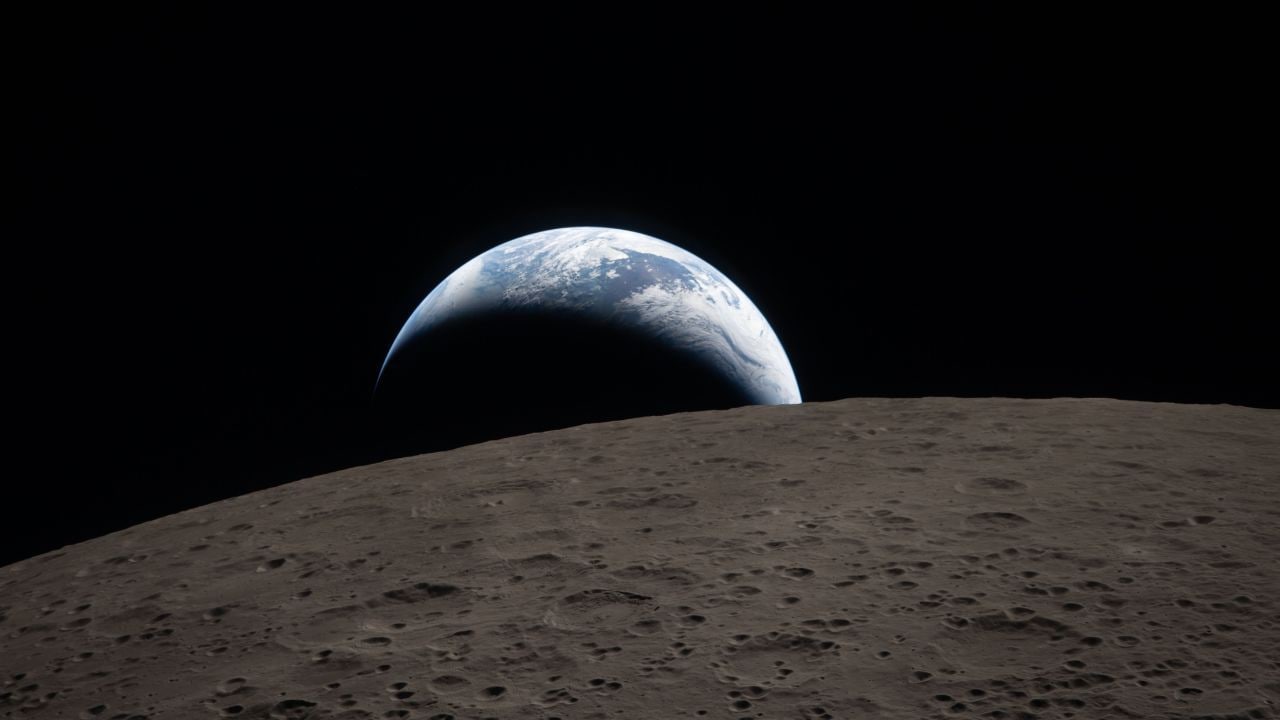
NASA just dropped a collection of images from the Artemis II preparations that make every grainy moon landing photo from the 60s look like a middle school art project. We’re looking at the far side of the moon, the Milky Way, and even a solar eclipse captured with tech that didn't exist five years ago. This isn't just about pretty pictures. It’s about the fact that four humans are about to fly past the lunar horizon for the first time in over half a century.
The Artemis II mission represents a massive shift in how we approach the stars. While the uncrewed Artemis I proved the hardware works, this mission puts hearts and lungs into the Orion spacecraft. NASA's recent photo release serves as a high-definition roadmap of what Reid Wiseman, Victor Glover, Christina Koch, and Jeremy Hansen will actually see through those small windows.
If you think you've seen the moon before, you haven't seen it like this.
The Dark Side Myth and What NASA Actually Found
People love calling it the "dark side" of the moon. It’s a catchy name, but it’s scientifically wrong. It’s the far side. It gets just as much sun as the side we see from Earth, but because the moon is tidally locked to us, that hemisphere remained a total mystery until the Soviet Luna 3 probe snapped some blurry shots in 1959.
The new Artemis II reference photos show a landscape that looks nothing like the "Man in the Moon" face we're used to seeing. The far side is rugged. It’s battered. It lacks the large, smooth basaltic plains—called maria—that define the near side. Instead, it’s a chaotic mess of impact craters.
Why does this matter? The far side acts as a literal shield for Earth. It’s been taking hits from space rocks for billions of years so we don't have to. Seeing these high-resolution details helps geologists understand the early history of our solar system. When the Artemis II crew loops around that hidden face, they’ll be looking at a record of cosmic violence written in dust and stone. It’s lonely out there. It’s quiet. And for a few hours, those four astronauts will be the most isolated humans in history, cut off from all radio contact with Earth by the massive bulk of the moon itself.
Seeing the Milky Way Without Earthly Interference
We spend millions of dollars trying to see the stars through our thick, soup-like atmosphere. Even on a clear night in the desert, the air distorts light. These new NASA shots of the Milky Way captured from deep space perspectives show a clarity that’s honestly intimidating.
Without an atmosphere to twinkle the stars, they don’t shimmer. They’re just piercing, steady points of light against a blackness so deep it feels heavy. The Artemis II mission is using these views to calibrate navigation systems. Orion uses "star trackers"—highly sensitive cameras that recognize star patterns to tell the ship exactly where it is in three-dimensional space.
It’s old-school seafaring navigation meeting 21st-century optics. If the primary computers fail, the crew needs to know they can look at the Milky Way and find their way home. The images released aren't just for wallpapers. They’re proof that our sensors can handle the harsh radiation of deep space without getting fried or blinded by the sun’s glare.
The Most Realistic Solar Eclipse You Will Ever See
Most of us have seen an eclipse from the ground. You wear the goofy glasses, the birds stop chirping, and for a few minutes, it gets chilly. From the perspective of the Artemis II trajectory, an eclipse looks like a cosmic alignment of marbles.
NASA shared views of the moon passing in front of the sun as seen from deep space. It’s different. You see the solar corona—the sun’s outer atmosphere—whipping around the black disk of the moon with a level of detail that looks like CGI. But it’s real. These photos help scientists study the sun’s "space weather," which is a fancy way of saying the radiation that might kill astronauts if we don't plan correctly.
The Artemis II mission will fly a "free-return trajectory." Basically, they’ll use the moon’s gravity like a slingshot to whip them back toward Earth. During that loop, the alignment of the sun, moon, and Orion will create lighting conditions that humans haven't experienced since 1972. Imagine trying to land a spacecraft when the sun is hitting your eyes at an angle that hasn't been studied in decades. These images are the training manual.
Why Artemis II Isn't Just Apollo 2.0
I hear people say we’ve already done this. "We went to the moon in 1969, why are we doing it again?" That’s like saying there’s no point in using a smartphone because you once used a rotary phone.
The Apollo missions were about "flags and footprints." It was a sprint. Artemis is about staying. The Orion capsule is designed to keep humans alive for weeks in deep space, not just a few days. The tech inside is light-years ahead. We’re talking about redundant life support systems, radiation shielding that actually works, and communication arrays that can beam high-definition video across 240,000 miles.
The crew on Artemis II is also much more representative of who we are today. Christina Koch is a veteran of the longest single spaceflight by a woman. Victor Glover is a seasoned Navy captain. This isn't just a test flight; it's a stress test for the Gateway—the space station we plan to put in lunar orbit.
The Hard Truth About Deep Space Radiation
NASA’s rare photos also highlight a terrifying reality: the Van Allen radiation belts. To get these shots of the Milky Way and the far side, the cameras—and eventually the crew—have to pass through zones of intense radiation trapped by Earth's magnetic field.
Most satellites stay below or above these belts. Artemis II goes right through the heart of them. The images show a weird "noise" or graininess in some raw files. That’s not a bad camera. That’s subatomic particles hitting the sensor.
The Orion spacecraft uses a special "storm shelter" area where the crew can hunker down if a solar flare hits. They’ll surround themselves with water tanks and cargo to create a literal wall of mass against the radiation. It’s low-tech protection for a high-tech problem. Seeing these photos reminds us that space isn't just empty. It’s a shooting gallery of invisible particles.
What Happens When the Cameras Turn Toward Earth
The most famous photo in history is "Earthrise." It changed how we saw our planet. Artemis II is going to give us "Earthrise 2.0."
When the crew reaches the far side and starts their swing back home, they’ll see Earth as a tiny, fragile blue marble hanging in a total void. NASA’s preview images of Earth from lunar distances are crisp enough to see individual weather patterns and the deep blues of the Pacific.
It hits different when you realize there are four people behind that lens. In the Artemis I mission, we saw the Earth from the perspective of an empty ship. This time, the emotions will be real. We’ll hear their voices as they see the entire human race through a single window. That’s the "human" part of the Artemis II mission that no robot can replicate.
Preparing for the 10 Day Journey
The Artemis II mission will last about ten days. It’s not a long time, but every second is choreographed.
- Launch: The SLS rocket—the most powerful in the world—blasts them into a high Earth orbit.
- System Checks: They’ll spend the first 24 hours making sure the toilets work and the air is breathable.
- Trans-Lunar Injection: A massive engine burn pushes them toward the moon.
- The Loop: They swing around the far side, snapping those high-res photos and testing deep-space comms.
- The Return: They use gravity to fall back toward Earth, hitting the atmosphere at 25,000 mph.
The photos NASA is sharing now are the "before" shots. They want the public to understand the scale of the landscape before the astronauts get there. They’re building the hype, sure, but they’re also setting the stage for the most dangerous thing humans have done in our lifetime.
The Tech Behind the Lens
You can't just take a Nikon off the shelf and expect it to work in a vacuum at -200 degrees. The cameras used for these photos are specialized pieces of hardware designed to withstand thermal expansion and contraction.
When one side of the camera is in direct sunlight and the other is in the shadow of the spacecraft, the temperature difference can be hundreds of degrees. Ordinary glass would shatter. The sensors would melt. NASA uses custom housings and heat sinks to keep the optics stable.
They also have to deal with "outgassing." In the vacuum of space, materials like glue or plastic can release vapors that fog up lenses. Everything on Artemis II is "baked out" before launch to make sure those rare shots of the Milky Way stay clear.
What You Should Do Now
Stop looking at the blurry reposts on social media. Go to the official NASA Artemis gallery and look at the raw files. Look at the shadows in the craters on the moon’s far side. Notice how the stars in the Milky Way photos don't look like the ones from your backyard.
This mission is scheduled for a late 2025 or early 2026 launch. We are in the final stretch. Pay attention to the "Orion Drop Tests" and the crew's training schedules. This isn't science fiction anymore. It’s happening. If you want to understand the next decade of human history—which includes a permanent base on the moon and a trip to Mars—Artemis II is the starting line.
Keep an eye on the official Artemis social channels for the "Live from Space" broadcasts. When that crew passes behind the moon and the signal goes silent, remember those photos of the cratered far side. That’s where they’ll be. Totally alone. Doing the hardest job in the universe.
Check the NASA SLS launch schedule monthly. Dates shift because of fuel leaks or weather. Don't get caught off guard when the countdown finally hits zero.