The recent release on bail of two men suspected of torching ambulances belonging to a Jewish charity is more than a local police blotter entry. It is a siren. When emergency vehicles designed for life-saving missions are reduced to charred skeletons in the middle of the night, the act transcends simple property damage. It becomes a calculated strike against the foundational sense of safety that a community relies on to function.
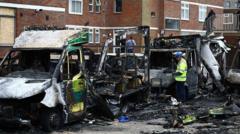
In the early hours of the morning in North London, several vehicles operated by Hatzola—a volunteer emergency medical service serving the Jewish community—were set ablaze. The suspects, aged 21 and 22, were apprehended shortly after the incident but have now been released pending further investigation. While the legal process grinds forward, the community is left to navigate the charred remains of its primary safety net. This is not just about the loss of hardware; it is about the psychological toll of seeing the red and blue lights of an ambulance replaced by the orange glow of a targeted fire.
The Calculated Choice of a Medical Target
Arson is rarely a crime of convenience. It requires intent, preparation, and a specific choice of venue. By targeting Hatzola, the perpetrators chose an organization that sits at the intersection of religious identity and public service. Hatzola is a unique entity in the urban fabric, providing rapid-response medical aid that often beats the municipal services to the scene because their volunteers live and work within the neighborhoods they serve.
When you burn an ambulance, you aren't just destroying a van. You are destroying a mobile intensive care unit. Each vehicle is outfitted with thousands of pounds worth of defibrillators, oxygen delivery systems, and trauma kits. More importantly, you are removing a resource that could be the difference between life and death for someone having a cardiac arrest three streets away. The cruelty of the act lies in its indiscriminate potential for harm. The fire doesn't care who the next patient was going to be.
The release of the suspects on bail has sparked a predictable wave of anxiety. In the eyes of many residents, the legal system's "business as usual" approach feels inadequate compared to the gravity of the crime. However, the reality of the British justice system is that bail is a standard procedure unless there is an immediate, demonstrable risk of flight or further specific harm that cannot be mitigated by conditions. This gap between legal procedure and community perception is where fear grows.
Measuring the Cost Beyond the Insurance Claim
The financial impact of this attack is easy to quantify on a spreadsheet. A fully equipped ambulance can cost upwards of £100,000. Insurance will likely cover the bulk of the physical loss, but it won't cover the "protection gap" created during the weeks or months it takes to source, out-fit, and certify replacement vehicles.
We must also look at the volunteer fatigue. Hatzola operates on the goodwill of people who hold down regular jobs and spend their "off" hours on call. When their tools are targeted, the emotional burden increases. It forces a shift in focus from "How can we save lives?" to "How can we keep our people and equipment safe?"
This shift is expensive. It requires:
- Upgrading physical depots with high-grade security fencing.
- Installing 24-hour thermal imaging and AI-monitored surveillance.
- Hiring private security patrols to guard stationary assets.
- Increased insurance premiums across the entire fleet due to the new risk profile.
These are funds that should be going toward medical training and newer life-saving technology. Instead, they are diverted into bunkers. This is the hidden "tax" on minority communities that face targeted aggression.
The Pattern of Escalation
To view this as an isolated incident of vandalism is a failure of analysis. We are seeing a shift in how communal tensions manifest in the physical world. For years, the focus of security was on "hard targets" like synagogues or schools. These locations have become fortresses, complete with guards and reinforced glass.
Because the hard targets are difficult to hit, the aggression migrates toward "soft targets"—the support infrastructure that exists in the public square. Ambulances are high-visibility symbols of a community's self-reliance. They are parked on residential streets or in open lots. They are vulnerable.
This arson attack follows a global trend where symbols of community resilience are being tested. When you cannot easily reach the people, you attack the things that help the people. It is a strategy of attrition. The goal is to make the cost of existing as a distinct community so high—both financially and emotionally—that the community begins to retract from public life.
The Bail Dilemma and Public Trust
The decision to grant bail to the suspects has been met with sharp criticism from community leaders. From a policing perspective, the investigation is likely focused on digital forensics and forensic chemistry. They need to match accelerants found at the scene to the suspects and trace their movements via CCTV and mobile phone data. This takes time.
However, the optics are disastrous. To the average citizen, it looks like a violent, hate-motivated act is being treated with the same weight as a minor shoplifting offense. Trust in the criminal justice system is fragile, and it is built on the belief that those who pose a threat to the community will be held accountable. When suspects are released back into the wild, it creates a sense of lawlessness that emboldens copycat behavior.
The police have a duty to communicate the status of the investigation without compromising their case. At the moment, the silence feels like a void. The "no further action" or "released under investigation" status are phrases that act as placeholders for a deeper anxiety about the lack of visible justice.
The Long-Term Resilience of Hatzola
Despite the smoke and the sirens, Hatzola has demonstrated a remarkable ability to bounce back. The community support for these organizations is often overwhelming. Donations pour in to replace the vehicles, and new volunteers step forward. This is the paradoxical effect of targeted attacks: they often strengthen the very identity they were intended to undermine.
But resilience is not a blank check. It has a limit. The community should not have to constantly rebuild what should never have been destroyed in the first place. The challenge for the authorities is to move beyond the reactive "investigation and bail" cycle and address the root causes of why someone would see a medical vehicle as a valid target for fire.
The focus must now shift to the prosecution's case. If the evidence is there, the charges must reflect the severity of the act—not just as simple arson, but as a deliberate attempt to cripple a critical community infrastructure. The message sent by the courts will be the final word on whether this attack was an anomaly or a new, dangerous precedent in the targeting of minority institutions.
As we see the two men released on bail, the community is watching the legal process with a mix of skepticism and hope. They are also looking at their own backyards and wondering if their safety can ever truly be guaranteed when the very vehicles that are supposed to save them are vulnerable to the flick of a lighter in the dead of night.