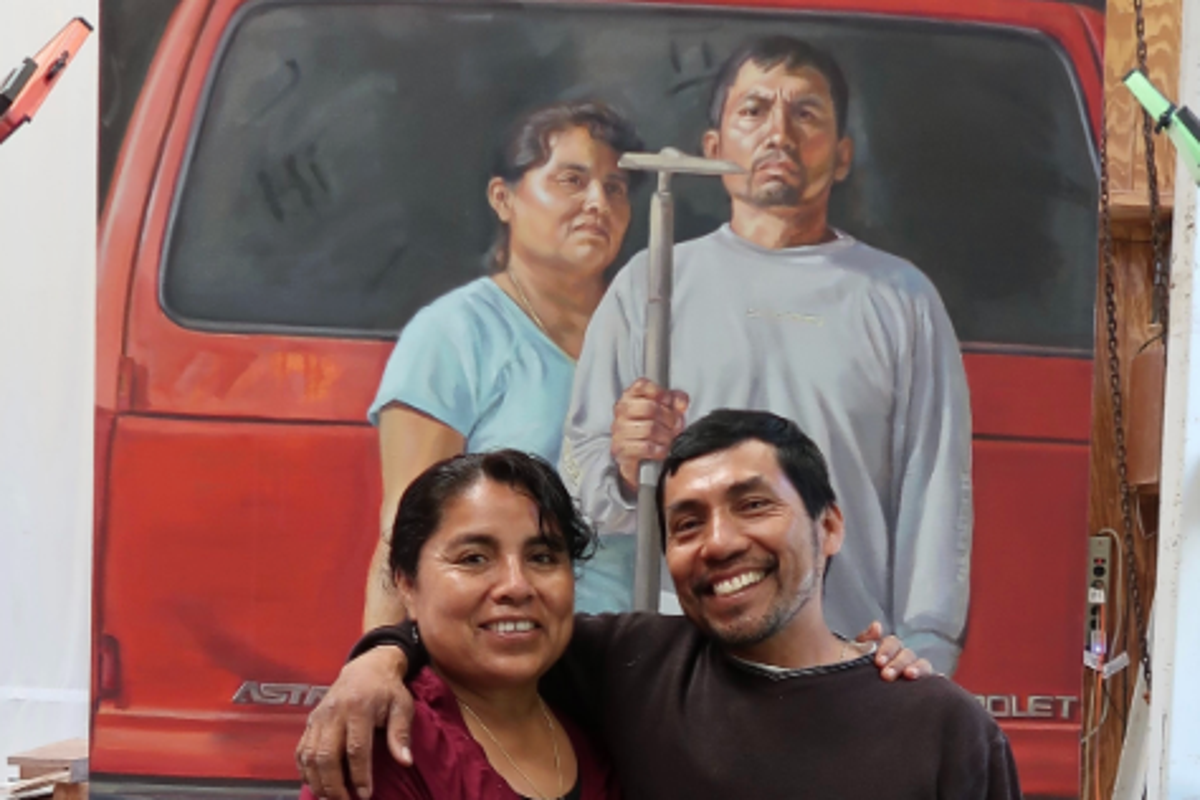
Art usually stays on the wall. It’s meant to be observed, debated, or perhaps ignored in a crowded gallery. But sometimes, the subject of a painting walks out of the frame and into a nightmare. That’s exactly what happened when the migrant father featured in the viral "New American Gothic" painting was arrested by ICE. This isn't just a story about immigration law. It’s a jarring reminder that for many people in this country, visibility is a double-edged sword. You can become a symbol of hope one day and a target for deportation the next.
The painting, a modern riff on Grant Wood’s 1930 classic, replaced the stoic Midwestern farmers with a real-life immigrant family. It was supposed to humanize a group of people often reduced to statistics. Instead, the man in the portrait, known as Rubelsy, found himself in handcuffs. His arrest highlights the massive gap between cultural representation and legal protection. We love the art, but we can't always protect the person who inspired it.
When Visibility Becomes a Liability
We often think that putting a face to a cause helps. In theory, it does. When artist Bryan Chambers painted Rubelsy and his family, the goal was to shift the narrative. The image went everywhere. It was shared across social media and featured in news segments. It became a shorthand for the modern American struggle. But the problem with being the face of a movement is that you’re also the easiest person to find.
ICE doesn't always need a sophisticated tracking system when a person's likeness is plastered across the internet. While there’s no direct evidence that the painting itself led to the arrest, the timing is impossible to ignore. Being "seen" is a privilege when you have papers. When you don’t, being seen is a risk. We have to ask ourselves if the cultural capital gained from these viral moments is worth the very real human cost. Rubelsy wasn't just a model. He was a father, a worker, and a human being who was suddenly thrust into a legal meat grinder.
The artist himself has been vocal about the devastating impact of the arrest. Chambers noted that the family was trying to live a quiet life, contributing to their community while navigating a broken system. Then the spotlight hit. It’s a cruel irony. The very thing meant to advocate for his safety may have contributed to his loss of it.
The Broken Promise of the American Gothic
Grant Wood's original painting was about resilience during the Great Depression. It showed people who were tied to the land, weathered but firm. The "New American Gothic" tried to claim that same space for immigrants. It argued that the people picking our crops, building our homes, and raising families in our neighborhoods are the "true" Americans of today.
But the original couple in Wood's painting didn't have to worry about being snatched from their porch.
Why Sympathy Isn't a Legal Defense
I've seen this play out dozens of times in the legal and activist circles. People get outraged. They sign petitions. They share the artwork. But the immigration court doesn't care about your aesthetic contributions or how many likes your portrait got on Instagram. The system is cold. It’s binary. You’re either "legal" or you’re "removable."
- The Law is Blind to Art: An immigration judge isn't going to grant a stay of removal because a painting of the defendant is in a museum.
- The Burden of Proof: Families like Rubelsy’s have to prove "extreme and unusual hardship," a bar that is notoriously difficult to clear.
- The Power of ICE: Immigration and Customs Enforcement has broad discretionary power, and they often use it to make examples of high-profile individuals.
This arrest proves that the "good immigrant" narrative is a trap. Rubelsy was a "good" immigrant by every societal metric. He was a devoted father. He was a symbol of hard work. He was literally a piece of art. It didn't save him. This tells us that the system isn't looking for "bad hombres." It’s looking for anyone it can catch to fill a quota or send a message.
The Reality of ICE Tactics in 2026
The tactics used by ICE haven't shifted much over the years, despite changes in administration or public sentiment. They rely on surveillance, tips, and sometimes, pure luck. In Rubelsy’s case, reports indicate he was taken into custody during a routine stop or a targeted enforcement action near his home.
This sends a shockwave through the community. When a public figure—even an accidental one—is taken, everyone else retreats into the shadows. That’s the point. It’s called "enforcement through attrition." If you make people scared enough, they might leave on their own. Or, at the very least, they stop showing up at community meetings, stop reporting crimes, and stop being the face of art projects.
What the Artist Wants You to Know
Bryan Chambers hasn't stayed silent. He’s used his platform to raise funds for Rubelsy’s legal defense. This is where art actually becomes useful. The painting didn't protect Rubelsy from the arrest, but the notoriety of the painting might help pay for the lawyers who can get him out. It’s a messy, circular reality.
Chambers has pointed out that the family is terrified. The kids, who are also in the painting, are now dealing with the trauma of seeing their father taken away. This is the part the viral posts don't capture. They don't show the empty chair at dinner or the frantic phone calls to bondsmen. They just show the brushstrokes.
How to Support Families in the Crosshairs
If you're moved by the story of the New American Gothic, don't just share the image. Art is a starting point, not a solution. Real change happens through sustained support and policy shifts that don't rely on whether or not someone is "photogenic" enough to deserve stay of removal.
First, look for local bond funds. These organizations do the heavy lifting of getting people out of detention so they can fight their cases from home. Being in detention makes it statistically much harder to win a case. You can't gather evidence or meet with your lawyer easily when you're behind bars.
Second, understand the "Know Your Rights" basics. Everyone on U.S. soil has certain rights, regardless of their immigration status. You don't have to open your door unless the agents have a warrant signed by a judge. You have the right to remain silent. These aren't just suggestions. They are the only shield many people have.
The arrest of the migrant father from the New American Gothic is a tragedy, but it's not an anomaly. It's the system working exactly how it was designed to work. If we want a different outcome, we have to change the system, not just the paintings on the wall. Support the legal defense fund for Rubelsy’s family. Contact your local representatives to demand an end to targeted enforcement that tears families apart. Stop treating immigrants as symbols and start treating them as neighbors who deserve the same security we claim to value in our art.

:strip_icc()/pic2513216.jpg)