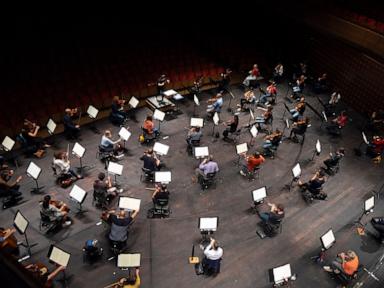
The air inside Davies Symphony Hall before a rehearsal does not feel like music. It feels like physics. It is a heavy, pressurized quiet compounded by the density of eighty-five distinct acoustic instruments and the collective anxiety of the human beings holding them.
To understand what it means for Elim Chan to step onto the podium as the San Francisco Symphony’s first female music director, you must first understand the terrifying intimacy of the conductor’s box. It is a wooden square, barely four feet wide. Stand inside it, and you are entirely exposed. Your back is to thousands of paying strangers. Your face is inches from a wall of professional skeptics who have dedicated their entire lives to mastering an instrument, and who are currently looking at you to tell them how to breathe.
For centuries, that box was treated as a monarchy. The traditional image of the maestro was forged in the image of nineteenth-century European autocracy: stern, silver-haired, unyielding, and invariably male. He ruled by fear, or at least by an unquestioned, inherited authority.
When Chan raises her baton, that entire historical framework evaporates.
The appointment marks a tectonic shift for one of America’s most storied cultural institutions. But the true story isn’t found in the press releases or the board resolutions. It is found in the friction between tradition and survival. Symphony orchestras around the world are staring down an existential crisis, fighting aging audiences and dwindling endowments. San Francisco just bet its future on a conductor who replaces the old architecture of intimidation with something entirely different.
Clarity.
The Anatomy of a Gesture
Consider a hypothetical moment in the middle of Igor Stravinsky’s The Rite of Spring. The time signature is mutating every single bar. The brass section is screaming. The percussionists are swinging wooden mallets with enough force to splinter oak. To an audience member, it feels like a thrilling freefall into chaos.
To the musicians on stage, it is a mathematical minefield. If the horn players misjudge a single syncopated beat by a fraction of a millisecond, the entire performance collapses like a house of cards.
In the old days, a conductor might have glared a musician into submission after such an error. Chan takes a different approach. Watching her rehearse is like watching a master translator work in real-time. Her left hand might be floating, tracing a lyrical line for the violins, while her right wrist delivers sharp, metronomic commands to the timpani. There is no wasted motion. No theatrical thrashing for the sake of the audience's entertainment.
Musicians speak about her eyes. In an orchestra, eye contact is a scarce commodity. Players spend ninety percent of their cognitive energy staring at sheet music or tracking the physical mechanics of their instruments. When they look up at the podium, they need a lifeline, not a performance. Chan tracks them like radar. She catches the eye of the principal oboe a measure before a crucial solo, offering a microscopic nod.
It is an unspoken contract: I see you. I know exactly how difficult this moment is. You are safe to take the risk.
That psychological safety changes the literal sound of the room. When musicians are terrified of making a mistake, they play defensively. They pull back their volume, round off the sharp edges of their notes, and blend into the background. When they trust the podium, they play with a raw, muscular abandon.
From Hong Kong to the Bay
Chan’s trajectory to the top of the classical music world lacks the predictable, linear path of the old guard. Born in Hong Kong, her initial academic pursuits leaned toward the sciences. She wanted to be a doctor. That background in forensic analysis is still visible in her music-making today. She approaches a complex symphonic score not as a sacred, untouchable monument, but as a living mechanism to be dissected, understood, and reassembled.
The turning point came during her time at Smith College, followed by the University of Michigan, where the pull of the podium became undeniable. The wider world took notice in 2014, when she became the first woman to win the prestigious Donatella Flick Conducting Competition.
That victory wasn't just a trophy; it was a passport to the backstage realities of the global orchestral circuit. She guest-conducted from London to Los Angeles, stepping into rehearsal rooms where she was often younger than almost every musician in the strings section.
Walking into a new orchestra as a young guest conductor is a psychological gauntlet. Musicians are notorious for testing newcomers within the first thirty seconds of the downbeat. They will intentionally play a wrong note to see if the conductor notices. They will drag the tempo to test the conductor's nerve.
Chan survived, and then thrived, in those rooms because she refused to play the part of the infallible dictator. She possessed the technical authority to catch the wrong notes, but the emotional intelligence to address them without ego.
When the San Francisco Symphony began its search for a successor to lead them into a highly uncertain post-pandemic landscape, they weren't just looking for someone who could keep time. They were looking for an anchor.
The Weight of the First
We like to celebrate historical milestones with uncomplicated joy. We print the headlines, throw the confetti, and use words like "historic" until they lose meaning.
But being the "first" anything carries an invisible, exhausting tax.
When a male conductor has a bad night, it is an individual failure. The critics write that he was tired, or perhaps his interpretation of Brahms lacked nuance. When the first female music director has a bad night, the subtext changes. The ancient, regressive doubts whisper from the back of the hall. Can a woman truly command the brass section? Does she have the stamina for Mahler?
Chan carries that weight without letting it stiffen her posture. It is a delicate tightrope walk. To acknowledge the glass ceiling is necessary; to let it dictate your art is fatal.
During a recent performance, you could see how she converts that external pressure into kinetic energy. The piece was a contemporary work, full of jagged rhythms and unfamiliar tonal landscapes that could easily alienate a traditional subscription audience. Instead of retreating into academic coldness, Chan leaned into the physical drama of the piece. She used her entire body to sculpt the sound, dropping her shoulders to demand a hushed, terrifying whisper from the cellos, then exploding upward to unleash a torrent of percussion.
The audience wasn't just listening to a piece of modern music. They were watching a human being wrestle a massive, complicated machine into submission and turn it into something beautiful.
The Sound of Tomorrow
The relationship between a music director and an orchestra is closer to a marriage than a business contract. The initial honeymoon phase of guest conducting gives way to the daily, grinding reality of institutional life. Chan is inheriting an organization with a proud history, but one that must adapt to a city that has transformed completely around it.
San Francisco is a city defined by disruption, technology, and rapid reinvention. Its symphony cannot survive as a museum piece mirroring nineteenth-century Vienna. It needs to reflect the restless, forward-looking energy of the Pacific Rim.
Chan represents that bridge. Her programming choices suggest an artist who respects the canon but refuses to be imprisoned by it. She pairs Beethoven with voices that have been silenced or ignored by history. She understands that classical music is not a fragile artifact that will break if touched by modern hands; it is an enduring language capable of expressing contemporary grief, anxiety, and joy.
The true test will not happen under the bright lights of opening night. It will happen on a rainy Tuesday morning in November, three years from now, when the orchestra is exhausted, the repertoire is difficult, and the subscription sales are down.
But watch her in the quiet moments between the movements. When the applause dies down and the stage freezes. She takes a breath. She doesn't look at the hall. She doesn't look at the critics. She looks at the musicians, raises her arms, and invites eighty-five people to step off the cliff with her.
The baton drops. The silence ends. And the music that follows sounds entirely new.