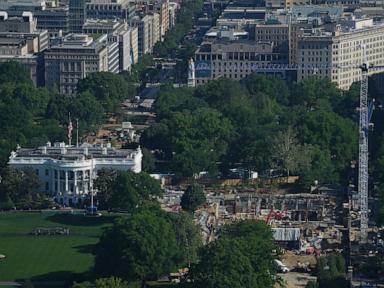
The proposed $1 billion appropriation for "security adjustments and upgrades" at the White House complex represents a 250% increase over the estimated $400 million base construction cost of the East Wing Modernization Project. While public discourse focuses on the optics of a presidential ballroom, a structural analysis of the legislative text and the modern threat environment reveals a shift toward an integrated defense-in-depth model. This funding is not a construction subsidy but a capital investment in three distinct security layers: kinetic hardening, subterranean resilience, and electronic countermeasures.
The Tri-Layer Defense Framework
The legislative language specifically allocates funds to the United States Secret Service (USSS) for enhancements related to the "East Wing Modernization Project." To understand why the security cost is more than double the visible construction cost, the project must be viewed through three primary defensive silos.
1. Kinetic and Ballistic Hardening
Surface-level structures in the new East Wing are subject to "above-ground security features" that exceed standard civilian reinforced construction. This includes:
- Transparent Armor Systems: The integration of multi-layered, polycarbonate-laminated glass capable of resisting sustained fire from high-caliber ballistic rounds and thermal shock.
- Blast Mitigation Geometry: The architectural design uses specific angles to deflect pressure waves from improvised explosive devices (IEDs), a requirement that dictates the external footprint of the ballroom.
- Perimeter Integration: Modernizing the fence line to include active sensors and automated physical barriers that interface directly with the new structure’s access points.
2. Subterranean Strategic Resilience
The "below-ground" component of the funding addresses the expansion of the Presidential Emergency Operations Center (PEOC) and related bunker facilities. The $1 billion figure reflects the extreme costs of deep-earth excavation and life-support systems in a high-density urban environment.
- C4ISR Infrastructure: The underground section serves as a Command, Control, Communications, Computers, Intelligence, Surveillance, and Reconnaissance hub. Hardening these systems against Electromagnetic Pulse (EMP) events is a primary cost driver.
- Medical and Life Support: Unlike standard bunkers, this project includes a self-sustaining medical facility and independent air filtration systems capable of neutralizing biological and chemical agents.
- Structural Load Bearing: Building a 90,000-square-foot facility above existing and new tunnels requires complex geotechnical engineering, where the cost of "securing" the ground itself is substantial.
3. Electronic and Aerial Countermeasures
The incident at the Washington Hilton on April 25 exposed a critical vulnerability in managing large-scale presidential events in unhardened environments. The new project seeks to internalize these events within a "managed spectrum."
- Counter-UAS (Unmanned Aerial Systems): A significant portion of the $1 billion is designated for integrated drone detection and neutralization systems. These utilize Directed Energy (DE) or electronic jamming to create a permanent "no-fly" dome over the East Wing.
- Signal Isolation: The ballroom is designed as a partial Faraday cage, preventing unauthorized signal egress and protecting sensitive communications from external SIGINT (Signals Intelligence) collection.
The Economics of Fixed vs. Variable Protection
The strategic logic behind the $1 billion investment rests on the transition from variable to fixed security costs. Current presidential event protocols rely on "temporary hardening"—the labor-intensive process of securing third-party hotels or convention centers.
The Surge Cost Mechanism
Every external event requires a "security surge" involving hundreds of USSS agents, local law enforcement, and specialized tactical units. These costs are recurring and inflationary. By centralizing high-profile events within the White House perimeter, the USSS moves from a reactive posture (securing an unknown variable) to a proactive posture (utilizing a pre-hardened fixed asset).
The Appropriation Gap
A discrepancy exists between the $400 million private construction budget and the $1 billion public security budget. This 2.5:1 ratio is standard for high-security government installations. In Tier 1 federal facilities, "non-security elements"—the flooring, walls, and aesthetics—are often the least expensive components. The technical "gut" of the building, including redundant power, secure data trunks, and specialized HVAC for CBRN (Chemical, Biological, Radiological, and Nuclear) defense, accounts for the bulk of the capital expenditure.
Legal and Procedural Bottlenecks
The funding is currently tied to a broader budget reconciliation package, a tactical move to bypass the 60-vote filibuster threshold in the Senate. However, this creates a specific set of risks:
- The Byrd Rule Limitation: Provisions in a reconciliation bill must have a direct impact on outlays or revenues. If the Senate Parliamentarian determines the $1 billion is primarily a policy vehicle rather than a budgetary necessity, the funding could be stripped.
- Oversight Conflict: The USSS is the designated recipient, but the funding is linked to a project currently under litigation by the National Trust for Historic Preservation. While Judge Richard Leon’s recent ruling allows national security work to continue, the definition of "security work" versus "construction" remains a point of legal friction.
The strategic play here is a decoupling of the facility from the function. By defining the $1 billion as "Secret Service enhancements" rather than "ballroom construction," the GOP is attempting to insulate the funding from the legal challenges surrounding the East Wing's demolition. The long-term viability of the project depends on whether the USSS can demonstrate that the $1 billion investment yields a measurable reduction in the "risk-to-cost" ratio of presidential protection through 2029 and beyond.
The final strategic move for the administration is the categorization of all "above-ground" ballroom features as integrated defensive components. If the walls are the armor, the distinction between the "ballroom" and the "shield" disappears, effectively neutralizing the legislative prohibition on funding non-security elements.