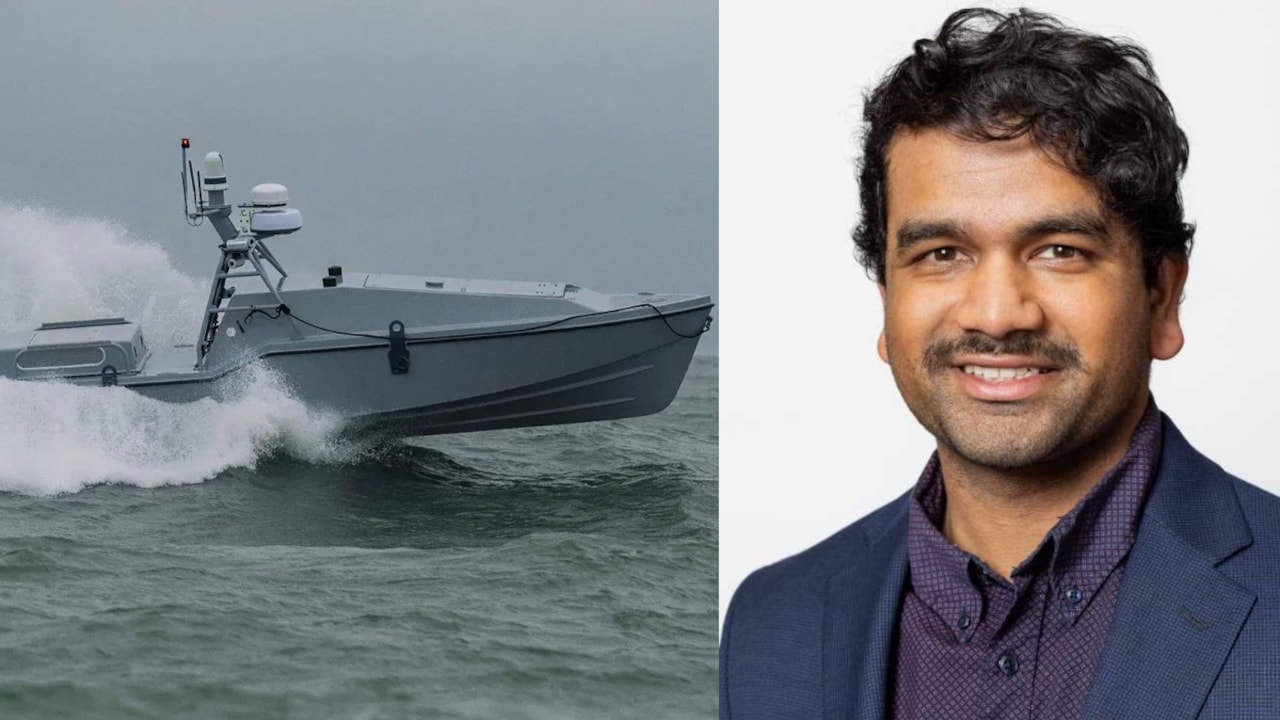
The successful recovery of two downed US Army AH-64 Apache aviators in the Strait of Hormuz by an uncrewed surface vessel (USV) establishes a new operational baseline for maritime Combat Search and Rescue (CSAR). Rather than relying on traditional, high-signature manned assets, US Central Command executed the extraction utilizing a 24-foot Corsair USV, designed by Austin-based Saronic Technologies. This deployment represents the first documented operational personnel recovery performed by an autonomous maritime platform in a contested theater.
Understanding the strategic and technical implications of this mission requires analyzing the engineering principles of autonomous maritime systems, the operational dynamics of Task Force 59, and the shifting cost-benefit curves of force protection in modern littoral warfare.
The Operational Mechanics of the Corsair USV
The execution of a maritime rescue operation within a highly contested choke point like the Strait of Hormuz introduces distinct environmental and tactical variables. To operate effectively under these constraints, a USV must balance endurance, payload capacity, and signature management.
The Platform Performance Profile
The Corsair USV operates within a specific performance envelope that enables rapid deployment and long-range persistence:
- Propulsion and Speed: Powered by a diesel internal combustion engine, the vessel achieves transit speeds up to 35 knots, minimizing the time-to-target window during time-critical recovery windows.
- Range and Endurance: The platform possess a maximum operational range exceeding 1,000 nautical miles, allowing for extended loitering in contested zones without requiring frequent refueling or tender support.
- Payload Constraints: With a net payload capacity of 1,000 pounds, the hull is optimized for modular configurations, accommodating passive sensor suites, medical extraction gear, or localized defense systems.
The Sensor Architecture
Locating two isolated personnel in open water at 3:30 AM local time requires an integrated approach to data acquisition and processing. The Corsair relies on a 360-degree passive sensing payload designed to operate without radiating active signals that could reveal its position to electronic warfare units.
The sensor stack uses a combination of long-wave infrared (LWIR) cameras and electro-optical arrays to distinguish the thermal signatures of personnel from background marine clutter. The onboard software architecture—overséen by Saronic Chief Technology Officer Vibhav Altekar—processes these feeds locally via edge-computing hardware. By implementing localized computer vision algorithms, the platform can identify, classify, and track human targets in real-time before establishing a telemetry link back to human operators.
The Logistics of the Rescue Chain
The recovery off the coast of Oman was not an isolated robotic action but a multi-tiered operation involving autonomous, manned, and airborne elements. The extraction sequence reveals how autonomous surface vessels integrate into existing joint force command structures.
The Search and Recovery Sequence
The timeline of the rescue spanned approximately two hours from the initial downing of the Apache helicopter to the secure containment of the crew.
[AH-64 Downing] ──> [Task Force 59 Command] ──> [Corsair USV Dispatched]
                                                       │
                                                       ▼
[Manned Helicopter Hoist] <── [Extraction Site] <── [Passive Detection]
- Detection and Vectoring: Upon the loss of the AH-64 Apache, regional command networks localized the emergency beacon data. The US Navy’s Task Force 59 routed a forward-deployed Corsair USV—fielded in-theater since late March—to the last known coordinates.
- Autonomous Navigation and Human-in-the-Loop Control: The vessel navigated the initial transit leg via semi-autonomous waypoint routing. Once within the localized search grid, a remote human operator took command via real-time remote command-and-control interfaces to manage the precise approach to the aviators.
- Physical Extraction and Transit: The low freeboard of a 24-foot USV reduces the physical barrier for personnel climbing out of the water compared to high-sided traditional naval combatants. Once the aviators were secured aboard the hull, the Corsair transited away from the immediate hazard zone to a secondary rendezvous location.
- The Manned-Unmanned Teaming (MUM-T) Handshake: To minimize the exposure of high-value assets, an 82nd Airborne Division or naval helicopter performed a standard hoist operation from the moving or stationary USV deck at the secondary location, completing the final leg of medical evacuation to shore facilities.
The Strategic Shift in Force Protection Economics
The utilization of a USV for personnel recovery alters the tactical math for commanders operating in anti-access/area-denial (A2/AD) environments. Traditional CSAR operations are notoriously asset-intensive, often requiring a package of dedicated rescue helicopters, attack escort aircraft, and airborne command posts.
Flipping the Cost Curve
In a theater where asymmetrical threats like one-way attack drones and anti-ship missiles are prevalent, risking a $30 million manned helicopter and its crew to save another downed crew introduces severe operational risk. The Corsair represents a significantly lower capital risk. Supported by Saronic’s $392 million production contract with the US Navy, these platforms allow the military to scale its presence without a linear increase in personnel exposure.
The primary systemic vulnerability shifted by this mission is the Search-to-Risk Ratio. By substituting an uncrewed hull for a manned rescue boat or helicopter during the initial, high-risk detection phase, the joint force limits its human exposure to the final, rapid hoist phase of the operation.
Systemic Limitations of Autonomous CSAR
While the mission validates the core concept of autonomous maritime recovery, the framework possesses inherent limitations that prevent it from completely replacing manned assets:
- Medical Intervention Deficit: A USV lacks onboard medical personnel. While it provides an immediate physical platform out of the water, it cannot administer life-support measures to critically injured personnel during transit.
- Environmental Degradation: Small, 24-foot surface vessels face severe operational degradation in high sea states. While a hull of this size can operate efficiently in light to moderate littoral chops, its extraction capabilities diminish significantly in Sea State 4 or higher.
- Securing Unconscious Personnel: Current USV designs require rescued personnel to actively participate in their own recovery, such as climbing a ladder or pulling themselves onto a low-profile deck. For unconscious or severely incapacitated crews, an autonomous platform without robotic articulation or human divers remains incapable of executing physical recovery.
Structural Integration and Force Design
The deployment of the Corsair by Task Force 59 aligns with the broader institutional objectives of the Pentagon’s Replicator initiative, which emphasizes the rapid scaling of low-cost, expendable autonomous systems.
The technical legacy behind this deployment stems from a highly specialized engineering pipeline. The development of the software architecture governing the Corsair reflects principles refined on previous defense programs, including the Royal Australian Navy’s Ghost Shark autonomous submarine project. The transition of engineering talent from early-stage defense tech firms like Anduril to hardware-focused startups like Saronic underscores a broader industrial migration toward modular, software-defined military hardware.
The long-term operational framework dictating the use of these vessels relies on a distributed basing model. Rather than deploying large, centralized fleets from major naval bases, smaller autonomous craft are integrated directly into routine patrols and blockades—such as those currently monitoring oil shipments and enforcement zones in the region. This guarantees that sensor nodes and extraction platforms are already distributed inside the weapon engagement zone prior to a kinetic event.
The primary strategic directive going forward requires addressing the communication dependencies of these platforms. When operating under heavy electronic warfare conditions, reliance on satellite telemetry for remote piloting introduces a severe single point of failure. Future variants must achieve full autonomy during the extraction phase, utilizing advanced localized machine learning models to detect, approach, and secure personnel without requiring an active network uplink. Commanders preparing for high-intensity littoral conflicts must integrate low-profile USVs directly into their strike packages, treating autonomous recovery assets not as emergency add-ons, but as core components of the initial strike configuration.