Imagine finding the oldest piece of human art in your country, only to have the entire scientific community pat you on the head, call it a natural fluke, and ignore it for a century.
That's exactly what happened in South Wales.
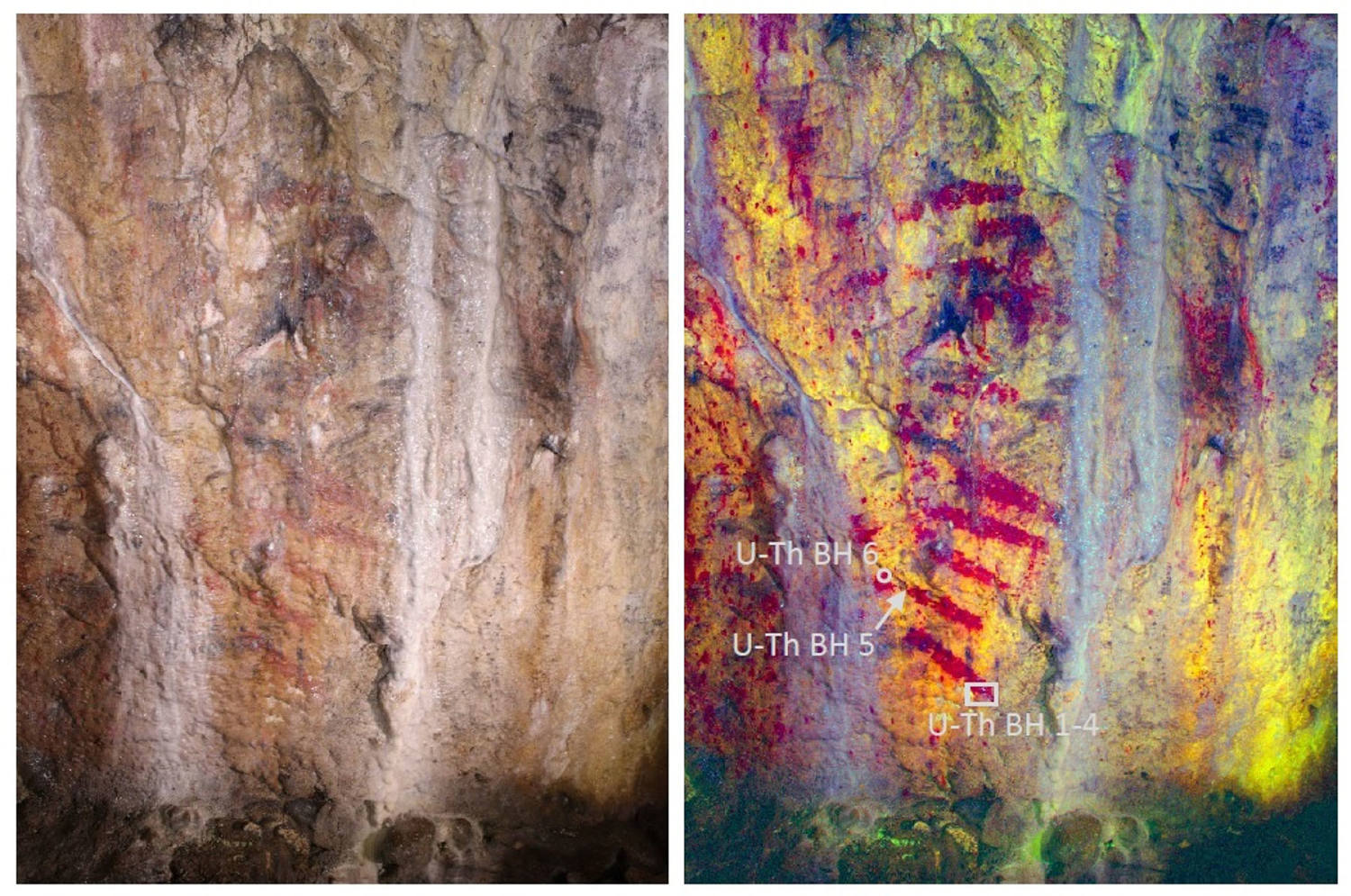
Back in 1912, two professors found a series of horizontal red bands on a limestone wall inside Bacon Hole, a cave nestled in the Gower Peninsula. They claimed it was ancient cave art. By 1928, the mainstream scientific community shut them down. Critics claimed the red streaks were just natural iron oxide seeping through the stone. Newspapers even printed retractions.
They were wrong. Dead wrong.
New scientific analysis just proved that those dismissed red lines are actually 17,100 years old. It isn't a natural stain; it's a deliberate, human-made painting. This officially crowns the Bacon Hole stripes as the oldest rock art in the British Isles and northwestern Europe.
The 100-Year Skepticism Trap
When Professor William Sollas and the French archaeologist Abbé Henri Breuil first laid eyes on the red panel in 1912, they knew they had something special. They announced it as the first Paleolithic cave painting discovered in the UK.
Then the skepticism rolled in.
Critics pointed out that a local fisherman had painted graffiti on the other side of the cave chamber in 1894. Others insisted the geology of the Gower Peninsula made natural mineral bleeding incredibly common. By 1928, the consensus shifted entirely against the discovery. The cave art theory was buried.
The real problem wasn't a lack of imagination; it was a lack of technology. In the 1920s, scientists simply didn't have the tools to analyze microscopic pigment structures or date stone surfaces accurately. Instead of admitting they couldn't prove it either way, they defaulted to the most boring explanation possible: it's just a wet rock.
Cracking the 17,000-Year-Old Paint Recipe
An international research team led by Dr. George Nash, a specialist in prehistoric art, went back into Bacon Hole with modern gear. They used uranium-thorium dating on the layers of calcite that had slowly formed over the red pigment.
Because the calcite grew on top of the paint, dating that mineral layer gives us a rock-solid minimum age. The results came back at 17,100 years before present.
The team also ran a full archaeometric analysis on the red streaks. If the lines were just mineral seepage, the composition would perfectly match the natural bleeding of the surrounding limestone. It didn't.
Instead, the laboratory tests revealed a highly specific "pigment recipe." The red bands are made of applied hematite mixed with a precise combination of calcite and clay residues. The lines are totally horizontal, perfectly equidistant, and were clearly applied using human fingers. Nature doesn't paint geometric lines with a recipe.
Surviving the Ice Age in Wales
To understand why this matters, you have to look at what Wales looked like 17,100 years ago. The region was just beginning to crawl out of the Devensian glaciation—a brutal, freezing phase of the last Ice Age.
The environment wasn't a lush forest. It was a bleak, treeless, periglacial tundra with sparse vegetation. It was a harsh, unforgiving place to stay alive. Yet, even in those brutal conditions, humans crawled into a coastal cave overlooking what is now the Bristol Channel to leave a permanent mark.
The Bacon Hole discovery shatters the old timeline for British rock art. Before this realization, the title of the UK's oldest art belonged to an engraved reindeer found in nearby Cathole Cave, which dates back to around 14,500 years ago. These red stripes push the human artistic timeline back by nearly three millennia.
The Fight to Protect the Cave
Right now, Bacon Hole sits in an Area of Outstanding Natural Beauty, and it's under the watchful eye of the National Trust of Wales. But surprisingly, it isn't listed as an officially protected "scheduled monument."
Because the cave is accessible and has a history of modern graffiti, protecting this panel is incredibly urgent. The research team is already pushing for formal protected status, and a steel grille has been installed across the entrance of the side chamber to keep the 17,100-year-old finger paintings safe from modern hands.
If you want to track this discovery as more data drops, keep an eye on the official announcements coming from the National Trust of Wales. The full academic breakdown of the pigment analysis is also accessible through the First Art project archives and recent listings in the MDPI geosciences journals, which lay out the exact chemical footprint separating this ancient human masterpiece from the surrounding rock.