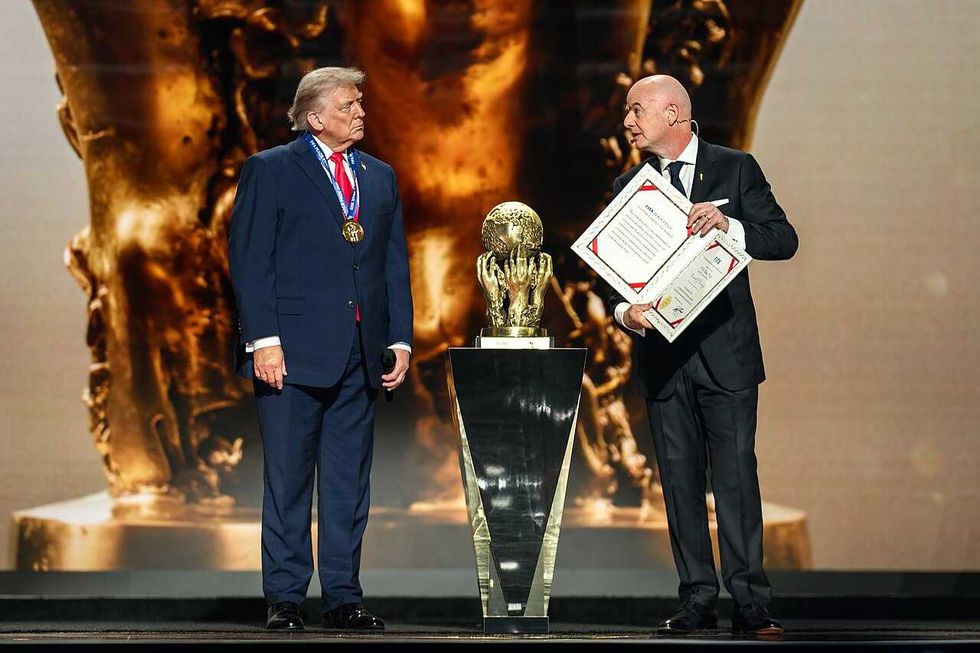
The convergence of global sports governance and sovereign executive power operates not on shared ideology, but on a precise matrix of resource exchange. The establishment of the inaugural FIFA Peace Prize and its immediate conferral upon US President Donald Trump during the December 2025 World Cup draw in Washington, DC, offers a clean case study in this dynamic. While external commentators label the event a farce or an embarrassment, structural analysis reveals a highly calculated, transactional mechanism. This transaction trades institutional insulation for political validation, securing the operational environment for the multi-billion-dollar 2026 World Cup.
Understanding this phenomenon requires moving past superficial critiques of hypocrisy to map the underlying value exchange between two distinct entities: a transnational sports monopoly seeking regulatory immunity and an executive administration prioritizing public validation and regional hegemony.
The Operational Matrix of the Sports-Sovereign Exchange
The relationship between a global sports governing body and a superpower host nation can be broken down into three operational pillars. Each pillar represents a critical dependency where the sports entity requires sovereign intervention to protect its revenue streams.
+------------------------------------------------------------+
|             THE SPORTS-SOVEREIGN EXCHANGE MATRIX           |
+------------------------------------------------------------+
|  1. Regulatory and Legal Insulation                       |
|     - Protection against domestic antitrust and tax laws  |
|     - Prevention of cross-border corruption probes         |
+------------------------------------------------------------+
|  2. Logistical and Infrastructural Underwriting            |
|     - Sovereign-backed visa exemptions and entry fast-tracks|
|     - Publicly funded security and stadium infrastructure  |
+------------------------------------------------------------+
|  3. Commercial Freedom and Revenue Extraction              |
|     - Uncapped corporate hospitality pricing models        |
|     - Elimination of local municipal tax liabilities        |
+------------------------------------------------------------+
1. Regulatory and Legal Insulation
Global sports organizations operate outside traditional corporate frameworks, relying on Swiss associative status to maintain low regulatory compliance. However, when entering the legal jurisdiction of the United States, these organizations face immediate exposure to Department of Justice scrutiny, antitrust laws, and financial transparency mandates. By presenting an executive-level honor to the head of state, the organization constructs a psychological and political barrier against aggressive federal oversight. The prize functions as a preemptive diplomatic shield, designed to minimize the probability of aggressive regulatory interference during a critical revenue cycle.
2. Logistical and Infrastructural Underwriting
The execution of a 48-team tournament across three sprawling North American nations requires unprecedented sovereign cooperation. The United States government commands absolute control over the physical execution of this tournament through border control, visa issuance, and federal security coordination. The creation of the White House Task Force for the World Cup is not a passive bureaucratic gesture; it is a critical operational requirement. Offering a high-profile accolade ensures that the executive branch remains incentivized to streamline immigration bottlenecks, waive standard visa restrictions for controversial delegations, and deploy federal security assets without friction.
3. Commercial Freedom and Revenue Extraction
The primary financial objective of the tournament is the maximization of matchday and corporate hospitality revenue. In the high-cost US market, this involves implementing hyper-aggressive pricing strategies, including uncapped corporate hospitality packages and premium tier ticketing. To extract maximum value, the organization requires local municipal authorities and federal bodies to waive standard entertainment and hospitality taxes. Cultivating a direct, transactional friendship with the chief executive establishes a top-down political pressure framework, signaling to lower-level regulators that the event carries absolute state protection.
The Strategic Asymmetry of the Value Exchange
The transaction between FIFA President Gianni Infantino and President Trump operates via an asymmetric value function where both parties exchange low-cost internal resources for high-value external assets.
       [FIFA]                                          [US EXECUTIVE]
   (Low Internal Cost)                             (Low Internal Cost)
  Inaugural Peace Prize --------------------------> Political Endorsement
        |                                                 |
        v                                                 v
  Secures:                                         Secures:
  - White House Task Force Deployment              - Validation of Global Status
  - Federal Border Expeditions                     - Rejection of Traditional Elite
  - Regulatory Shielding                           - Domestic Populist Rhetoric
   (High External Value)                            (High External Value)
The cost of producing a gold-plated physical trophy and inventing a new internal designation is statistically zero for a global sports apparatus. The return on this investment, however, is massive: a public, recorded commitment from the world’s most powerful executive to support the organization's business goals.
Conversely, for the US President, the cost of appearing at the Kennedy Center to receive an award and delivering a short speech is negligible. The return is a massive injection of ego validation and symbolic leverage. Having faced historical exclusion from traditional legacy honors like the Nobel Peace Prize, the executive eagerly adopts alternative validation mechanisms that mimic the aesthetics of global prestige. The physical act of the president placing the medal around his own neck during the ceremony highlights the direct, unmediated consumption of this symbolic capital.
Governance Degradation and Internal Friction
The primary risk factor in this transactional strategy is the systemic internal friction it generates within the sports organization's own governance structure. By bypassing traditional institutional channels to deliver a political asset, leadership creates a structural vulnerability.
Institutional Neutrality Violation
The foundational statutes of international sports federations explicitly mandate political neutrality. This neutrality is not a moral position; it is a structural necessity that allows the organization to operate across conflicting geopolitical regimes simultaneously. When the leadership unilaterally creates and awards a peace prize to a sitting political figure, the core fiction of neutrality dissolves. This action transforms the organization from an independent global cartel into an explicit instrument of specific sovereign agendas.
The Breakdown of the Council Process
According to internal governance frameworks, the introduction of a new global honor or strategic initiative must originate from, or be ratified by, the governing Council. The unilateral introduction of the award by the president represents a centralization of authority that bypasses internal checks and balances. This creates an institutional bottleneck, concentrating all geopolitical risk within a single executive relationship.
The consequences of this concentration became clear following the award's conferral. In the weeks after the December draw, the US administration executed aggressive regional policy maneuvers, including unilateral military strikes in maritime corridors and escalated rhetoric regarding territorial acquisition, such as threats regarding Greenland.
This rapid shift in the geopolitical environment exposed the organization to immediate institutional blowback. Mid-level and senior officials within the organization expressed deep internal embarrassment, recognizing that their brand equity had been directly tethered to an unpredictable state actor. Furthermore, member associations, led by the Norwegian Football Federation, initiated formal complaints to the Ethics Committee, alleging explicit violations of the organizational code of ethics regarding political neutrality.
The Inevitability of Brand Devaluation
The long-term limitation of creating a bespoke accolade for immediate political utility is the permanent destruction of the asset's credibility. An honor’s value is derived entirely from its historical scarcity and the perceived independence of its selection committee.
By tying the inaugural award to a highly polarizing political figure under active geopolitical scrutiny, the organization guaranteed the immediate depreciation of the prize's future utility. No legitimate international diplomat, humanitarian, or state leader can accept the award in subsequent years without implicitly validating the initial criteria and context of its creation. The award is dead on arrival as a legitimate instrument of global soft power. It can now only function as a repeating transaction—a recurring token used to placate or bribe future authoritarian or populist hosts of subsequent tournaments.
Tactical Framework for Cross-Border Operations
For corporate strategists and institutional leaders operating at the intersection of global commerce and volatile state politics, this episode provides a clear blueprint for managing host-country relations under populist regimes.
- Map the Decision-Maker’s True Currency: Do not attempt to buy cooperation with financial instruments or standard corporate concessions when dealing with narcissistic or populist state leaders. Identify the symbolic deficit they are actively trying to fill (e.g., global validation, legacy recognition, elite status) and construct low-cost symbolic assets that directly address that deficit.
- Buffer Internal Governance Prior to Execution: When executing a highly political corporate transaction, leadership must insulate its internal staff from the initial blast radius. Centralize the political relationship entirely within the office of the CEO or President, allowing mid-level operations and core product teams to claim plausible deniability and maintain focus on technical execution.
- Priced-In Brand Depreciation: Accept that certain geopolitical maneuvers will cause measurable damage to institutional brand equity among progressive Western demographics. Treat this degradation as a calculable cost of doing business. Weigh the short-term loss of prestige against the hard financial guarantees of state-backed infrastructure, tax exemptions, and logistical security.
- Establish Decentralized Multi-Jurisdiction Backups: To mitigate the risk of host-country volatility or sudden international boycotts, ensure that tournament infrastructure or operational footprints are partially decentralized. Splitting hosting duties across neighboring nations—such as Mexico and Canada—provides an operational pressure valve, allowing elements of the event to shift geographically if the primary host nation experiences an unmanageable political or military escalation.