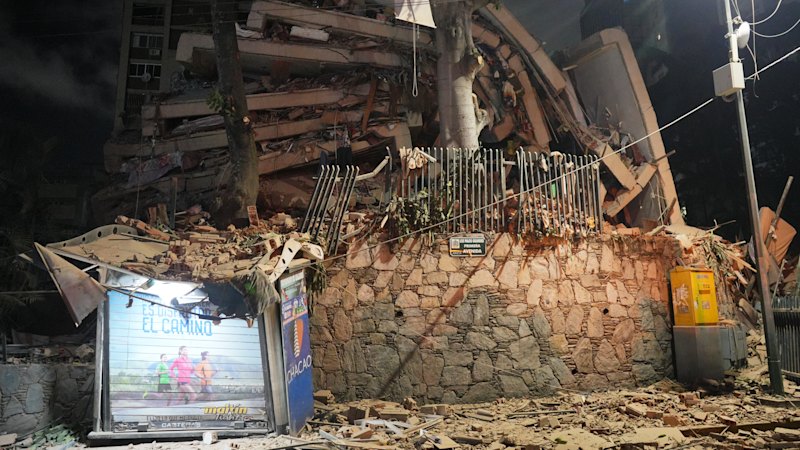
A devastating seismic doublet struck north-central Venezuela on June 24, 2026, exposing structural vulnerabilities in the country’s metropolitan infrastructure and emergency response capabilities. Within a span of 39 seconds, two massive strike-slip earthquakes registered at magnitudes of $M_w 7.2$ and $M_w 7.5$. The epicenters were concentrated in the Veroes municipality of Yaracuy State, along the highly active plate boundary system where the Caribbean Plate slides past the South American Plate.
The immediate result was catastrophic structural failure across several states, with the highest concentration of high-rise collapses occurring approximately 280 kilometers away in the capital city of Caracas. While preliminary government reports confirmed 32 fatalities and over 700 hospitalizations outside the hard-hit La Guaira disaster zone, predictive models from the United States Geological Survey (USGS) PAGER system estimate a 37% to 41% probability that the final death toll will stabilize between 10,000 and 100,000 individuals.
The Mechanics of a Seismic Doublet
The severe destruction observed across Venezuela cannot be understood purely through the lens of a single earthquake. The June 24 event was a true seismic doublet—a rare phenomenon where two earthquakes of comparable magnitude occur in close spatial and temporal proximity.
The first event, classified as an $M_w 7.2$ foreshock, occurred at 18:04 local time at a depth of approximately 20 kilometers. This initial rupture altered the localized stress field along the fault zone. Instead of relieving total systemic tension, the displacement transferred immense stress to an adjacent segment of the fault. Exactly 39 seconds later, this trigger mechanism culminated in a larger $M_w 7.5$ mainshock at a much shallower depth of 10 kilometers.
Because both ruptures occurred along a major strike-slip fault system, the ground motion was primarily horizontal. The shallow depth of the second, more powerful shock meant that the seismic energy had minimal distance to dissipate before reaching the surface. This resulted in exceptionally high peak ground acceleration (PGA), compounding the structural stress already initiated by the foreshock less than a minute prior.
The Amplification Bottleneck in Caracas
Geographic distance typically acts as a natural dampener for seismic waves. However, Caracas suffered disproportionate structural damage despite being nearly 300 kilometers from the epicenters in Yaracuy. This severe localized destruction is explained by two primary variables: basin amplification and structural resonance.
Deep Sedimentary Basin Amplification
The capital city of Caracas is situated directly inside a deep, soft-soil sedimentary basin surrounded by mountainous terrain. When high-frequency seismic waves transition from hard bedrock into the loose, saturated sediments of a basin, their velocity decreases sharply. Due to the conservation of energy, this deceleration forces a massive increase in wave amplitude. The basin acts essentially as a physical amplifier, trapping the seismic energy and causing the ground to shake with significantly greater intensity and duration than the surrounding bedrock areas.
The Holiday Exposure Variable
The timing of the doublet intersected directly with a national holiday commemorating the 1821 Battle of Carabobo. This created a specific socioeconomic exposure profile:
- High-Density Residential Occupancy: Because offices and schools were closed, a vast majority of the urban population was concentrated inside multi-story residential concrete structures rather than commercial or industrial facilities.
- Vertical Evacuation Failures: In high-density districts like Altamira and Los Palos Grandes, residents attempting to escape down stairwells during the 39-second window between the foreshock and mainshock were caught mid-evacuation when structural columns completely failed.
Architectural Vulnerability and Progressive Collapse
The structural failure of prominent buildings in Caracas—including a 22-story high-rise in Altamira—highlights systemic engineering deficits. The destruction followed a predictable sequence of progressive collapse, driven by decades of deferred maintenance and unregulated construction practices.
[Shallow Mw 7.5 Mainshock]
          │
          ▼
[Horizontal Shear Stress on Unreinforced Masonry]
          │
          ▼
[Brittle Shear Failure in Concrete Columns]
          │
          ▼
[Loss of Axial Load-Bearing Capacity]
          │
          ▼
[Progressive Pancake Collapse of Floor Slabs]
The underlying vulnerability functions across Venezuelan urban centers can be divided into distinct engineering issues:
Soft-Story Vulnerability
Many of the multi-story residential buildings featuring open-ground parking spaces or large commercial windows on the first floor suffered classic "soft-story" failures. These structures lack adequate lateral bracing at the ground level. Under intense horizontal shear stress, the flexible ground floor deforms excessively, causing the rigid upper floors to collapse straight down onto the foundation.
Lack of Ductility in Aged Reinforced Concrete
Buildings constructed prior to modern seismic codes lack the tight steel stirrup spacing required to give concrete columns ductility. Without sufficient confinement steel, columns subjected to cyclic shaking experience rapid, brittle shearing. Once the concrete core crushes, the vertical load-bearing capacity drops to zero, triggering instantaneous "pancake" collapses where floor slabs stack directly on top of one another.
Critical Infrastructure Failure and Operational Realities
The primary economic and humanitarian bottleneck in the hours following the doublet was the immediate, simultaneous failure of critical lifelines. This systemic shutdown severely degraded local search and rescue capacity.
Transportation Interdiction
Simón Bolívar International Airport in Maiquetía, the nation’s primary international aviation gateway, sustained severe structural damage and was immediately closed to all commercial and emergency traffic. Land transit faced parallel bottlenecks: collapsed overpasses, deep cracks in highways, and heavy debris field accumulation blocked primary routes between the coastal disaster zones in La Guaira and the medical hubs in Caracas.
Power and Telecommunications Blackouts
The shaking triggered automatic protection trips and physical damage across the regional electrical grid, causing widespread blackouts. The loss of primary electrical power caused a cascading failure across the telecommunications infrastructure. Cell towers, lacking sufficient prolonged backup battery power, went offline within hours, crippling emergency telemetry, disrupting coordination between rescue units, and generating a severe regional information vacuum.
Resource Constraints and International Dependency
Acting President Delcy Rodríguez declared a nationwide state of emergency across seven states. While neighboring entities like the Colombian Red Cross mobilized regional search and rescue teams, the operational efficacy of these deployments depends entirely on the logistically damaged domestic infrastructure. Emergency crews are currently forced to operate under severe asset constraints, clearing heavy reinforced concrete rubble using minimal heavy machinery while managing intermittent municipal water and power supplies.
The Strategic Path Toward Seismic Resilience
The long-term recovery and stabilizing strategy for Venezuela's urban centers requires moving away from reactive emergency management and transitioning toward a quantified risk-reduction framework.
- Mandatory Basin-Specific Building Code Revisions: Future construction frameworks must legally enforce strict seismic engineering guidelines that specifically account for the low-frequency wave amplification inherent to the Caracas sedimentary basin.
- Systemic Retofitting of Soft-Story Structures: Structural engineers must prioritize adding exterior structural steel bracing or concrete shear walls to existing high-rise residential buildings that exhibit soft-story characteristics.
- Decentralization of Emergency Lifelines: Critical communication nodes, backup power arrays, and emergency medical storage must be physically decentralized across municipalities to prevent single-point-of-failure network collapses during future aftershock sequences.