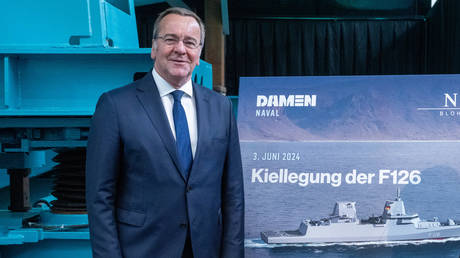
The cancellation of Germany’s F126 frigate program represents a fundamental case study in structural procurement failure. Initiated during Ursula von der Leyen’s tenure as Defense Minister and finalized under Boris Pistorius, the €10 billion project to construct six 10,500-tonne multi-purpose surface combatants was intended to anchor the German Navy’s blue-water capabilities. Instead, the German Ministry of Defense halted the program after €2.3 billion in sunk costs, projecting that continuation would drive total expenditures past €18 billion.
Analyzing this decision requires looking past the political optics to evaluate the systemic friction points that doomed the F126: structural misalignment in prime contractor handoffs, cascading software integration delays, and the changing tactical demands of Baltic and North Sea security. This breakdown outlines the operational mechanisms behind the project’s collapse and the economic realities driving Germany’s strategic pivot to Thyssenkrupp Marine Systems’ (TKMS) smaller MEKO A-200 platform.
The Economics of a Sunk Cost Threshold
The financial trajectory of the F126 program highlights a classic defense procurement dilemma: the point where projected cost growth outpaces the marginal utility of a bespoke platform. The baseline contract was awarded in 2020 to Dutch shipbuilder Damen Naval to build four vessels, later expanded to six. By mid-2026, the program encountered a mathematical bottleneck.
F126 Financial Trajectory:
[Initial Target: €10B] ---> [Sunk Capital: €2.3B] ---> [Rheinmetall/NVL Estimate: €15.2B] ---> [Projected Final Cost: €18B+]
The €2.3 billion already spent covered basic design work, initial construction phases, software architecture framing, and initial contractor outlays. When severe scheduling friction developed between Damen Naval and Germany’s Federal Office of Bundeswehr Equipment, Information Technology and In-Service Support (BAAINBw), Berlin attempted to restructure the program. The lead contractor role was slated to transfer to German defense conglomerate Rheinmetall via its newly acquired Naval Vessels Lürssen (NVL) shipyard division.
Rheinmetall's audit of the inherited architecture produced an updated delivery quote of roughly €15.2 billion for the remaining work. Coupled with existing outlays and integration contingency funds, the total program cost ballooned to €18 billion—an 80% premium over the initial baseline. The defense ministry determined that the marginal cost of continuing the F126 path exceeded the procurement cost of a completely restructured fleet.
Three Drivers of Structural Failure
The collapse of the F126 was not caused by a single point of failure. It was driven by three distinct, compounding operational issues.
1. The Integration Premium and Scale Mismatch
The F126 design was an anomaly: a 166-meter frigate displacing 10,500 tonnes, making it larger than many modern guided-missile destroyers. Scaling a hull to this size while maintaining a frigate design creates severe engineering friction. Large hulls require complex mechanical systems, elongated cabling runs, and massive power generation grids.
When a shipyard scales a platform to this degree, the complexity of the internal systems grows exponentially rather than linearly. This scale mismatch created a structural deficit that the engineering teams could not resolve within the original budget.
2. Software Architecture and BAAINBw Bureaucracy
The primary engine of delay was the ship's combat management system and command-and-control software. Modern naval vessels function as floating datacenters; the F126 was designed with an open architecture to integrate anti-submarine warfare (ASW) suites, air defense systems, and modular mission components.
Friction developed because BAAINBw’s rigid compliance specifications clashed with Damen’s commercial systems engineering standards. Every software modification required a lengthy approvals loop, freezing construction schedules. Because naval assembly requires physical systems to be laid down concurrently with their digital frameworks, software delays stalled the physical build at the yards, generating significant daily overhead costs.
3. Contractual Handoff Shock
Attempting to salvage the project by shifting the primary contractor role from Damen to Rheinmetall/NVL introduced extreme risk. In complex defense manufacturing, a change in prime contractor requires a complete transfer of intellectual property, design liabilities, and supply-chain guarantees.
Rheinmetall priced this risk directly into its €15.2 billion bid. The company had to account for latent defects or design gaps in the work finished by Damen. This risk premium made the transfer economically unviable for the German government.
The Strategic Alternative: Rapid Fleet Optimization
To address the capabilities gap left by the F126, Defense Minister Boris Pistorius executed a structural pivot, reallocating capital to Thyssenkrupp Marine Systems (TKMS). Berlin expanded an existing framework to purchase a total of eight MEKO A-200 frigates.
| Metric | Scrapped F126 Class | Replacement MEKO A-200 Class |
|---|---|---|
| Planned Fleet Count | 6 Ships | 8 Ships |
| Displacement | ~10,500 tonnes | ~4,200 tonnes |
| Length | 166 meters | 121 meters |
| Projected Cost | €18 Billion | €11.6 Billion (Total for two batches) |
| Primary Mission Focus | Extended Blue-Water / Global ASW | Regional ASW / High-Intensity Littoral |
The financial logic of the MEKO pivot rests on capital efficiency and platform maturity. The first batch of four MEKO A-200 vessels carries a fixed price of €6.3 billion, with a contractual option for four additional hulls at approximately €5.3 billion. For a total projected outlay of €11.6 billion (plus the €2.3 billion sunk in F126), Germany secures eight operational hulls instead of six, while reducing total capital exposure by billions.
From an operational standpoint, the MEKO A-200 is an established export platform with a stable supply chain, mitigating the design and software integration risks that doomed the F126. The smaller 4,200-tonne displacement matches current Baltic and North Sea security priorities.
While the F126 was optimized for long-endurance, global deployments, the current threat environment requires dense anti-submarine and air-defense coverage closer to home. Deploying eight hulls instead of six expands regional presence, offering more deployment flexibility across critical maritime chokepoints.
Market Repercussions and Defense Industrial Impacts
The cancellation generated immediate adjustments across the European defense industrial base, illustrating how concentrated state procurement contracts affect corporate valuations.
- Rheinmetall (RHM): Shares dropped by up to 13% following the announcement. The loss of the F126 contract removes a highly anticipated, multi-billion-euro long-term revenue stream, slowing the company's efforts to expand into large-scale naval integration after its March acquisition of NVL.
- Thyssenkrupp Marine Systems (TKMS): Shares climbed roughly 10%. The capital reallocation solidifies TKMS’s position as Germany’s primary domestic naval contractor, stabilizing its balance sheet ahead of potential spin-off or joint-venture maneuvers.
The Strategic Path Forward
Germany’s procurement leadership must treat the F126 failure as a clear signal to reform its acquisition frameworks. To prevent similar capital allocation issues in upcoming programs, the defense ministry needs to shift from bespoke, over-specified platforms toward modular, mature designs.
The primary recommendation for the BAAINBw is to decouple software development from hull construction. Future contracts should use standardized containerized mission modules with frozen software baselines prior to keel-laying.
Furthermore, industrial risk-sharing mechanisms must be restructured. When procurement agencies insist on bespoke modifications midway through a project, they must bear the financial consequences of those changes. Conversely, contractors must face enforceable penalties for failing to meet software delivery milestones.
By prioritizing platform maturity over sheer vessel size, Germany can build a more resilient naval force capable of meeting its NATO obligations on a predictable timeline.
For a deeper look into the industrial dynamics affecting European defense procurement, this Analysis of German Industrial Shifts breaks down the immediate corporate adjustments following the ministry's announcement.