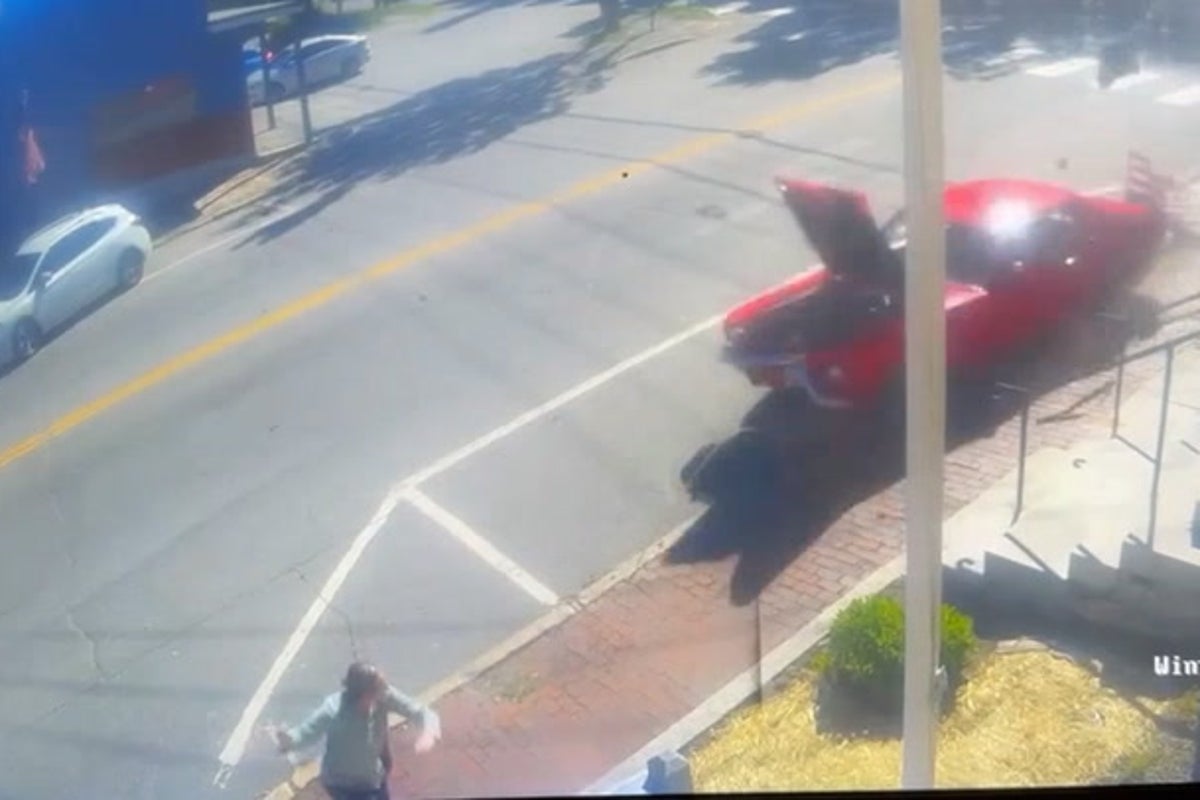
Urban traffic incidents involving vehicle-sidewalk incursions are typically reported as isolated, sensational anomalies. This framing misdiagnoses a systemic failure of infrastructure physics and spatial segregation. When a multi-ton vehicle mounts a curb and narrowly misses a pedestrian, the event is not merely a near-miss; it is a predictable manifestation of kinetic energy overcoming inadequate physical containment. Maximizing pedestrian survival requires analyzing these events through mechanical thresholds, structural deficits, and cognitive friction rather than relying on driver intent or luck.
The Triad of Kinetic Incursion
Every vehicle-sidewalk encroachment operates as a function of three variables: mass-velocity potential, structural resistance, and reaction latency. The interplay of these forces determines whether a loss of vehicle control remains confined to the roadway or breaches civilian safe zones.
                  [Mass-Velocity Potential]
                     (Kinetic Energy)
                           |
                           v
    [Structural Resistance] ---> [Reaction Latency]
     (Curb/Bollard Deficit)     (Pedestrian Spatial Awareness)
Mass-Velocity Potential
The kinetic energy ($E_k$) of a moving vehicle scales linearly with mass but quadratically with velocity, governed by the formula:
$$E_k = \frac{1}{2}mv^2$$
A standard 2,000-kilogram passenger vehicle traveling at 50 kilometers per hour possesses roughly 193 kilojoules of energy. If that speed increases to 80 kilometers per hour, the kinetic energy surges to approximately 494 kilojoules. Urban environments frequently introduce high-velocity corridors immediately adjacent to pedestrian walkways without scaling defensive infrastructure to match this exponential energy curve.
Structural Resistance Deficits
Standard urban curbs measure between 10 and 15 centimeters in height. This vertical displacement is optimized for water drainage and low-speed tire deflection, not kinetic containment. When a vehicle approaches a standard curb at an acute angle at speeds exceeding 40 kilometers per hour, the tire acts as a ramp rather than a barrier. The suspension compresses, absorbing the initial vertical shock, and transfers the remaining forward momentum directly onto the sidewalk plane.
Reaction Latency and Spatial Blindness
Pedestrian survival during an incursion depends on the human reaction time loop: perception, decision, and execution. The average human reaction time to an unexpected visual and auditory stimulus ranges from 1.5 to 2.5 seconds.
A vehicle traveling at 60 kilometers per hour covers 16.7 meters per second. If a vehicle veers toward a sidewalk from a distance of 15 meters, the pedestrian possesses less than one second to recognize the threat and clear the trajectory. This creates a cognitive bottleneck; the threat materializes and executes faster than the nervous system can process the need for evasive action.
Infrastructure Asymmetry and Spatial Design Flaws
The fundamental vulnerability of modern sidewalks stems from an asymmetric allocation of defensive design. Urban planning historically prioritizes vehicle throughput and velocity over spatial isolation for non-motorized actors.
The Buffer Zone Deficit
The distance separating the active roadway from the pedestrian walking path is the primary determinant of survival margins. Urban centers regularly compress this buffer to expand vehicle lanes.
- Zero-Buffer Zones: Sidewalks directly flush with the curb edge. In these configurations, any steering overcorrection or mechanical failure results in an immediate spatial breach.
- Soft Buffers: Grass strips, tree pits, or painted bike lanes. While visually separating traffic, these offer zero mechanical resistance to a runaway vehicle.
- Hard Buffers: Engineered elements including parked vehicles, utility poles, and certified bollards capable of absorbing or redirecting kinetic energy.
Geometric Trajectory Hazards
Certain roadway geometries inherently elevate the risk of sidewalk incursions. Mid-block straightaways allow for maximum velocity accumulation, but intersections and sharp curves introduce lateral acceleration vectors.
When a vehicle loses traction while cornering, it follows a tangential path outward from the apex of the curve. If sidewalks are positioned along these outer radii without structural reinforcement, pedestrians are placed directly in the line of inevitable kinetic discharge during a friction failure.
Technical Solutions for Spatial Segregation
Mitigating pedestrian vulnerability requires shifting the burden of safety from human behavior to deterministic engineering controls. Relying on driver compliance or pedestrian vigilance is a failed strategy; infrastructure must physically prevent energy transfer between zones.
Passive Kinetic Barriers
The most effective mechanism to eliminate sidewalk incursions is the deployment of crash-rated bollards. Unlike decorative concrete planters or standard light poles—which often shear at the base and become secondary projectiles—engineered bollards are anchored deep into sub-surface concrete foundations.
| Barrier Rating | Kinetic Energy Capacity | Operational Context |
|---|---|---|
| Low-Impact (Non-Rated) | < 50 kJ | Low-speed parking lots, decorative boundaries |
| M30 / P1 Certification | ~ 700 kJ | Medium-speed urban arterials, commercial districts |
| M50 / P1 Certification | ~ 2,000 kJ | High-security zones, high-velocity transit corridors |
Implementing M30-rated barriers along high-risk pedestrian corridors ensures that even if a driver suffers a medical emergency or mechanical failure, the vehicle's kinetic energy is entirely dissipated by the infrastructure before breaching the pedestrian perimeter.
Active Intelligent Interventions
Modern vehicular safety suites utilize Advanced Driver Assistance Systems (ADAS) to mitigate spatial breaches before physical contact occurs. Automated Emergency Braking (AEB) and Lane Keep Assist (LKA) rely on optical sensors, RADAR, and LiDAR to map lane boundaries.
The structural limitation of current ADAS technology lies in edge-case detection. Faded lane markings, heavy precipitation, or sudden mechanical component failures can blind these systems. Therefore, digital interventions must be viewed as secondary redundancy layers rather than replacements for physical barriers.
Strategic Reconfiguration of Vulnerable Urban Zones
Municipalities and urban developers must audit existing pedestrian networks to identify and fortify high-vulnerability sectors. The optimization framework requires three immediate phases:
First, execute a spatial risk assessment utilizing velocity telemetry and pedestrian density mapping. Prioritize corners on down-slope gradients and intersections with a history of high-angle turns.
Second, replace soft buffers with high-density physical obstructions. Where permanent bollards are cost-prohibitive, utilize on-street parallel parking configurations to serve as a sacrificial structural shield between moving traffic and pedestrians.
Third, adjust intersection geometry to force lower vehicle turn speeds. Reducing the turning radius at intersections naturally lowers the maximum velocity a vehicle can maintain while cornering, directly reducing the kinetic energy potential during a loss of control. Municipalities must transition away from wide, sweeping radiuses that prioritize vehicle speed at the expense of human reaction windows. Strategic deployment of these physical constraints remains the only viable methodology to guarantee pedestrian insulation from kinetic failure points.