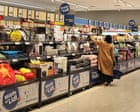
The displacement of legacy grocery incumbents by limited-assortment discounters is not a temporary consumer reaction to macroeconomic stress, but a structural reallocation of market share driven by incompatible operating models. The recent displacement of Morrisons by Lidl as the fifth-largest supermarket in Great Britain—with Lidl securing an 8.6% market share against Morrisons’ 8.3% for the 12 weeks ending May 17, 2026—serves as an empirical validation of this thesis.
While mainstream commentary attributes this shift purely to consumer price sensitivity during inflationary cycles, a corporate strategy analysis reveals a deeper structural asymmetry. Lidl’s 8.8% year-on-year sales growth, contrasted against Morrisons’ 1.3% advance, is the logical outcome of a highly optimized capital allocation model competing against a leveraged corporate structure burdened by private equity debt service.
The Strategic Asymmetry: Capital Expenditure vs. Debt Amortization
The divergent trajectories of Lidl and Morrisons are fundamentally determined by their balance sheets. The operational mechanics of grocery retailing demand continuous capital reinvestment to maintain scale, optimize logistics, and expand physical footprints. When capital is redirected toward debt service rather than asset optimization, structural decline becomes inevitable.
+---------------------------------------------------------+
|                  THE CAPITAL REINVESTMENT LOOP          |
+---------------------------------------------------------+
|                                                         |
|   LIDL (Unleveraged Capital Injection)                  |
|   Retained Earnings / Parent Equity                     |
|          │                                              |
|          ▼                                              |
|   Real Estate Expansion & Supply Chain Automation        |
|          │                                              |
|          ▼                                              |
|   Increased Scale & Lower Unit Costs (Flywheel)         |
|                                                         |
+---------------------------------------------------------+
|                                                         |
|   MORRISONS (Leveraged Private Equity Structure)        |
|   Operating Cash Flow                                   |
|          │                                              |
|          ▼                                              |
|   Debt Service (£3.1bn Balance Sheet Liability)         |
|          │                                              |
|          ▼                                              |
|   Capital Preservation: Store Closures & Zero Growth    |
|                                                         |
+---------------------------------------------------------+
The Cost Function of Debt-Laden Incumbents
Morrisons’ operational flexibility has been severely constrained since its £7 billion leveraged buyout by Clayton, Dubilier & Rice (CD&R) in 2021. Despite strategic interventions implemented under leadership appointed in 2023, which reduced the outstanding debt pile by 46% to £3.1 billion, the required interest payments function as a permanent tax on the retailer's gross margin.
To defend net margins under this capital structure, an incumbent is forced to make trade-offs that weaken its long-term competitive positioning:
- Capital Expenditure Rationalization: Directing cash flow toward debt reduction prevents the acquisition of new commercial real estate and halts supermarket footprint expansion.
- Asset Divestment: Monetizing vertical integration assets, such as exploring the sale of food production capacity from its Myton manufacturing division to competitors, provides short-term cash but surrenders long-term margin defense mechanisms.
- Footprint Compression: Closing operational units, including the planned closure of 100 convenience locations under the Morrisons Daily banner due to rising statutory operating costs, yields immediate cost mitigation at the expense of total market penetration.
The Expansion Flywheel of Limited-Assortment Discounters
Conversely, Lidl operates on an unleveraged or corporate-backed financing model via the Schwarz Group. This structure allows the business to reinvest retained earnings directly into market-share acquisition without demanding immediate, high-yield cash distributions to external creditors.
Lidl’s deployment of a £600 million capital expenditure allocation dedicated to opening 50 new UK footprints in the 2026 fiscal year demonstrates a compounding growth loop. In grocery retail, new physical locations do not merely add linear revenue; they optimize logistics density. Each new store increases the drop-density for the chain’s 13 distribution centers, lowering the marginal transport cost per SKU across the entire network.
Supply Chain Mechanics and Assortment Economics
The fundamental divergence in revenue growth—Lidl expanding at 8.8% while Morrisons grows at 1.3% against a background grocery price inflation rate of 3.1%—reveals that Morrisons is experiencing negative volume growth. To understand why consumers are permanently shifting their primary baskets, one must analyze the unit economics of the limited-assortment model.
SKU Rationalization and Velocity
The core engine of Lidl’s profitability is extreme Stock Keeping Unit (SKU) rationalization. A standard Morrisons supermarket manages between 20,000 and 30,000 distinct SKUs, whereas a typical Lidl store limits its assortment to approximately 2,000 to 3,000 highly curated SKUs, heavily skewed toward private label.
The mathematical consequences of this inventory design alter the cost structure in three distinct ways:
- Purchasing Leverage: By consolidating its total procurement volume into a fraction of the SKUs handled by traditional grocers, Lidl extracts extreme volume discounts from manufacturers, achieving lower cost-of-goods-sold (COGS).
- Inventory Velocity: A restricted SKU count accelerates inventory turnover rates. High velocity reduces working capital requirements and minimizes holding costs, mitigating wastage in fresh food categories.
- In-Store Operational Efficiency: Fewer SKUs simplify the labor model. Products are delivered in shelf-ready packaging, reducing the labor hours required for restocking. This allows Lidl to run high-volume locations with significantly lower headcounts per square foot than traditional competitors.
The Illusion of Spatial Protection
Incumbent grocers historically relied on spatial monopolies—the geographic distribution of large-format stores—to capture consumer spend. Incumbent arguments suggest that discounter growth is artificial because it is driven primarily by new store openings while incumbent market shares remain stable on a like-for-like basis within existing footprints.
This defense overlooks a critical reality: the limited-assortment discounter model has successfully unbundled the traditional weekly shop. By achieving price leadership on high-velocity staples (dairy, produce, fresh proteins), discounters divert primary grocery baskets away from traditional formats. Legacy supermarkets are left defending lower-velocity, lower-margin long-tail SKUs, which are structurally more expensive to supply and stock.
The Demographics of Market Penetration
The hypothesis that discount grocery formats are restricted to lower-income demographics is disproven by consumer data. Lidl's current penetration rate stands at over three in five British households, indicating an expansion that crosses socio-economic boundaries.
Traditional View:
[Low Income] ──► Shop at Discounters
[High Income] ──► Shop at Premium Incumbents

Structural Reality (The Flight to Value):
[All Demographics] ──► Segment Baskets ──► Staples to Discounters (Lidl/Aldi)
                                       ──► Premium/Long-Tail to High-End Grocers
The growth strategy has shifted toward capturing higher-income market segments. Lidl’s targeted real estate acquisition strategy, which identifies new site openings in affluent urban postcodes such as Kensington, Hampstead, and Mayfair, confirms this intent.
When discounters penetrate premium geographic zones, the historical socioeconomic barriers associated with discount branding diminish. High-income consumers demonstrate a clear flight to value on identical or comparable private-label goods when the convenience and quality barriers are removed. This dynamic creates an asymmetric loss for mid-market incumbents like Morrisons and Asda, who lack both the structural cost base to match discounter pricing and the brand equity to insulate their consumer base through premiumization.
Strategic Forecast and Competitive Vulnerability
The realignment of the British grocery hierarchy is far from complete. The transition of Lidl to the fifth position is part of a broader ongoing consolidation.
+-------------------------------------------------------+
|          ESTIMATED MARKET SHARE RANKINGS (MID-2026)   |
+-------------------------------------------------------+
|  1. Tesco                                    ~27.5%   |
|  2. Sainsbury's                              ~15.0%   |
|  3. Asda                                     ~12.5%   |
|  4. Aldi                                     ~10.0%   |
|  5. Lidl                                       8.6%   |
|  6. Morrisons                                  8.3%   |
+-------------------------------------------------------+
Tesco and Sainsbury’s have erected defensive barriers against the discounters by deploying aggressive price-matching programs financed by loyalty data monetization and scaled supply chains. This structural defense leaves the debt-burdened tier of mid-market grocers uniquely exposed.
Asda, currently occupying the third position, exhibits similar vulnerabilities to Morrisons, characterized by declining volumes and complex debt obligations from its own leveraged acquisition structure. Meanwhile, Aldi remains positioned in fourth place, less than one percentage point behind Asda.
The structural data indicates that the next structural shift in the UK grocery landscape will be Aldi displacing Asda for the number three position, leaving the top tier of British retail divided into two starkly defined operational camps: unencumbered premium scale players (Tesco, Sainsbury's) and high-velocity limited-assortment discounters (Aldi, Lidl).
For mid-market incumbents operating under highly leveraged capital structures, survival cannot be achieved through marginal price reductions or promotional campaigns. Without a radical restructuring of corporate balance sheets to free up capital for physical and logistical expansion, the continuous loss of market share to unleveraged corporate models remains mathematically predetermined. Mid-market operators must aggressively downsize their physical asset estates, convert capital-intensive large formats into localized micro-fulfillment hubs, and pivot entirely to high-margin proprietary verticals if they are to halt ongoing market share erosion.