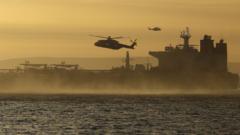
The physical seizure of the Cameroon-flagged crude oil tanker Smyrtos in the English Channel by British Royal Marine Commandos and National Crime Agency (NCA) officials establishes a precedent in western maritime enforcement. While political rhetoric frames this six-hour tactical operation as an isolated blow to Russia's war economy, a rigorous analysis reveals it as a stress-test of western legal geography and operational doctrine. The interdiction exposes the economic levers, legal mechanisms, and structural bottlenecks that define the confrontation between G7 sanctions and Russia’s maritime logistics network.
The global energy trade currently contends with a parallel shipping network composed of over 700 vessels. This shadow fleet transport approximately 75% of Russia’s seaborne crude oil exports. Understanding the systemic friction introduced by the English Channel interdiction requires moving beyond video footage to evaluate the architectural vulnerabilities of stateless arbitrage.
The Economic Architecture of Shadow Logistics
The survival of Russia's export economy depends on minimizing maritime transaction costs while operating outside G7 maritime service ecosystems. This is achieved through an asset-degradation model characterized by three structural components.
- Asset Arbitrage: Utilizing aging hulls—over 72% of the shadow fleet exceeds 15 years of age—purchased at near-scrap value. This mitigates the capital expenditures lost in the event of hull asset seizure.
- Jurisdictional Obfuscation: Registering vessels under flags of convenience, such as Cameroon, that lack the institutional capacity or political will to enforce international safety and financial standards.
- Liability Externalization: Operating without Tier-1 Protection and Indemnity (P&I) insurance clubs, thereby shifting the environmental risk of structural hull failure entirely onto coastal states.
The financial objective of this infrastructure is to counter the G7 price cap mechanism. The state's defensive economic performance is measurable through the net value of its seaborne trade. The UK Ministry of Defence reports that Russian oil revenues fell by 24% year-on-year in 2025, with revenues down 27% compared to October 2024.
This contraction is not solely driven by pricing, but by a rising cost function in shadow operations. The introduction of physical interdiction hazards creates a new variable in this cost function, illustrated by the structural diversion of parallel traffic. Following the seizure of the Smyrtos, marine tracking data recorded immediate course corrections for comparable shadow tankers, including the Maini, the Lion I, and the Sona, which altered routes to bypass the English Channel entirely. The economic consequence is an immediate inflation of ton-mile costs for Baltic exports, compounding the discount Russia must offer to non-aligned buyers in Asia.
The Legal Framework of Sovereign Interdiction
Sovereign operations against commercial vessels on the high seas are tightly constrained by international law. The legal mechanics of the Channel interdiction rely on specific provisions within the United Nations Convention on the Law of the Sea (UNCLOS), paired with domestic enforcement statutory powers.
The primary legal lever used by the UK state is UNCLOS Article 110, which governs the Right of Visit. A warship is permitted to board a foreign merchant vessel on the high seas if there are reasonable grounds to suspect the vessel is effectively stateless, engaged in piracy, or flying a fraudulent flag. When a flag state such as Cameroon fails to validate a vessel's registry or when the vessel operates under an invalidated status, it is legally classified as a vessel without nationality.
Once statelessness is established within territorial or contiguous waters, jurisdictional authority transitions from international law to domestic enforcement frameworks. In this instance, the UK deployed a combination of maritime enforcement mechanisms:
$$\text{Jurisdictional Authority} = \text{UNCLOS Article 110 (Statelessness Determination)} + \text{Russia Sanctions Regulations 2019} + \text{Policing and Crime Act 2017}$$
The Russia (Sanctions) (EU Exit) Regulations 2019 provide the domestic statutory authority to detain specified ships designated for sanctions evasion. The deployment of the NCA alongside military personnel confirms that the operation was executed under criminal asset forfeiture and maritime enforcement powers granted by the Policing and Crime Act 2017. This framework transforms a diplomatic sanctions regime into an actionable criminal enforcement protocol.
Operational Execution and Asset Integration
The six-hour operation to secure the Smyrtos demonstrates an integrated force package designed to suppress asymmetric maritime risks. The tactical profile demanded rapid insertion to prevent scuttling or political counter-escalation in a narrow, high-traffic waterway.
The deployment matrix combined strategic surveillance with kinetic boarding capabilities:
- Broad-Spectrum Surveillance: An RAF P-8 Poseidon maritime patrol aircraft provided continuous electronic intelligence and surface-search radar tracking to isolate the vessel's signature.
- Surface Containment: The Type 23 frigate HMS Sutherland and the Hunt-class mine countermeasures vessel HMS Ledbury established a physical cordon, cutting off evasive maneuvers.
- Kinetic Insertion: Royal Marine Commandos executed a night-time fast-rope insertion from CH-47 Chinook helicopters, supported by Merlin Mk4 and Wildcat rotary platforms from the Maritime Air Group.
- Evidentiary Security: Specially trained NCA officers boarded immediately behind the kinetic wave to secure physical documentation, digital logs, and bridge systems before they could be erased or destroyed.
The integration of civilian law enforcement within a military boarding party addresses a critical bottleneck in sanctions enforcement. Military units can secure a platform, but they lack the statutory mandate to collect chain-of-custody evidence capable of holding up in domestic courts. By embedding the NCA, the state ensures that the vessel’s documentation can be leveraged to map the beneficial ownership networks funding the shadow ecosystem.
Systemic Vulnerabilities and Strategic Risk Metrics
The expansion of physical interdictions reveals deep vulnerabilities for both the sanctioning coalition and the target state. For the western coalition, the primary systemic limitation is the operational capacity required to scale these operations. A six-hour deployment involving a frontline frigate, multiple rotary assets, fixed-wing surveillance, and elite commando units cannot be replicated for every one of the 700 vessels in the shadow fleet.
The second limitation is geopolitical. The Smyrtos was intercepted within a zone of clear UK-French bilateral coordination and unambiguous territorial jurisdiction. Attempting equivalent operations within international straits or disputed economic zones risks direct kinetic escalation with Russian naval escorts or commercial retaliation from non-aligned destination states.
For Russia, the vulnerability lies in the fragility of its maritime insurance and technical networks. The shadow fleet operates at a high risk of structural failure; over 50 marine incidents have already been recorded involving these vessels. By forcing these un-insured, structurally degraded hulls out of optimal choke points like the English Channel and into longer, more hazardous routes around the North Sea or the Atlantic margin, the enforcement coalition increases the probability of a catastrophic environmental event. Such an event would force a hard choice between environmental containment and sovereign liability.
The Subsea Hybrid Conflict Vector
The escalation of maritime enforcement in the English Channel cannot be decoupled from the parallel vulnerability of subsea infrastructure. The North Sea and Baltic maritime corridors contain approximately 64 major undersea telecommunications cables alongside critical European gas pipelines. European security assessments directly link shadow fleet movements to hybrid warfare profiles, noting multiple incidents where these vessels hovered over sensitive subsea nodes.
The operational reality is that shadow tankers provide plausible deniability for state-directed sabotage. Dragging anchors, deploying sub-surface acoustic sensors, or deploying unmanned underwater vehicles (UUVs) can be masked as routine mechanical failures or navigational errors by a poorly maintained merchant vessel.
The UK government's stated intent to introduce new legislation targeted at subsea infrastructure protection confirms that the seizure of the Smyrtos is part of a broader doctrine. Maritime enforcement is shifting from passive financial exclusion to active territory denial. The goal is to constrain the operational freedom of these gray-zone platforms before they can be leveraged for asymmetric infrastructure disruption.
Tactical Playbook for Global Maritime Enforcement
The English Channel interdiction alters the risk premium for entities operating within the parallel energy market. To maximize the strategic return on this operational shift, enforcement agencies must transition from occasional tactical interventions to a systematic containment strategy.
The optimal play requires deploying targeted financial sanctions alongside physical interdiction. State authorities should identify the specific flag registries—such as Cameroon, Eswatini, or Gabon—that show the highest density of shadow operations, and issue formal compliance ultimatums. If these registries fail to de-register sanctioned hulls within a 30-day window, the enforcement coalition must systematically treat those specific vessels as stateless under UNCLOS Article 110 upon entering contiguous zones.
Simultaneously, the physical seizure of vessel documentation must be fed into automated data analytics pipelines. By extracting data from seized bridge systems, satellite transponders, and bunkering logs, authorities can map the shell companies providing ship-to-ship (STS) transfer services in the Mediterranean and North Atlantic. Forcing these intermediary service providers out of business creates a more durable bottleneck than attempting to seize every individual hull at sea. The future of sanctions enforcement will not be decided by the sheer volume of military boardings, but by the systemic application of legal friction to the narrow logistical nodes where the shadow fleet remains dependent on western geography.