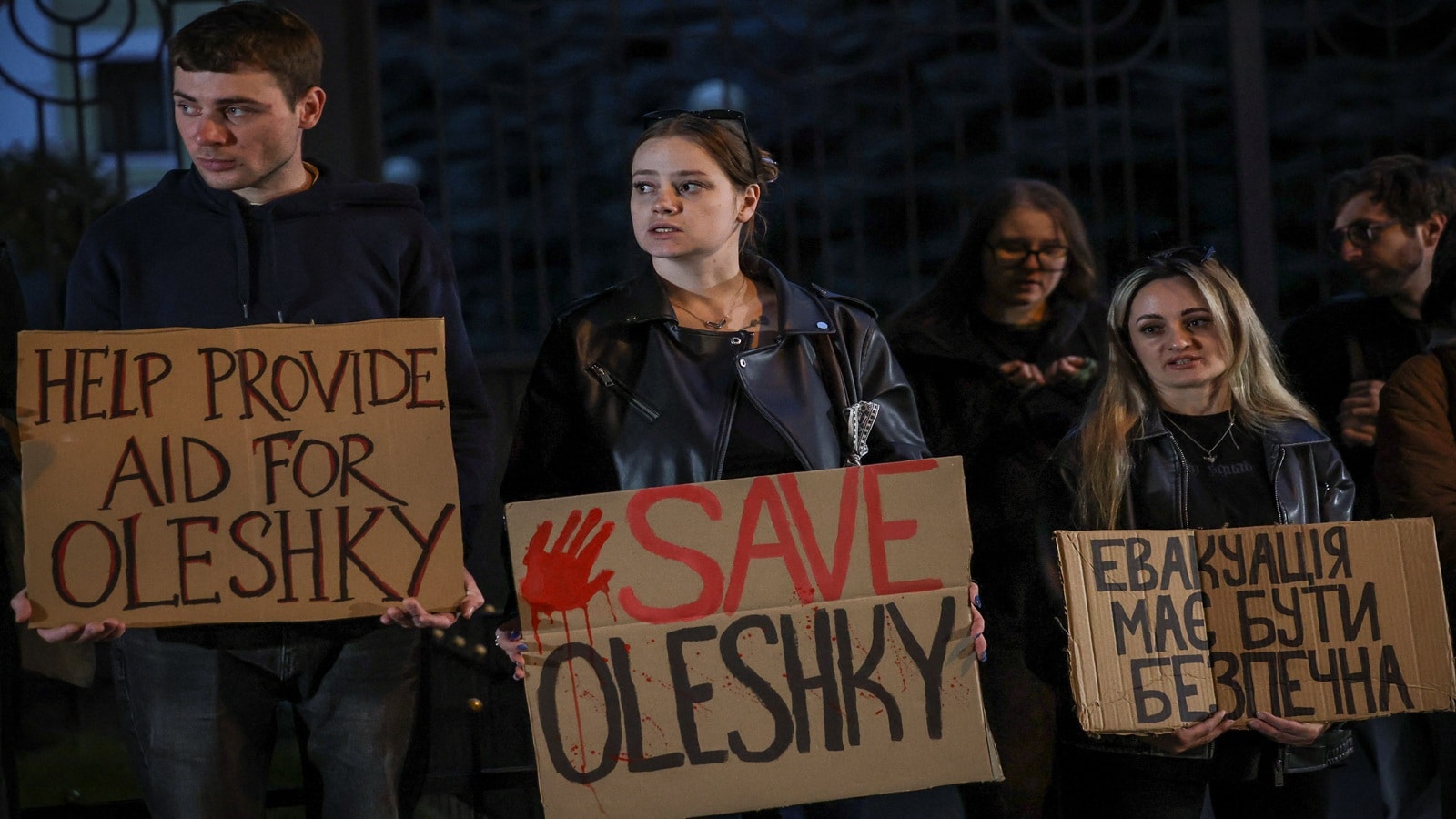
Localized humanitarian truces in high-intensity conflicts are rarely acts of goodwill; they are temporary equilibrium points where the political and logistical costs of obstructing aid exceed the tactical advantages of maintaining a blockade. When a rare ceasefire allows a humanitarian convoy to reach an occupied, disaster-stricken city like Oleshky, the event reveals the underlying mechanics of modern siege warfare, the fragility of deconfliction protocols, and the operational friction of aid delivery across contested front lines.
The Structural Mechanics of a Localized Truce
In conventional media coverage, a localized ceasefire is often framed as a diplomatic breakthrough. In operational reality, it is a strictly bounded micro-agreement governed by game theory and immediate tactical utility. For two belligerents locked in attritional warfare—such as Russian and Ukrainian forces along the Dnipro River—to pause kinetic operations, three structural conditions must align simultaneously.
First, mutual non-utility of the immediate window must exist. Neither side can believe that launching an offensive operation during the proposed truce window will yield decisive territorial gains. Along a static, heavily mined, or flooded riverine front, offensive operations carry high attrition rates. Pausing artillery and drone strikes for a six-to-twelve-hour window costs neither side immediate strategic momentum.
Second, asymmetric reputational pressure reaches a critical threshold. When a civilian population faces acute, visible catastrophe—such as the collapse of critical infrastructure, severe flooding, or total medical depletion—the occupying power faces mounting international scrutiny and internal administrative collapse. Allowing a third-party humanitarian convoy to enter offloads the immediate logistical burden of civilian survival onto external actors without requiring the occupier to divert military transport or supply lines.
Third, verifiable containment must be guaranteed. Both military commands require absolute assurance that the humanitarian corridor will not be exploited for reconnaissance, troop rotation, or resupply of forward combat positions. This necessitates the involvement of a neutral intermediary, typically the United Nations or the International Committee of the Red Cross (ICRC), whose physical presence acts as a human tripwire against kinetic escalation.
Deconstructing the Oleshky Operational Environment
To understand why a humanitarian mission into Oleshky represents an extreme outlier in conflict logistics, one must examine the specific geographic and military constraints of the left bank of the Dnipro River in Kherson Oblast.
Following the destruction of the Kakhovka Dam and the subsequent inundation of low-lying settlements, Oleshky became a compound disaster zone. The city sits directly opposite Ukrainian-held territory on the right bank, placing it inside the active "gray zone"—an area continuously saturated by artillery, mortar fire, and First-Person View (FPV) drones.
In this environment, standard humanitarian logistics break down due to three compounding variables:
- The Fire-Control Envelope: Every road leading into Oleshky is within direct line-of-sight or drone-surveillance range of opposing forces. Any uncoordinated vehicle movement is immediately classified by automated or human-in-the-loop targeting systems as military logistics, triggering instant kinetic interdiction.
- Infrastructure Decoupling: Prolonged shelling and flooding sever the baseline lifelines of an urban center: municipal water pumping stations, electrical substations, and sewage treatment facilities. When these systems fail simultaneously, the population shifts from needing supplemental aid to requiring total life-support sustainment—potable water, diesel generators, trauma medicine, and shelf-stable calories.
- Administrative Vacuum: Under military occupation, pre-war municipal governance dissolves. Aid agencies cannot rely on local civil defense networks to distribute supplies. Instead, convoys must operate under the direct supervision of occupying military authorities, creating severe friction regarding who controls the point of distribution and who receives priority access.
The Three Pillars of Humanitarian Deconfliction
Executing a mission into a city like Oleshky requires a rigid deconfliction architecture. Deconfliction is not a peace treaty; it is a technical communication protocol designed to prevent accidental fratricide or deliberate targeting of non-combatants. The process relies on three operational pillars.
1. Spatial and Temporal Boxing
Military planners define a precise geographic corridor—down to specific road coordinates and turnarounds—and a strict time window. Outside these exact parameters, rules of engagement remain unchanged. If a convoy is delayed by road damage, unexploded ordnance (UXO), or checkpoint inspections, the truce expires automatically unless renegotiated in real time through military-to-military hotlines. This creates immense time pressure on convoy leaders, forcing them to balance speed against the high risk of mines and structural hazards.
2. Zero-Dual-Use Manifest Verification
Every item on a humanitarian truck undergoes intense scrutiny by both belligerents before movement begins. Belligerents operate on worst-case threat assumptions. Items that aid workers view as essential relief—such as satellite communication terminals, high-capacity batteries, heavy-duty tarpaulins, or certain surgical trauma kits—are frequently flagged by military intelligence as "dual-use" assets that could be confiscated and repurposed by enemy combatants. Consequently, manifests are stripped down to the most basic, non-convertible commodities: bottled water, hygiene kits, basic foodstuffs, and standard chronic-illness medications.
3. Visual and Electronic Signature Management
In modern warfare, camouflage is lethal for aid workers. Humanitarian vehicles must maximize their visual and electronic signatures to avoid misidentification. Vehicles are painted stark white, marked with large, top-facing emblems visible to high-altitude reconnaissance drones, and stripped of any military-style radio antennas. Convoys travel at fixed, predictable speeds without defensive formations, signaling non-hostile intent to airborne sensors miles away.
The Cost Function of Aid Delivery Under Occupation
When evaluating the success of a rare truce, analysts must look beyond the headline metric of "aid delivered" and examine the underlying cost function. Every cross-line humanitarian mission incurs severe operational, political, and moral costs that explain why these events remain anomalies rather than standard practice.
The Legitimization Dilemma
To enter an occupied city, humanitarian organizations must negotiate access with the de facto controlling authority. While international humanitarian law (specifically the Fourth Geneva Convention) mandates that occupying powers facilitate relief schemes, belligerents routinely weaponize access. By granting permission for a convoy, the occupying force extracts implicit administrative recognition and projects an image of compliance with international norms, even if the broader campaign involves systematic infrastructure destruction.
The Diversion Risk
Once supplies cross the front line and enter an occupied zone, third-party monitoring drops precipitously. Security constraints rarely allow international staff to remain on the ground for days to oversee household-level distribution. Supplies are often handed over to local distribution committees vetted by the occupying military. This creates a structural vulnerability: aid can be diverted to military personnel, used to coerce civilians into accepting occupation passports or administrative registration, or withheld from demographics deemed disloyal.
The Single-Bolus Limitation
A single convoy, regardless of size, provides only a temporary caloric and medical buffer. If a city of several thousand remaining residents receives a ten-truck convoy, the water and food delivered may sustain the population for two to three weeks. Without a recurring, institutionalized logistics pipeline, the population inevitably slides back into acute crisis the moment the supplies are exhausted. A one-off truce treats the acute symptoms of siege while leaving the structural cause—active military occupation and continuous bombardment—entirely intact.
Tactical Execution: How Cross-Line Convoys Actually Move
The physical execution of a truce-backed mission follows a strict, sequential protocol designed to eliminate ambiguity at every stage of transit.
- Pre-Deployment Synchronization (T-Minus 48 Hours): Liaison officers from the humanitarian agency transmit the exact GPS route, vehicle registration numbers, driver identities, and cargo manifests to the joint coordination centers of both militaries. Both sides acknowledge receipt and issue localized "stand-down" orders to artillery batteries, drone operators, and forward infantry units along the specified sector.
- The Zero-Line Crossing (T-Minus 0 Hours): Convoys rarely cross active, mined front lines directly. Instead, they utilize pre-cleared transit points—often located dozens of kilometers away from the target city—and approach the stricken area from the rear of the occupying force's lines. If a direct front-line crossing is required, military engineering units from both sides must conduct synchronized demining operations hours prior to the convoy's arrival.
- Checkpoint Filtration: Upon entering the occupied sector, the convoy passes through multiple military checkpoints. Despite prior high-level agreements, friction frequently occurs here. Local unit commanders may lack updated orders from central command, or they may conduct intrusive physical searches that consume valuable hours of the truce window.
- Rapid Offloading: Upon reaching the designated distribution hub in Oleshky, teams execute a high-speed offload. Convoys do not park or stage for extended periods; stationary clusters of vehicles represent high-value targets if a rogue unit violates the ceasefire. Offloading is typically completed within 60 to 120 minutes.
- Exfiltration and Window Closure: The convoy exits along the exact ingress route. Only after the last vehicle clears the outer perimeter of the fire-control zone does the humanitarian agency notify both military commands that the mission is complete, effectively terminating the localized ceasefire.
Separating Known Facts from Analytical Hypotheses
When assessing reports of rare truces in active combat zones, rigorous analysis requires separating verified operational facts from strategic hypotheses regarding intent.
- Verified Fact: Localized ceasefires in the Russia-Ukraine war are exceptionally rare compared to earlier phases of the conflict in Donbas (2014–2021), where Minsk-era mechanisms facilitated routine prisoner swaps and infrastructure repairs. The proliferation of decentralized, low-cost drone warfare has made enforcing localized truces significantly harder, as a single unauthorized operator can collapse a sector-wide agreement.
- Verified Fact: Civilians remaining in frontline cities like Oleshky are disproportionately elderly, disabled, or economically unable to evacuate. This demographic profile suffers exponentially higher mortality rates when basic utilities fail, creating an acute humanitarian imperative that forces international agencies to accept extreme operational risks.
- Educated Hypothesis: The willingness of an occupying force to permit a rare humanitarian mission often correlates with periods of localized logistical strain. When military supply lines are heavily interdicted by enemy long-range strikes, the occupying command prioritizes ammunition and fuel over civilian relief, temporarily outsourcing civilian sustainment to international organizations to prevent localized civil unrest or disease outbreaks that could affect garrisoned troops.
- Educated Hypothesis: Such truces serve as low-stakes stress tests for military-to-military communication channels. Belligerents occasionally use humanitarian deconfliction hotlines to verify whether the opposing command still maintains strict centralized control over its forward tactical units.
Strategic Imperatives for Humanitarian Planners
Relying on ad-hoc, high-friction truces to sustain besieged populations is a failing operational model. To prevent catastrophic civilian mortality in frontline zones without becoming instruments of military propaganda, humanitarian leadership and international donors must execute three specific shifts in doctrine.
First, decouple aid delivery from single-event negotiations. Diplomatic capital should not be expended on securing one-off convoys that provide temporary relief. Instead, negotiators must push for automated, recurring "humanitarian maintenance windows"—pre-agreed, weekly four-hour pauses along fixed corridors that trigger automatically unless explicitly vetoed by a central command, shifting the political burden onto the side that chooses to block aid.
Second, pre-position decentralized survival micro-kits. Because large convoys are vulnerable to bureaucratic stalling and dual-use restrictions, agencies must prioritize high-density, low-signature supplies during any open window. Rather than bulk water—which is heavy, volume-inefficient, and quickly exhausted—convoys should maximize capacity with point-of-use water filtration units, high-calorie nutrient pastes, and solar-rechargeable medical cold-chains that allow local clinics to function independently for months after the convoy departs.
Third, enforce strict conditionality on third-party verification. Humanitarian organizations must establish a hard operational red line: if occupying authorities refuse to allow independent international monitors to observe the actual distribution of goods to end-users, subsequent convoys must be suspended. Delivering supplies into a black box where military diversion cannot be ruled out violates core neutrality principles and subsidizes the occupying force's war economy. Without verifiable end-user delivery, a humanitarian truce ceases to be an act of relief and becomes a logistical asset for the siege itself.