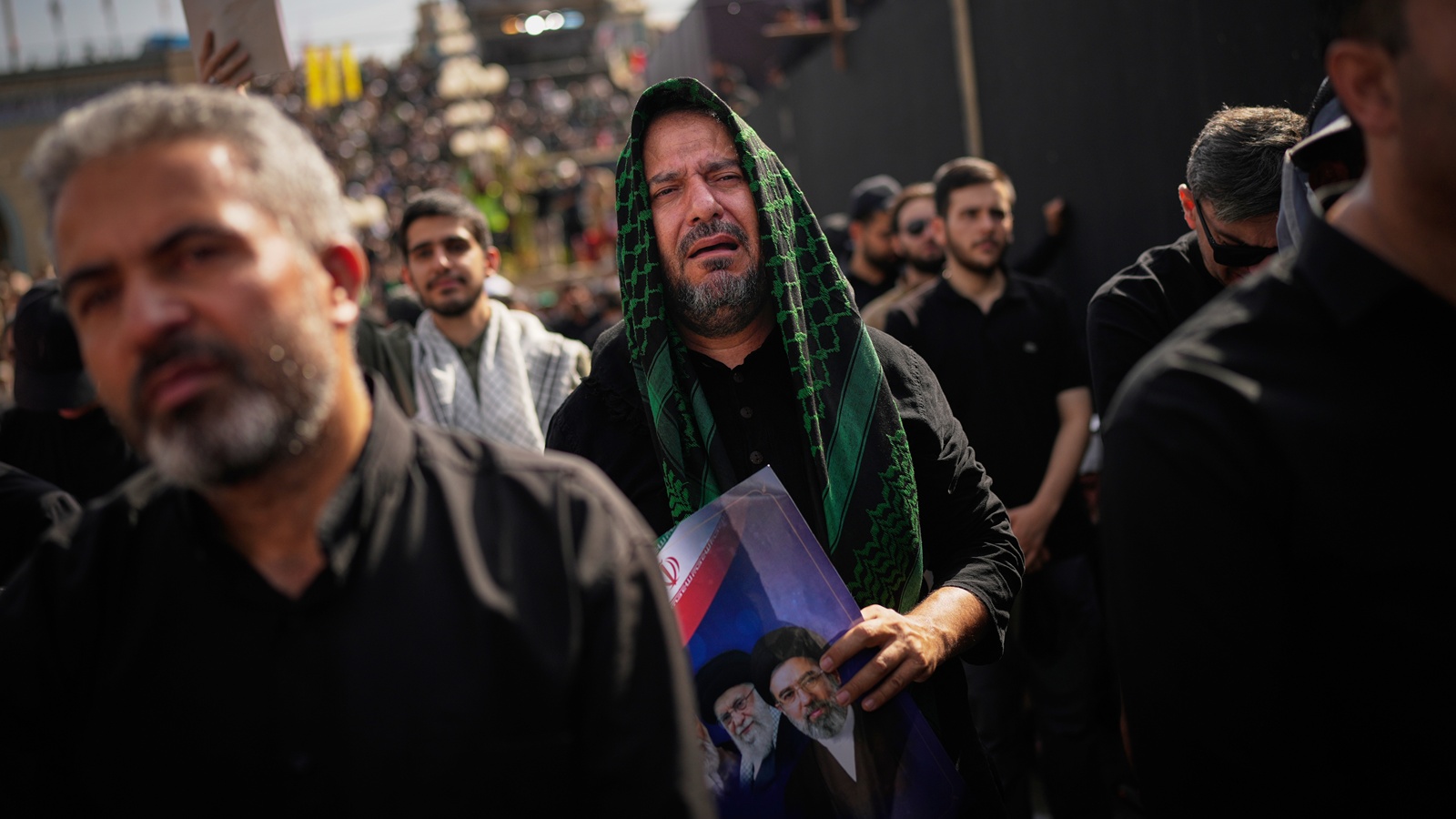
The death of a Supreme Leader in the Islamic Republic of Iran represents the ultimate stress test for the regime's dual-legitimacy framework, which attempts to synthesize divine mandate with republican institutions. State-sanctioned mass gatherings and ritualized anti-Western rhetoric during such transitions are not spontaneous outbursts of public sentiment. Instead, they operate as calculated, highly managed mechanisms of institutional stabilization and elite consolidation. To evaluate the trajectory of the Iranian state during a leadership transition, analysts must look past the performative theatrics of the street and dissect the underlying structural pillars that govern the transfer of autocratic power.
The survival of the political system depends on mitigating three distinct vectors of vulnerability: bureaucratic paralysis within the clerical establishment, factional infighting among military elites, and domestic civil unrest. Western commentary frequently misinterprets the state’s ideological rhetoric as a signal of impending foreign policy shifts. In reality, these performative displays are inward-facing tools designed to signal continuity, deter external opportunism, and bind competing domestic factions to the foundational myths of the 1979 revolution.
The Three Pillars of Regime Continuity
Securing a transition of power within an authoritarian state requires the synchronized alignment of ideological, constitutional, and coercive forces. If any single pillar fractures, the entire succession pipeline enters a state of crisis.
Ideological Mobilization as a Strategic Deterrent
The deployment of state-directed chants and mass funeral logistics serves a specific operational function. In the immediate aftermath of a leader’s death, a power vacuum is perceived by both domestic dissidents and foreign adversaries. The state utilizes mass mobilization to project an illusion of absolute homogeneity.
- Risk Mitigation: The public display of ideological fervor aims to signal to foreign intelligence services that the regime retains mass mobilization capabilities, thereby raising the perceived cost of external intervention.
- Elite Alignment: Public participation in state rituals forces mid-level bureaucrats and military commanders to publicly reaffirm their loyalty to the core ideology, neutralizing potential defectors before they can form alternative coalitions.
- Information Monopolization: By saturating state media with highly choreographed funeral proceedings, the regime crowd-outs alternative narratives or organizing spaces for civilian opposition groups.
The Constitutional Pipeline and the Assembly of Experts
Article 107 of the Constitution of the Islamic Republic of Iran vests the authority to elect the Supreme Leader in the Assembly of Experts, an 88-member body of senior clerics. While the constitutional text implies a deliberative theological process, the operational reality is highly managed.
The selection process moves through a rigid structural funnel. The Guardian Council—a 12-member body half-appointed by the Supreme Leader and half by the judiciary—vets all candidates for the Assembly of Experts years in advance, ensuring that only absolute loyalists sit on the body. When the Supreme Leader dies, a specialized leadership council consisting of the President, the head of the judiciary, and a theologian from the Guardian Council temporarily assumes leadership duties if the Assembly of Experts faces a deadlock. This constitutional design ensures that while individual actors change, the structural preferences of the office remain completely static.
The Coercive Guardrail
The ultimate arbiter of the succession process is not the clergy, but the Islamic Revolutionary Guard Corps (IRGC). The IRGC operates as a parallel military-industrial complex with a vested economic interest in maintaining the status quo.
The IRGC views the clerical leadership as the source of its legal and theological legitimacy. Therefore, its primary objective during a transition is the enforcement of total domestic compliance. The military apparatus deploys the Basij paramilitary forces across major urban centers to suppress assembly outside of state-sanctioned events. The internal security apparatus treats any unsanctioned political gathering during the mourning period as an existential threat, enforcing a zero-tolerance policy for dissent.
The Economics of Succession Risk
Political transitions introduce acute volatility into Iran’s highly distorted economy. The regime’s financial network relies on a complex web of bonyads (bonyads are untaxed, cleric-run charitable foundations that control up to 20 percent of Iran’s GDP) and IRGC-front companies. A shift in the Supreme Leader's office threatens to disrupt the distribution of economic rents among these elite factions.
[Supreme Leader Office] ──> [Bonyads & IRGC Enterprises] ──> [Elite Rent Distribution]
         │
         ▼ (Transition Disruption)
[Factional Re-alignment] ──> [Asset Reallocation Risk] ──> [Macroeconomic Instability]
The first structural vulnerability occurs within the currency markets. Anticipation of a leadership change historically triggers capital flight and a rapid depreciation of the Iranian Rial on the free market. The Central Bank of Iran is forced to burn through limited foreign exchange reserves to artificially stabilize the currency, reducing the state’s fiscal headroom to subsidize basic commodities like bread and fuel for the lower economic classes.
The second vulnerability lies in the reallocation of commercial monopolies. The new Supreme Leader will inevitably favor specific economic networks, meaning current stakeholders face the risk of expropriation or marginalization. This economic anxiety creates a strong incentive for current elite factions to demand a predictable, conservative successor rather than an ideological reformer who might alter the financial architecture of the state.
Geopolitical Signaling and Risk Calculus
The rhetoric observed during state funerals is intrinsically linked to Iran's asymmetric deterrence strategy. The regional network known as the Axis of Resistance—encompassing militias in Iraq, Syria, Lebanon, and Yemen—relies on the explicit theological and financial backing of the Supreme Leader’s office.
During a leadership transition, the Supreme Leader's office must project unwavering commitment to these proxy forces to prevent tactical fragmentation.
The state utilizes a dual-channel signaling framework:
| Target Audience | Signal Dispatched | Operational Objective |
|---|---|---|
| Regional Proxies | Continuity of financial and military supply lines | Prevent proxy autonomy or tactical drift |
| Western Adversaries | Strategic defiance and ideological intransigence | Deter preemptive sanctions or kinetic strikes |
| Domestic Populace | Inevitability of the regime's geopolitical arc | Suppress defection and domestic resistance |
The external messaging is designed to convey that the strategic posture of the state is institutionalized, not individualized. The regional command structure of the IRGC Quds Force remains operational independent of the clerical leadership, ensuring that command-and-control loops over foreign operations suffer zero latency during the political handoff.
Definitive Operational Forecast
The structural realities of the Iranian state dictate a highly predictable sequence for the final selection of the next Supreme Leader. The regime cannot tolerate an extended period of ambiguity; therefore, the Assembly of Experts will move rapidly to ratify a candidate pre-approved by the security apparatus.
The next leader will not be a reformer or a charismatic theological innovator. The institutional preference of both the IRGC and the senior clergy converges on a status-quo bureaucrat who possesses deep ties to the security state and minimal popular independent backing. This structural dependence ensures that the new Supreme Leader will remain beholden to the institutional interests of the military commanders who guaranteed his ascension.
The immediate policy output of the post-transition government will be characterized by a hardening of domestic social controls and an unyielding commitment to regional asymmetric leverage. The regime will likely orchestrate an immediate, high-profile demonstration of its regional capabilities—such as a coordinated missile test or an escalation by a regional proxy—to empirically prove that the transition has not degraded its strategic reach. Western policymakers expecting an internal collapse or a diplomatic opening during this transition miscalculate the systemic redundancy built into the Iranian autocracy. The system is engineered to absorb the shock of succession by transforming elite anxiety into aggressive, coordinated institutional survival strategies.