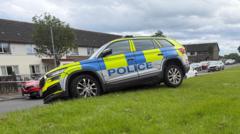
The operational matrix of frontline policing exposes law enforcement personnel to acute, low-probability, high-impact physical threats. When an incident escalates to the attempted murder of a police officer, public discourse typically focuses on the immediate criminal proceedings and individual culpability. However, an analytical evaluation requires breaking down these events into systemic vulnerabilities, legal thresholds, and the operational architecture of state security. The stabilization of civil order relies on the efficacy of these protective mechanisms when a state actor transitions from an enforcer of law to a target of lethal violence.
The Legal and Operational Thresholds of Lethal Intent
Quantifying an attack on a law enforcement officer requires a strict evaluation of the statutory elements of attempted murder. Unlike lower-tier assault charges, proving attempted murder demands establishing a dual-component legal reality: the commission of a physical act that is more than merely preparatory, and a specific, unequivocal intent to kill.
[Threat Escalation Pathway: Routine Contact -> Radical Non-Compliance -> Lethal Action]
In high-threat scenarios, this intent is rarely self-reported; it must be inferred by forensic reconstruction of the event. Investigators and prosecutors look for specific indicators to build this objective framework:
- Weapon Mechanics: The choice of weapon dictates the baseline lethality index. The utilization of firearms, bladed weapons, or vehicles as blunt-force instruments establishes a high probability of fatal outcomes.
- Anatomical Targeting: The physical trajectory of the attack provides objective evidence of intent. Targeting vital zones—specifically the head, neck, and central torso—signals a calculated effort to bypass standard body armor and inflict fatal trauma.
- Temporal Duration: A sustained attack, characterized by multiple strikes or continuous pursuit despite officer retreat, undermines claims of a panicked, non-lethal reaction.
The friction between rapid operational escalation and the deliberate speed of judicial processing creates an information asymmetry. Immediately following an arraignment, the state must transition from reactive crisis management to a structured evidentiary assembly. This process requires securing physical scenes, analyzing digital telemetry from body-worn video, and isolating witness testimonies before cognitive decay or media exposure alters recollections.
The Operational Cost Function of First-Responder Vulnerability
Every violent encounter involving a police officer alters the broader risk calculations within municipal management and state treasury systems. The economic and operational toll of a single critical incident extends far beyond the immediate medical expenses of the injured personnel.
Total Operational Cost = Direct Medical Care + Forensic Logistics + Overtime Compounding + Attrition Premium
Direct medical care represents the baseline cost. The true systemic strain lies in the secondary and tertiary economic ripples.
Forensic logistics require stripping active patrol units from their geographic sectors to preserve and document a wide-scale crime scene, often for multiple days. This geographic displacement creates response-time deficits in adjacent sectors, forcing municipal agencies to trigger mandatory overtime protocols to maintain minimum staffing thresholds.
The long-term fiscal variable is the attrition premium. Exposure to unmitigated, lethal violence accelerates early retirements, increases long-term psychological disability claims, and depresses recruitment yields. When the perceived physical risk of a role permanently outpaces the total compensation package, the state faces a structural deficit in human capital, leading to a reliance on lower-tier, less-trained auxiliary forces.
Structural Vulnerabilities in Lone-Officer Deployments
The structural vulnerability of law enforcement personnel is heavily influenced by tactical positioning and deployment ratios. A significant percentage of critical incidents occur during single-officer dispatches or routine traffic stops, where the data reveals a compounding risk framework.
The OODA Loop Compression Problem
When a single officer encounters a non-compliant subject, the officer's cognitive bandwidth is entirely consumed by the Observe-Orient-Decide-Act (OODA) loop. The officer must simultaneously assess environmental hazards, read subject body language, and communicate telemetry back to a central dispatch hub.
When a subject transitions instantly to lethal force, the officer's defensive response is structurally delayed by the physiological time required to process the shift from a low-threat posture to a survival framework. This delay often measures between 1.5 to 2.5 seconds—a window wide enough for an assailant to close distances or discharge a weapon effectively.
The Failure of Mechanical Deterrence
The presence of a uniform and visible defensive equipment is intended to function as a psychological deterrent. However, in scenarios involving radicalized individuals, severely intoxicated subjects, or individuals experiencing acute psychiatric crises, the standard deterrent model fails entirely. The uniform ceases to represent an agent of legal authority and instead becomes a high-contrast target, standardizing the officer's vulnerability.
Mitigation Frameworks for High-Threat Environments
Mitigating the frequency and severity of lethal attempts on police personnel requires abandoning purely reactive strategies in favor of proactive, structural interventions. These interventions must be applied across three distinct operational layers.
Dynamic Resource Allocation
The standard model of assigning patrols based purely on historical call volume fails to account for sudden threat spikes. True optimization requires real-time data integration, where dispatch algorithms automatically mandate two-officer responses to specific geographic nodes or call types that show high statistical correlations with weapon possession or volatile resistance.
Tactical Equipment Redundancy
Body armor standards must be dynamically updated to outpace the evolving availability of civilian weaponry. While soft armor protects against standard handgun calibers, it offers minimal defense against rifle rounds or specific bladed threats.
A modern protective posture requires the mandatory deployment of lightweight, high-grade ceramic plate systems in standard patrol vehicles, alongside integrated biometric sensors that automatically trigger a priority distress signal to dispatch if an officer's heart rate spikes abnormally alongside a rapid horizontal body orientation change.
Predictive Behavior Analytics
Training frameworks must shift away from rote mechanical drills and focus heavily on pre-attack indicators. Officers must be systematically trained to identify micro-behaviors—such as target fixation, bladed stances, repetitive target glancing, and subtle adjustments to waistbands—before a weapon is visibly produced.
This behavioral recognition compresses the officer's OODA loop, allowing for the pre-emptive escalation of force or the proactive creation of tactical distance.
The Strategic Path to Institutional Resilience
Addressing the systemic threats highlighted by high-profile attacks demands an overhaul of municipal security strategies. Agencies cannot rely on the binary outcome of individual judicial cases to deter future actors. Instead, the focus must shift to hardening the operational environment to ensure that any attempt at lethal violence against state actors faces an insurmountable tactical barrier.
Municipalities must index their law enforcement budgets not to political cycles, but directly to local threat metrics. This involves linking procurement cycles for advanced protective gear and high-frequency tactical training directly to the volume of weapons seizures and violent resistance incidents within a rolling twelve-month window.
By tying resource deployment to empirical threat realities rather than static historical budgets, administrative leadership can insulate their frontline personnel from predictable operational failures, stabilizing both the force and the communities they are tasked with securing.