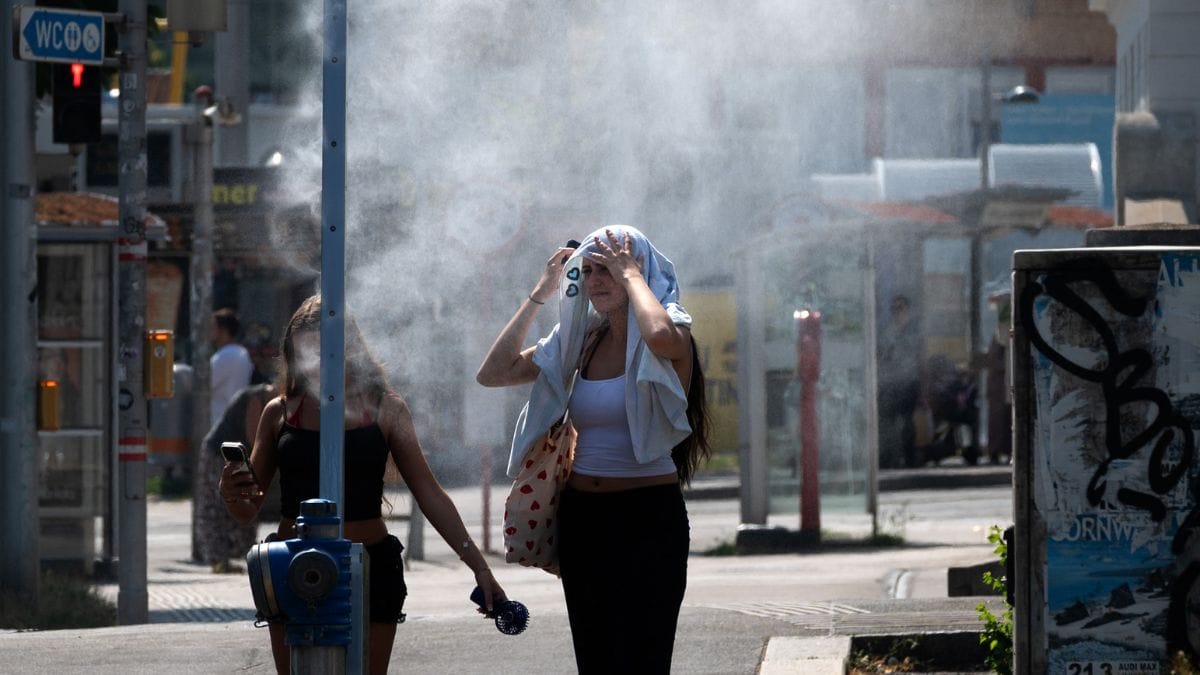
Extreme heatwaves are no longer just meteorological anomalies; they are structural stress tests for modern civil infrastructure. When ambient temperatures exceed historical design thresholds, the physical assets holding society together—roads, transit networks, and public health systems—experience compounding failures. The recent European heatwave, which claimed over 1,000 lives and caused visible damage to transport networks, exposed a critical vulnerability: infrastructure is engineered for past averages, not future extremes. To mitigate these disruptions, municipal authorities and civil engineers must transition from reactive crisis management to a structural framework rooted in materials science and thermodynamics.
The Tri-Axis Failure Framework of Thermal Stress
The systemic breakdown witnessed across European urban centers can be categorized into three distinct failure vectors. Examining these vectors reveals that infrastructure damage is a predictable reaction to thermodynamic limits rather than an arbitrary disaster. For an alternative perspective, read: this related article.
                  [Extreme Thermal Load]
                            │
         ┌──────────────────┼──────────────────┐
         ▼                  ▼                  ▼
[Rheological Failure]  [Thermal Expansion]  [Physiological Strain]
  (Asphalt Rutting)    (Rail/Bridge Stress)  (Grid & Health Load)
1. Rheological Degradation of Bituminous Pavements
The melting of roads and traffic signs is a direct consequence of polymer degradation and viscoelastic transition. Asphalt concrete behaves as a viscoelastic material. At standard operating temperatures, it possesses sufficient elasticity to deform under traffic loads and recover its original shape. However, asphalt absorbs solar radiation efficiently, often reaching temperatures 20°C to 25°C higher than the surrounding air.
When ambient temperatures surpass 40°C, the pavement surface temperature can exceed 60°C. This thermal energy drives the bitumen binder past its softening point. The material loses its elastic recovery properties, experiencing permanent plastic deformation under the weight of vehicular traffic. This causes rutting, shoving, and structural bleeding, where the liquid binder rises to the surface, destroying traction and ruining the road aggregate matrix. Further coverage on this matter has been shared by The Washington Post.
2. Linear Expansion and Structural Buckling
Solid infrastructure components, such as steel rail lines and concrete bridges, are bound by the laws of linear thermal expansion. The change in length ($\Delta L$) of a material is directly proportional to its initial length ($L_0$), the temperature differential ($\Delta T$), and its specific coefficient of linear thermal expansion ($\alpha$):
$$\Delta L = \alpha L_0 \Delta T$$
Continuous welded rail (CWR) tracks are anchored to prevent movement, turning thermal expansion into internal compressive stress. When the temperature rises significantly above the rail's neutral track temperature (the temperature at which the rail experiences zero thermal stress), the compressive force exceeds the lateral resistance of the ballast bed. The result is track buckling—a sudden, catastrophic lateral displacement that instantly derails rail operations. Bridges face similar bottlenecks when expansion joints bottom out, transferring immense compressive forces directly into concrete abutments and structural piers, risking micro-fracturing.
3. Anthropocentric and Utility Load Compounding
The human toll of a heatwave—exemplified by excess mortality figures—stems from a failure to decouple human physiology from ambient environmental conditions. When temperatures remain elevated during nocturnal cycles, the human body cannot shed heat via radiation, forcing reliance on evaporative cooling (sweat). In high-humidity environments, this mechanism fails, leading to systemic hyperthermia.
This biological crisis triggers a secondary infrastructure failure: the power grid. To maintain survivable indoor climates, commercial and residential air conditioning units run continuously at maximum capacity. This synchronous demand spikes the load on electrical distribution transformers. High ambient temperatures simultaneously reduce the heat dissipation capacity of these transformers, degrading their insulation and causing localized grid failures right when power is most critically needed.
Quantifying the Thresholds of Civil Vulnerability
Basing emergency responses on vague heat advisories fails to address specific engineering vulnerabilities. Effective intervention requires identifying the exact material and operational thresholds where infrastructure transitions from stable to unstable states.
| Infrastructure Asset | Primary Material | Critical Temperature Threshold | Engineering Failure Mode |
|---|---|---|---|
| Surface Transport Links | Binder-modified Asphalt | 58°C – 70°C (Surface Temp) | Viscoelastic shift, structural rutting, binder bleeding |
| Rail Networks | Carbon-Manganese Steel | 45°C – 55°C (Rail Temp) | Compressive stress exceeding ballast lateral resistance |
| Power Distribution | Copper/Aluminum Transformers | 40°C (Ambient Air) | Thermal derating, insulation degradation, core failure |
| Urban Signage & Assets | Thermoplastics (PVC/Polycarbonate) | 60°C – 80°C (Surface Temp) | Softening, loss of structural rigidity, sagging |
The data reveals that asset failure occurs long before materials reach their actual melting points. For example, thermoplastics used in secondary infrastructure like traffic signs do not liquify into puddles; instead, they reach their glass transition temperature ($T_g$). At this stage, the polymer chains become mobile, causing the material to sag under its own weight.
The Strategic Path to Thermal Resilience
Fixing broken roads and replacing buckled rails after the fact is financially unsustainable and operationally inefficient. Municipalities must implement structured engineering upgrades to harden infrastructure against rising baseline temperatures.
Climate-Resilient Material Specification
The first step requires updating material procurement standards. Standard asphalt binders must be systematically replaced with Polymer-Modified Bitumen (PMB). Incorporating elastomeric polymers, such as Styrene-Butadiene-Styrene (SBS), extends the upper performance grade of the pavement, keeping it stable up to surface temperatures of 76°C or higher. Similarly, railway networks must recalibrate their neutral track temperatures upward during maintenance cycles, shifting the engineering envelope to absorb higher compressive forces without buckling.
Maximizing Albedo via Cool Infrastructure
Urban centers suffer from the urban heat island effect due to low-albedo surfaces like traditional dark asphalt, which absorb up to 95% of solar radiation. Applying solar-reflective coatings to pavements and roofs raises the albedo from a baseline of 0.05 to over 0.40. This reflects solar energy back into the atmosphere, dropping surface temperatures by up to 15°C and protecting the underlying material layers from reaching critical failure thresholds.
Decentralized Grid Hardening
To prevent grid collapse from peak air conditioning loads, utility networks must deploy decentralized distributed energy resources (DERs). Integrating localized solar photovoltaic arrays with battery energy storage systems (BESS) allows neighborhoods to meet peak cooling demands locally. This relieves stress on centralized distribution transformers and prevents widespread blackouts during high-demand periods.
The Shift to Thermodynamic Asset Management
Traditional asset management relies on historical lifespans to schedule maintenance. This approach fails during extreme weather events. If a road engineered for a 20-year lifespan under historical averages experiences consecutive seasons of 40°C ambient heat, its true functional lifespan drops sharply due to accelerated polymer aging and structural deformation.
Asset managers must transition to dynamic, sensor-driven vulnerability modeling. Installing thermal sensors inside critical rail links and highway beds provides real-time data on material stress. When temperatures approach critical thresholds, automated mitigation protocols can deploy immediately. This includes enacting speed restrictions on vulnerable rail corridors to minimize dynamic loads on expanded steel, applying water misters to cool key substations, and redirecting heavy freight traffic away from soft pavement corridors.
The structural survival of urban centers depends on accepting a hard physical truth: infrastructure is an active participant in a changing thermodynamic environment. Failure to re-engineer these assets to handle higher baseline temperatures ensures that future heatwaves will continue to shut down transit networks, strain utility grids, and threaten human life. Municipal budgets must pivot immediately, treating thermal resilience not as an optional green initiative, but as a core requirement for structural survival.