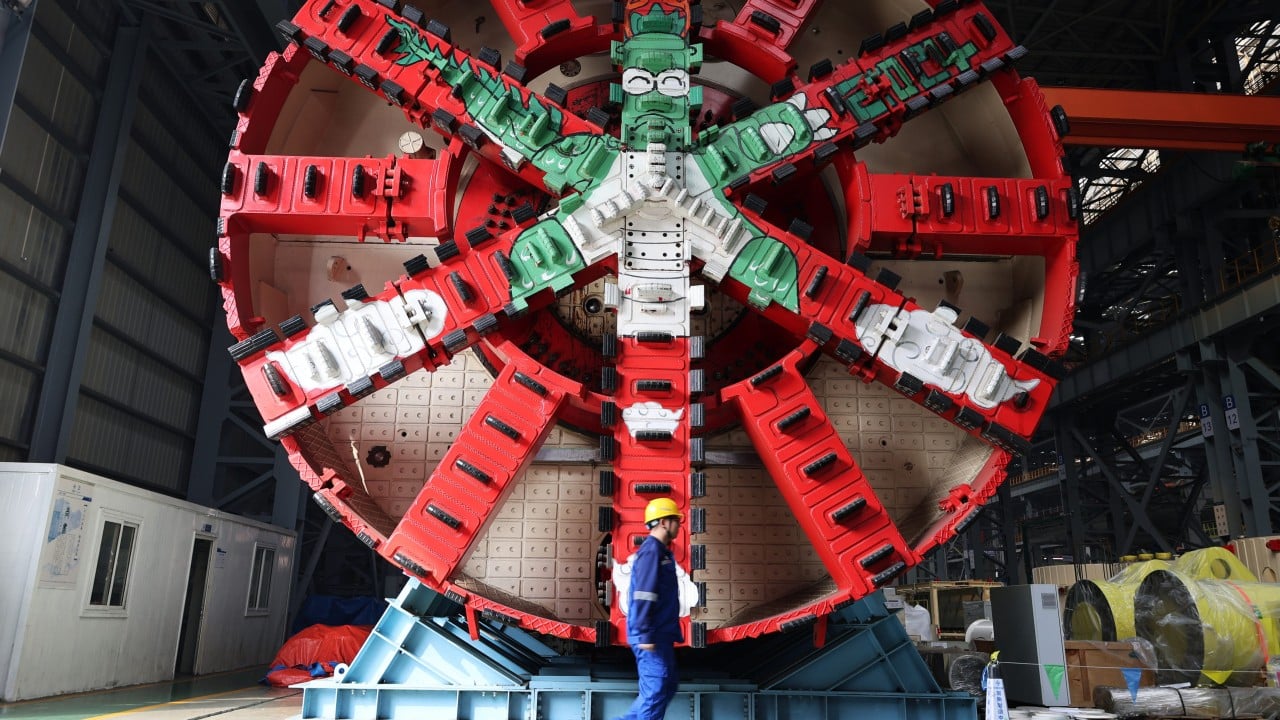
India's push to break free from Chinese heavy machinery export restrictions is not a simple import substitution play; it is a high-stakes race against capital expenditure bottlenecks and deeply entrenched tier-two component monopolies. When Beijing imposes export controls on specialized equipment—ranging from tunnel boring machines to precision computer numerical control (CNC) systems—it exposes a structural vulnerability in India's infrastructure and manufacturing ambitions. Resolving this dependency requires dismantling decades of cost-driven supply chain integration while simultaneously scaling domestic engineering capacity under severe time constraints.
The Structural Anatomy of the Machinery Chokepoint
To understand why India cannot simply switch suppliers overnight, one must examine the mechanics of capital goods manufacturing. Heavy machinery is not a commodity; it is an engineered system built upon layers of specialized sub-assemblies.
The Three Tiers of Machinery Dependency
- Tier-One Final Assembly: This includes the visible capital equipment—excavators, tunneling rigs, and automated assembly lines. While India has developed substantial domestic assembly capabilities through joint ventures and local conglomerates, these operations frequently rely on imported kits.
- Tier-Two Core Sub-Systems: This is the primary vulnerability zone. High-torque hydraulic pumps, heavy-duty gearboxes, precision bearings, and industrial servo motors require advanced metallurgy and micro-tolerance machining. Chinese manufacturers achieved global dominance here through massive state-backed economies of scale.
- Tier-Three Material Inputs and Tooling: At the base lies specialty alloy steels, rare-earth permanent magnets, and the precision machine tools used to manufacture the components in Tier Two. Export curbs often target this foundational layer, starving downstream assemblers of critical inputs without needing to ban finished machines outright.
When China restricts the outflow of specialized machinery or its underlying components, the impact ripples downstream as a severe time-to-market penalty. An Indian infrastructure developer waiting on a delayed tunnel boring machine or a domestic electronics manufacturer unable to source specialized automated optical inspection equipment faces immediate capital lockup. The machinery sits idle, project timelines slip, and the cost of capital escalates.
The Cost Function of Rapid Localization
A common misconception in industrial policy analysis is that tariffs or import bans automatically generate domestic manufacturing capacity. In reality, forcing rapid localization alters the total cost function of capital projects in three distinct ways.
First, upfront capital expenditure (CapEx) inflates. Chinese machinery suppliers historically offered equipment at a 20% to 40% discount compared to European, Japanese, or American equivalents, often bundled with aggressive supplier financing. Shifting procurement to Western or Japanese vendors immediately increases the initial capital outlay for Indian firms.
Second, operational expenditure (OpEx) risks destabilize. Heavy machinery operates in harsh environments where wear-and-tear is constant. The true cost of a machine is determined by its lifecycle maintenance and spare parts availability. Introducing new, untested domestic machinery or unfamiliar foreign brands disrupts established maintenance protocols, extends mean time to repair (MTTR), and forces operators to hold higher safety stocks of spare parts.
Third, learning curve inefficiencies depress early yields. Domestic manufacturers attempting to reverse-engineer or build complex machinery from scratch face steep learning curves. In precision manufacturing, a 2% variance in component tolerance can result in catastrophic mechanical failure under load. Early iterations of localized machinery inevitably suffer from lower reliability, shifting the financial burden of field-testing onto domestic buyers.
Why Standard Policy Prescriptions Fall Short
Governments typically deploy two primary tools to counter foreign supply chain dominance: protective tariffs and production-linked subsidies. Both mechanisms encounter friction when applied to the heavy machinery sector.
Tariffs raise the price of imported equipment, theoretically making domestic alternatives competitive. However, because heavy machinery is an input into other productive sectors—such as mining, construction, and automotive manufacturing—making machinery more expensive acts as a tax on the entire downstream economy. If an Indian steelmaker or road builder pays 25% more for capital equipment, their final output becomes less competitive globally.
Production-Linked Incentive (PLI) schemes, which reward manufacturers for incremental sales of domestically produced goods, solve part of the revenue equation but fail to address the research and development (R&D) valley of death. Designing a high-precision CNC controller or a heavy-duty hydraulic transmission requires years of foundational R&D, metallurgical testing, and failure analysis before a single unit can be sold. Subsidies tied to post-production sales do not fund the high-risk capital required during the pre-commercialization phase.
The Three Pillars of Supply Chain Resilience
Extricating an industrial base from a dominant supplier requires executing a coordinated, multi-year operational strategy rather than relying on reactive trade barriers.
1. Component-Level Backward Integration
Instead of attempting to build complete, complex machines domestically from day one, industrial strategy must target high-value Tier-Two bottlenecks. Focusing capital on domestic production of industrial hydraulics, precision bearings, and programmable logic controllers (PLCs) creates a shared component ecosystem. Once these foundational sub-systems exist domestically, multiple Tier-One assemblers can scale simultaneously.
2. Asymmetric Technology Partnerships
India cannot afford to spend twenty years rediscovering metallurgical and mechanical engineering principles that already exist. The fastest path to capability acquisition is structured technology transfer from mid-sized, specialized engineering firms in Germany, Japan, South Korea, and Taiwan. Many of these firms face aging workforces and high domestic production costs. Joint ventures that pair European or East Asian intellectual property with Indian engineering talent and domestic market access bypass the earliest, most expensive phases of R&D.
3. Demand Aggregation and De-Risked Procurement
Private sector buyers will naturally hesitate to purchase first-generation domestic heavy machinery due to reliability risks. State-owned enterprises and major public infrastructure projects—which account for a massive share of India's capital equipment demand—must act as anchor customers. By pooling demand across major infrastructure corridors and offering guaranteed multi-year off-take agreements, the state can provide domestic machinery builders with the volume certainty required to justify heavy fixed-asset investments.
Operational Realities and Structural Constraints
Any realistic assessment of India's decoupling trajectory must account for severe physical and institutional constraints. There are no frictionless transitions in heavy industry.
- The Tooling Paradox: To build precision machinery, a factory needs ultra-precision machine tools. Currently, the global supply of high-end five-axis machining centers and grinding equipment is heavily concentrated in Germany, Japan, Switzerland, and increasingly China. India must import the very tools needed to achieve self-reliance, creating a temporary spike in capital goods imports before domestic substitution takes effect.
- **The Testing and
Anatomy of Industrial Decoupling How India Plans to Neutralize Chinese Machinery Curbs
business
India’s manufacturing ambitions face an immediate physical constraint not from a lack of labor or capital, but from an acute dependency on imported heavy machinery, precision tooling, and tunnel boring equipment predominantly sourced from China. When Beijing restricts the export of specialized capital goods—whether through formal export licensing, customs delays, or informal bureaucratic friction—it directly throttles Indian infrastructure timelines and factory commissioning schedules. New Delhi’s stated resolve to "dig its way out" of these curbs represents a fundamental shift from passive import substitution to aggressive supply chain sovereignization, requiring a multi-tiered reconfiguration of domestic capital goods manufacturing, alternative foreign procurement, and reverse-engineering ecosystems.
The Anatomy of the Capital Goods Bottleneck
To understand the severity of Chinese machinery curbs, one must distinguish between consumer goods dependency and capital goods dependency. Halting the import of finished consumer electronics causes temporary retail inflation; halting the import of the machines that make electronics, bore metro tunnels, or stamp automotive chassis arrests industrial capacity expansion entirely.
Over the past two decades, Chinese state-backed industrial policy systematically captured the global mid-tier to high-tier machinery market. By combining massive domestic economies of scale with subsidized credit and dense regional supplier clusters, Chinese manufacturers drove down the capital expenditure (CapEx) required to build factories globally. Indian infrastructure developers and manufacturers optimized their financial models around these lower CapEx baselines.
The vulnerability manifests across three distinct operational choke points:
- Subterranean and Heavy Civil Infrastructure: The literal "digging" referenced in Indian policy circles centers on Tunnel Boring Machines (TBMs) and heavy earthmoving equipment. China dominates global TBM assembly and component supply, holding significant cost and delivery-time advantages over traditional German or Japanese incumbents. Delays in TBM deliveries or spare cutter-head components stall urban metro rail projects, hydroelectric dams, and strategic border road tunnels.
- Precision Machine Tools and Electronics Assembly: India’s Production Linked Incentive (PLI) schemes rely on rapid factory floor setup. However, the Computer Numerical Control (CNC) machines, Surface Mount Technology (SMT) lines, and specialized molds required to manufacture mobile phones, solar modules, and pharmaceuticals remain heavily concentrated in Chinese supply chains.
- The Maintenance, Repair, and Operations (MRO) Trap: Even when machinery is already installed on Indian factory floors, operational continuity depends on proprietary spare parts, firmware updates, and specialized technical technicians. Export curbs or visa restrictions on Chinese engineers turn minor mechanical failures into multi-month production halts.
The Three-Pillar Counter-Strategy
Neutralizing this leverage cannot be achieved through tariff barriers alone; taxing an input you cannot produce domestically merely inflates project costs without building capability. India’s response operates through a structured three-pillar framework designed to decouple immediate project execution from long-term capability building.
Pillar 1: Sovereign Indigenization via Public-Private Consortia
Rather than waiting for private Indian firms to organically absorb the high R&D risks of heavy machinery design, New Delhi is deploying state-anchored demand aggregation. Public Sector Undertakings (PSUs) and major infrastructure conglomerates are being mandated to co-develop domestic prototypes for critical equipment, particularly TBMs, high-capacity cranes, and specialized rolling stock.
This mechanism alters the risk-reward calculus for domestic engineering firms. By guaranteeing off-take agreements through state-funded infrastructure budgets, the government lowers the customer acquisition cost for nascent Indian machinery builders. The technical strategy relies heavily on modular localization: importing non-Chinese core subsystems (such as European hydraulics or Japanese control systems) while fabricating the massive structural steel frames, shields, and assembly lines within Indian heavy engineering hubs like Pune, Chennai, and Hazira.
Pillar 2: Friend-Shoring and Tier-1 Vendor Diversification
Where domestic capability cannot be materialized within a 24-to-36-month window, Indian procurement strategy shifts toward high-trust industrial allies—specifically Germany, Japan, South Korea, and Taiwan.
Historically, Indian firms avoided European and Japanese machinery due to a 30% to 50% CapEx premium compared to Chinese equivalents. To bridge this viability gap, New Delhi is utilizing two financial levers:
- Targeted CapEx Subsidies: Expanding the scope of PLI and dedicated capital goods schemes to subsidize the price differential when Indian manufacturers purchase non-Chinese automated machinery.
- Joint Venture (JV) Technology Transfers: Restructuring foreign direct investment norms and public procurement rules to incentivize German and Japanese OEMs to establish local assembly and R&D centers in India, using India as a lower-cost export base to compete globally against Chinese rivals.
Pillar 3: Component-Level Reverse Engineering and Supply Chain Mapping
A machine is only as vulnerable as its most specialized sub-component. Indian industrial bodies and research institutions are conducting granular Bill of Materials (BOM) audits across critical sectors to identify single-source Chinese dependencies.
Once isolated, high-friction components—such as precision ball screws, linear guides, specialized bearings, and programmable logic controllers (PLCs)—are targeted for rapid domestic reverse engineering and tooling grants. By focusing on the Tier-2 and Tier-3 component ecosystem rather than just final assembly, India aims to prevent Chinese suppliers from holding entire assembly lines hostage through minor component shortages.
Economic Friction and the Cost Function of Decoupling
Executing this transition imposes severe short-term economic penalties. In classical industrial economics, forcing a rapid shift away from the lowest-cost global supplier introduces an immediate "sovereignty tax" across the economy.
First, CapEx Inflation directly impacts project Internal Rates of Return (IRR). Replacing a Chinese TBM or solar cell manufacturing line with a European or nascent domestic alternative increases upfront capital outlay. For infrastructure projects financed through debt, higher CapEx translates to higher toll rates, increased power tariffs, or expanded fiscal deficits as the state absorbs the cost overrun.
Second, Learning Curve Inefficiencies degrade initial operational metrics. Domestic machinery prototypes inevitably suffer from lower Mean Time Between Failures (MTBF) and higher maintenance downtime compared to mature Chinese or German models. During the initial deployment phase, Indian factories and tunneling crews face slower throughput rates, testing the financial resilience of private contractors bound by strict completion deadlines.
Third, The Intermediate Input Paradox complicates localization. Even if an Indian firm assembles a complex machine locally, the specialty alloy steels, rare-earth permanent magnets, and chemical precursors required to manufacture the machine’s internal parts often trace back to Chinese refining and processing monopolies. True decoupling requires pushing localization backward into upstream metallurgy and materials science, a process measured in decades rather than fiscal quarters.
Operational Realities: Where the Strategy Faces Hard Limits
Policy declarations often underestimate the tacit knowledge embedded in mature manufacturing ecosystems. Blueprints and capital can be acquired, yet institutional operational mastery cannot be legislated into existence.
The primary constraint is precision tooling and metallurgy. Building heavy structural components is an established Indian strength; manufacturing high-tolerance, wear-resistant cutter discs capable of grinding through abrasive Deccan basalt or complex Himalayan geology without catastrophic failure is an entirely different metallurgical challenge. Failure in subsurface tunneling is non-linear—a jammed or broken cutter head dozens of meters underground cannot be easily swapped out, leading to months of dangerous, expensive excavation recovery.
Furthermore, the talent bottleneck in industrial automation slows the absorption of alternative technologies. Operating and maintaining advanced German or Japanese CNC and robotic systems requires a different tier of mechatronics engineering than running standardized Chinese lines. Without parallel investments in vocational tooling institutes and factory-floor apprenticeship programs, imported non-Chinese machinery risks running below rated capacity due to operational mishandling and delayed maintenance.
Finally, scale economics work against fragmented domestic champions. China’s machinery dominance is sustained by an internal market massive enough to support dozens of competing domestic OEMs, driving rapid iterative improvement. India’s domestic demand, while growing rapidly, is currently insufficient to sustain multiple competing domestic TBM or semiconductor equipment manufacturers at optimal scale. New Delhi must carefully balance fostering domestic competition against fragmenting order books to the point where no single Indian manufacturer achieves profitable unit economics.
Strategic Execution Mandate
To prevent Chinese machinery curbs from derailing its broader manufacturing trajectory, India must abandon broad-brush import restrictions in favor of surgical, sequenced industrial execution.
- Enforce phased localization mandates tied to guaranteed public procurement. State infrastructure agencies must lock in multi-year forward order books for TBMs, heavy cranes, and grid equipment, requiring a mandatory 30% domestic value addition in year one, scaling to 65% by year four, backed by milestone-based R&D disbursements.
- Establish centralized MRO and spare-parts strategic reserves. For existing Chinese machinery already operating in critical Indian infrastructure and factories, industry consortia must immediately stockpile a 24-month buffer of high-wear proprietary consumables while funding domestic CNC workshops to reverse-engineer non-patented mechanical spares.
- Deploy sovereign credit guarantees for Tier-1 allied JVs. Rather than offering generic tax holidays, the Indian government should directly co-invest in the local tooling and testing infrastructure of Japanese, German, and Korean machinery OEMs willing to transfer core subsystem manufacturing to Indian industrial corridors, bypassing the CapEx barrier for domestic buyers while accelerating tacit knowledge transfer.