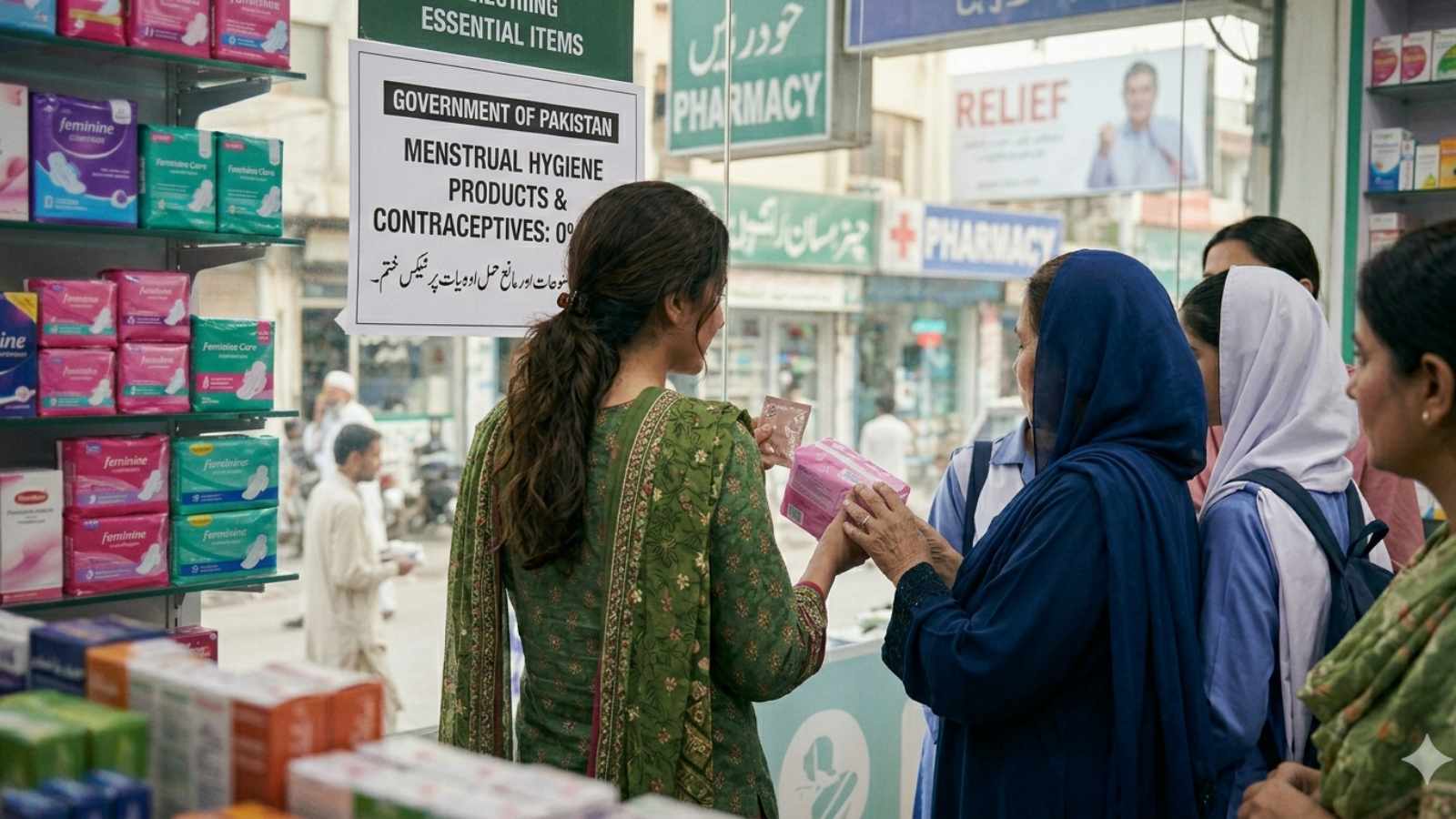
Taxing biological necessities creates an artificial economic bottleneck that suppresses labor participation, disrupts educational pipelines, and creates a regression in public health outcomes. Pakistan’s recent legislative shift in its Budget 2026–2027 to eliminate the 18 percent sales tax on sanitary napkins and contraceptives highlights the failure of historical fiscal frameworks. For decades, statutory classifications treated essential reproductive health products identically to discretionary luxury goods. Undoing this policy requires an examination of the underlying economic friction, market distortions, and the supply chain dynamics that dictate whether tax abolition translating into real-world price elasticity.
The Tri-Partite Cost Function of Menstrual Management
The real cost of a menstrual product extends far beyond its retail shelf price. For an individual consumer, the true economic burden is calculated through a compounded cost function comprised of three separate vectors. Expanding on this idea, you can also read: The Sky belongs to the Children.
- The Statutory Tax Burden: Until the recent budget adjustments, local manufacturing incurred an 18 percent sales tax, while imported products faced a 25 percent customs duty alongside localized tariffs. Combined, these mechanisms artificially inflated retail prices by roughly 40 percent.
- The Opportunity Cost of Absenteeism: When cost prohibits product acquisition, individuals substitute safe products with unhygienic alternatives or choose physical isolation. The macroeconomic result is systemic absenteeism. In developing economies, this equates to a predictable reduction in operational billable hours within industrial sectors and multi-day educational gaps for students every month.
- The Secondary Healthcare Premium: Using unhygienic substitutes introduces severe epidemiological risks, specifically reproductive tract infections and urogenital health complications. The financial cost to treat these preventable pathologies acts as a delayed tax, draining household income and overburdening state-subsidized healthcare systems.
When a standard pack of commercial sanitary products costs roughly 450 Pakistani Rupees against an average low-income household's monthly per capita allocation of roughly 34,000 Rupees, the product demands over 1.3 percent of total monthly income per individual. For families with multiple menstruating individuals, this baseline calculation forces a structural choice between nutritional security and basic hygiene.
Supply Chain Friction and Price Transmissibility
Removing a statutory tax does not automatically guarantee a corresponding drop in retail shelf prices. The primary structural threat to the success of this policy change lies in the supply chain and the behavior of corporate intermediaries. Experts at TIME have shared their thoughts on this trend.
[Raw Material Importers] ---> [Domestic Manufacturers] ---> [Wholesale Distributors] ---> [Retail Outlets]
     (Customs Duties)             (Production Overheads)          (Logistics Costs)            (Final Margin)
The abolition of the 18 percent domestic sales tax affects the final point of sale transaction. However, domestic manufacturers still operate under a complex tariff regime regarding raw material procurement. Pakistan imports a high percentage of the specialized polymers and non-woven fabrics required to produce safe sanitary products. If the 25 percent customs tax on these raw materials remains intact, the cost of goods sold (COGS) remains elevated.
A secondary barrier is the transmission elasticity within uncompetitive retail environments. In distributed supply networks with limited corporate oversight, distributors and retail store owners frequently absorb tax cuts to expand their gross margins rather than passing savings directly to end consumers. Without strict state monitoring or highly visible consumer price transparency, the fiscal relief intended for impoverished demographics risk becoming an unintended margin subsidy for corporate supply lines.
Structural Bottlenecks Beyond the Balance Sheet
Eliminating the fiscal penalty on hygiene products solves only the pricing component of a multi-variable problem. Two non-monetary bottlenecks continue to suppress product utilization even at a zero-percent tax rate.
Supply Elasticity in Rural Networks
The infrastructure of product distribution in developing nations heavily favors urban centers. Rural supply networks face fragmented logistics, which adds local transport premiums to product costs. If a product becomes tax-free but remains physically unavailable within a 20-mile radius of a rural settlement, the effective transactional cost—measured in transit time and transport fees—negates the legislative price reduction.
Information Asymmetry and Behavioral Stigma
Societal taboos act as an invisible tariff on transaction volume. In environments where the purchase of reproductive health products is heavily stigmatized, the psychological cost of acquisition remains high. This friction suppresses demand even when financial barriers are cleared. For government policy to realize its full economic return, fiscal reforms must be paired with systematic institutional distribution—such as integrating product access directly into public school systems and rural health clinics to bypass commercial retail barriers entirely.
Strategic Playbook for Market Regularization
To ensure that the elimination of the 18 percent sales tax delivers actual economic relief, the state must transition from passive legislative adjustment to active regulatory oversight. The following two-step structural framework outlines the required actions to maximize policy efficiency.
- Enact Raw Material Tariff Normalization: Expand the zero-rated tax classification from final retail goods to the specific Harmonized System (HS) codes governing the import of raw components used in manufacturing. Reducing final product taxes while leaving import tariffs on raw materials intact creates a domestic manufacturing disadvantage, encouraging the importation of finished foreign goods over local production.
- Establish Price Monitored Distribution Corridors: Implement mandatory Maximum Retail Price (MRP) adjustments on product packaging that reflect the exact 18 percent tax reduction. Simultaneously, leverage state-run utility stores to distribute unbranded, high-quality sanitary products at cost, creating a competitive price floor that forces commercial brands to pass tax savings down to the consumer.