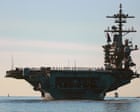
Modern carrier strike group operations are predicated on strict temporal limits, yet the operational tempo in the Middle East has pushed force management models past their calculated breaking points. When the Nimitz-class aircraft carrier USS Abraham Lincoln departed San Diego on November 21, 2025, its crew anticipated a standard six-month rotation. Instead, shifting geopolitical demands tied to operations involving Iran transformed the mission into a grueling endurance test. Surpassing 250 consecutive days at sea with only a single port stop in Guam during mid-December, the vessel established a modern baseline for fleet exhaustion.
An analytical breakdown of this deployment reveals three intersecting failure vectors: the degradation of logistical sustainment loops, the amplification of human capital friction, and the structural deficit of a single-carrier rotational model in high-threat theaters. Deconstructing these variables exposes why standard metrics of naval readiness failed to capture the compounding crisis beneath the flight deck.
The Logistics Collapse and Supply Chain Friction
Naval sustainment models rely on predictable replenishment-at-sea intervals and periodic access to industrial-grade port facilities. When a combatant remains underway for over eight months without deep logistics support hubs, the secondary and tertiary effects cascade rapidly through the engineering and hospitality plant.
- The Maintenance Deficit: Mechanical systems operating continuously in high-saline, high-temperature environments require scheduled preventative maintenance periods. Skipping these cycles converts minor wear into systemic infrastructure failures, manifesting as degraded air conditioning, restricted sanitation systems, and localized equipment breakdowns.
- The Caloric and Resource Bottleneck: Extended timelines disrupt supply chains, forcing provisions to stretch past standard replenishment thresholds. Reports from families citing sparse meals and restricted provisions highlight the vulnerability of afloat nutritional logistics under prolonged isolation. Clean water production and distribution systems face identical strain, stretching reverse-osmosis distillation units beyond optimal efficiency parameters.
- The Geographic Isolation Loop: Operating within the Arabian Sea and surrounding waters without friendly regional dry-dock access eliminates the safety margin for shipboard repairs. Every mechanical failure must be mitigated internally, consuming crew bandwidth that should be allocated to operational readiness.
Human Capital Depreciation and Psychological Load
Military organizations often treat human endurance as an elastic resource, yet cognitive and physiological degradation follow strict biological laws. The operational cost function of a 250-day deployment is paid in the exponential decay of crew morale and mental health stability.
- The Expectation-Reality Divergence: Naval morale relies heavily on temporal predictability. When a six-month deployment stretches past nine months without a fixed return date, psychological fatigue accelerates. The uncertainty surrounding liberty ports generates chronic stress, which directly impacts operational vigilance.
- The Physiological Toll of Confinement: Living among 5,000 sailors and Marines within a confined steel hull under combat conditions creates a hyper-compressed environment. Without the psychological reset provided by port visits—such as the upcoming scheduled stop in Thailand—sleep deprivation and chronic anxiety compound, elevating incident rates ranging from severe behavioral health crises to safety violations on the flight deck.
- The Leadership Communication Gap: Official assertions from defense leadership downplaying conditions often clash with empirical data transmitted via personal channels. This divergence damages institutional trust, leaving personnel isolated between high-stakes mission execution and unacknowledged internal distress.
Strategic Strain on the Global Force Management Model
The underlying driver of the Lincoln's record-breaking run is not tactical oversight, but a structural deficit in global naval capacity. The United States Navy maintains a finite number of carrier strike groups, forcing a zero-sum allocation strategy when regional conflicts erupt.
When one carrier must absorb the presence mission typically shared by two, rotational spacing collapses. The deployment of the USS George Washington to relieve the Lincoln in the Arabian Sea underscores the reactive nature of current force deployment. Rather than a proactive transition, relief operations become rescue missions for exhausted hulls and crews. This dynamic exposes a systemic shortfall: the naval industrial base and fleet size cannot sustain simultaneous high-intensity deterrence across multiple theaters without breaching personnel safety limits.
Operational Remediation and Future Deployment Architecture
Mitigating future failures requires abandoning the assumption that carrier endurance is infinite. Force planners must integrate hard caps on consecutive days underway, treating human capital depletion with the same rigor applied to nuclear reactor fuel limits.
- Enforce Non-Negotiable Rotational Thresholds: Hard-wire maximum underway timelines into combatant command scheduling, ensuring that relief carrier transit is initiated before crew cognitive fatigue reaches critical failure states.
- Diversify Regional Logistics Nodes: Expand agreements with allied nations in the Indo-Pacific and Middle East periphery to secure reliable, secure mid-deployment upkeep and crew rotation hubs, reducing reliance on single-stretch transits.
- Rebalance Fleet Architecture: Shift analytical focus from maximizing single-ship presence duration to optimizing cumulative fleet health, recognizing that an exhausted crew in a contested zone represents an unacceptable operational liability.
Establish a mandatory operational pause interval following any deployment exceeding 180 days at sea, decoupling ship readiness metrics from human endurance limits to preserve institutional capability over the long term.