The containment of foodborne pathogens traditionally relies on rapid source identification and localized consumer interventions. However, the multi-state surge in cyclosporiasis cases—exceeding 2,000 infections across more than 30 states, with Michigan registering a historical peak of over 1,500 cases—exposes a critical failure in standard consumer-level food safety paradigms. The underlying pathogen, Cyclospora cayetanensis, possesses biological and structural properties that render conventional retail produce washes, chemical sanitizers, and surface rinses largely ineffective.
To systematically minimize infection risk during the high-exposure window of May 1 through August 31, operations must shift from passive chemical remediation to structural risk evasion. This requires understanding the unique lifecycle mechanics of the parasite, identifying high-risk supply chain vectors, and implementing barrier-based and thermal intervention protocols.
The Structural Mechanics of Pathogen Persistence
Consumer product marketing frequently promotes topical vegetable washes and diluted acetic acid (vinegar) solutions as comprehensive sanitization tools. While these methods may reduce loose surface bacteria like Salmonella or E. coli, they fail against Cyclospora cayetanensis due to the parasite's evolutionary architecture.
The Oocyst Protective Barrier
The infective unit of Cyclospora is the sporulated oocyst. This microscopic sphere is protected by a dual-layered, highly resilient chemically resistant wall. This biomolecular shield protects the internal sporozoites from environmental stressors, including desiccation, standard chlorination levels used in municipal water treatment, and commercial chemical sanitizers.
Surface Adhesion Dynamics
The exterior surface of many high-risk raw agricultural commodities features complex micro-topographies. Structural attributes like the trichomes (microscopic hairs) on cilantro and basil, the deeply pitted drupelets of raspberries, and the micro-crevices of leafy greens provide mechanical anchor points for oocysts. When contaminated water comes into contact with these surfaces during pre-harvest irrigation or post-harvest washing, the oocysts adhere tightly via hydrophobic interactions and mechanical trapping. Standard superficial rinsing cannot exert enough hydrodynamic shear force to dislodge the parasite from these structural nooks.
The Latency Bottleneck in Epidemiology
A primary challenge in tracking and mitigating Cyclospora outbreaks is the temporal gap between consumption and clinical diagnosis. Unlike bacterial pathogens that manifest within hours, Cyclospora requires an incubation period of two to fourteen days (with a median duration of approximately seven days) inside the human host before initiating watery, prolonged gastrointestinal symptoms.
Furthermore, unlike viral or bacterial agents, Cyclospora is non-infectious immediately upon excretion. The unsporulated oocysts shed in feces require one to two weeks in warm environmental conditions outside the host to sporulate and become infective. This eliminates direct person-to-person transmission vectors but creates an extended diagnostic lag. By the time a cluster of cases is identified by public health agencies, the contaminated commercial lot has typically cleared retail shelves, leaving consumer memories as the primary, highly flawed tracing mechanism.
The Risk Vector Matrix
Effective mitigation requires a granular classification of produce based on surface topology and processing history. Risk is a function of surface area complexity and the level of aggregate exposure to communal processing water.
| Risk Tier | Commodity Profile | Primary Contamination Mechanism | Mitigation Feasibility |
|---|---|---|---|
| Critical Risk | Pre-cut salad kits, bagged spinach, shredded iceberg lettuce. | Large-batch immersion washing cross-contaminates entire commercial lots; internal cellular fluids promote pathogen adhesion. | Low: Surface washing is entirely ineffective post-packaging. |
| High Risk | Raspberries, blackberries, cilantro, basil, imported snow peas. | Complex micro-topography (drupelets, trichomes, crevices) traps oocysts via mechanical and hydrophobic bonds. | Moderate: Requires specialized physical scrubbing or strict thermal processing. |
| Moderate Risk | Whole heads of romaine or iceberg lettuce, cabbage. | Outer protective leaves absorb environmental and handling exposure; inner core remains isolated. | High: Complete structural removal of outer layers yields clean tissue. |
| Low Risk | Thick, smooth-skinned produce (melons, cucumbers, avocados). | Minimal surface area anomalies prevent tight adhesion; structural barrier prevents internal penetration. | Very High: Mechanical friction combined with target sanitizers removes surface units. |
The systemic vulnerability of pre-washed, bagged salad kits stems from commercial processing mechanics. When thousands of pounds of leafy greens are processed through centralized immersion flumes, a single contaminated batch introduces oocysts into the shared water volume. Because routine chemical sanitizers do not neutralize the pathogen, the flume water acts as an distribution vector, transferring the parasite across the entire production run.
A Data-Driven Decontamination Protocol
Given that topical liquid washes cannot reliably neutralize or detach Cyclospora oocysts from complex surfaces, consumers and food service operators must implement physical, structural, and thermal countermeasures.
1. Thermal Destruction (The Definitive Vector Elimination)
The only absolute safeguard against Cyclospora cayetanensis viability is the application of thermal energy. The cellular components of the oocyst wall denature at elevated temperatures.
- Mechanism: Raising the internal temperature of the commodity to a minimum of 158°F (70°C) instantaneously destabilizes the protective outer shell, rendering the internal sporozoites non-viable.
- Application: For commodities integrated into cooked dishes (such as basil in sauces or snow peas in stir-fries), verify that processing times allow the entire volume to surpass this thermal threshold.
2. Structural Layer Attrition
For leafy greens intended for raw consumption, risk reduction is achieved by discarding high-exposure structural elements rather than attempting to wash them.
- Mechanism: The outer leaves of whole heads of lettuce act as a physical shield, intercepting contaminated irrigation water and soil splashes during the cultivation phase.
- Application: Cease the procurement of pre-cut, bagged salad variations. Purchase whole heads of lettuce. Systematically remove and discard the outermost three to four layers of leaves. This removes the surface area most likely to carry an environmental pathogen load. The remaining inner leaves must then be processed under continuous running water rather than static immersion baths.
3. High-Friction Mechanical Clearing
For firm, smooth-skinned commodities, decontamination relies on mechanical displacement via physical abrasion.
- Mechanism: Direct physical friction disrupts the hydrophobic bonds anchoring oocysts to the waxy cuticles of produce skins.
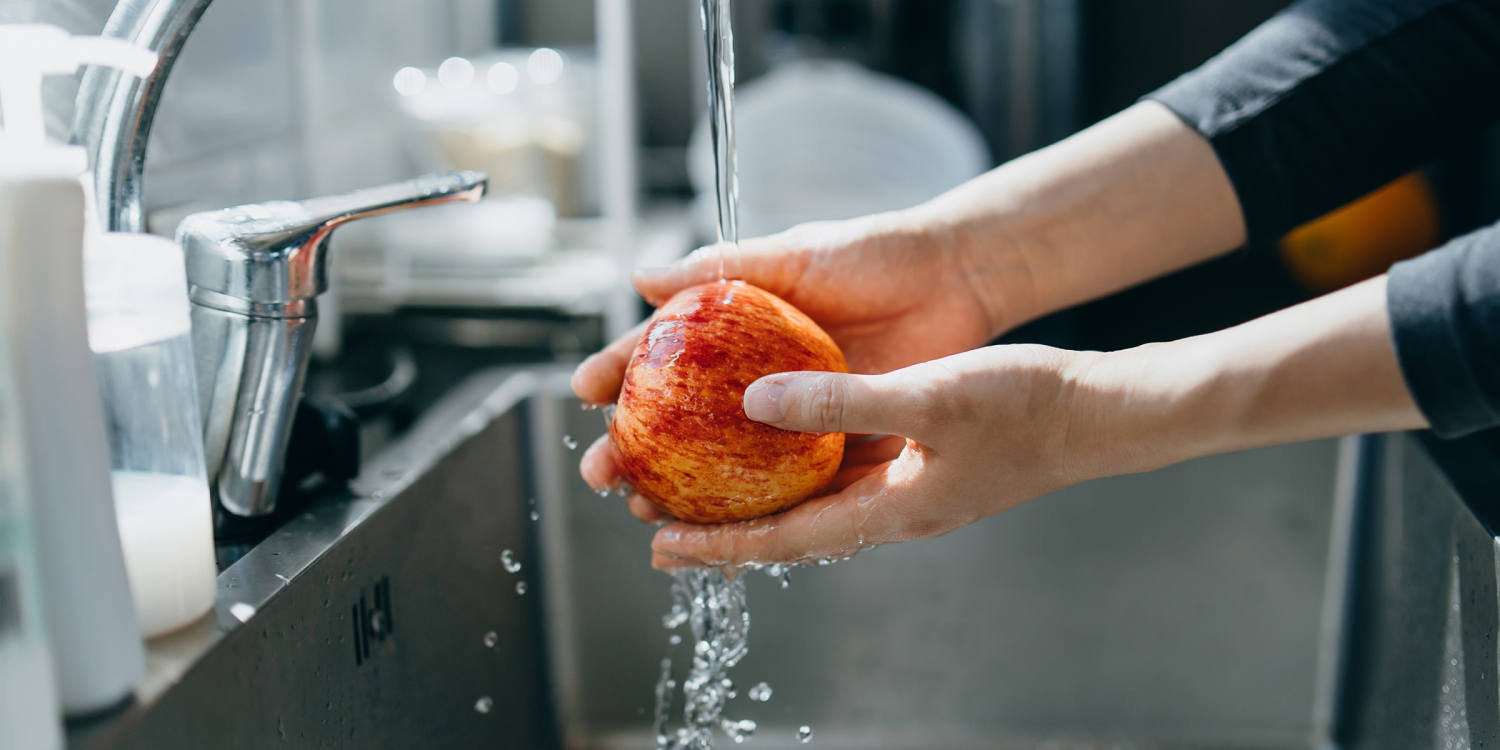
- Application: Utilize a dedicated, high-density nylon bristle vegetable brush under a high-flow stream of running water. Apply firm, omnidirectional pressure across the entire surface of the commodity (e.g., cucumbers, melons) for at least 30 seconds. This process mechanically dislodges adhered units and flushes them into the drainage system.
4. Centrifugal Fluid Displacement
For delicate items that cannot withstand intense manual scrubbing, structural drying protocols are necessary to prevent re-deposition.
- Mechanism: While immersion soaking fails to dislodge parasites, combining a mechanical rinse with high-velocity centrifugal extraction physically pulls moisture—and loose suspended particulates—away from the plant tissue.
- Application: Submerge produce in a continuous-flow rinse, transfer immediately to a mechanical salad spinner, and execute high-speed rotation until the surface is dry. This minimizes the residual water film that can harbor active oocysts during storage.
Strategic Outlook and Diagnostic Limitations
Definitive systemic protection remains constrained by current laboratory and regulatory realities. Cyclospora cayetanensis cannot be cultured in vitro, limiting real-time analytical monitoring within the supply chain. Furthermore, standard multiplex PCR gastrointestinal panels utilized by healthcare facilities do not universally include Cyclospora targets without explicit physician ordering, contributing to the systemic undercounting acknowledged by the Centers for Disease Control and Prevention. Recent structural changes, such as the 2025 decision to transition state-level reporting of the infection to an optional status within federal surveillance networks, further complicate predictive modeling and traceback efficiency.
Consequently, relying on agricultural oversight or retail certifications provides an insufficient safety margin during the summer peak. The optimal operational play requires moving away from the assumption that raw, complex-surface produce can be thoroughly sanitized at home. Mitigation must depend on strict raw-commodity avoidance, structural peeling of whole items, high-friction mechanical washing of smooth surfaces, and the prioritization of thermal processing across all high-risk food matrices.