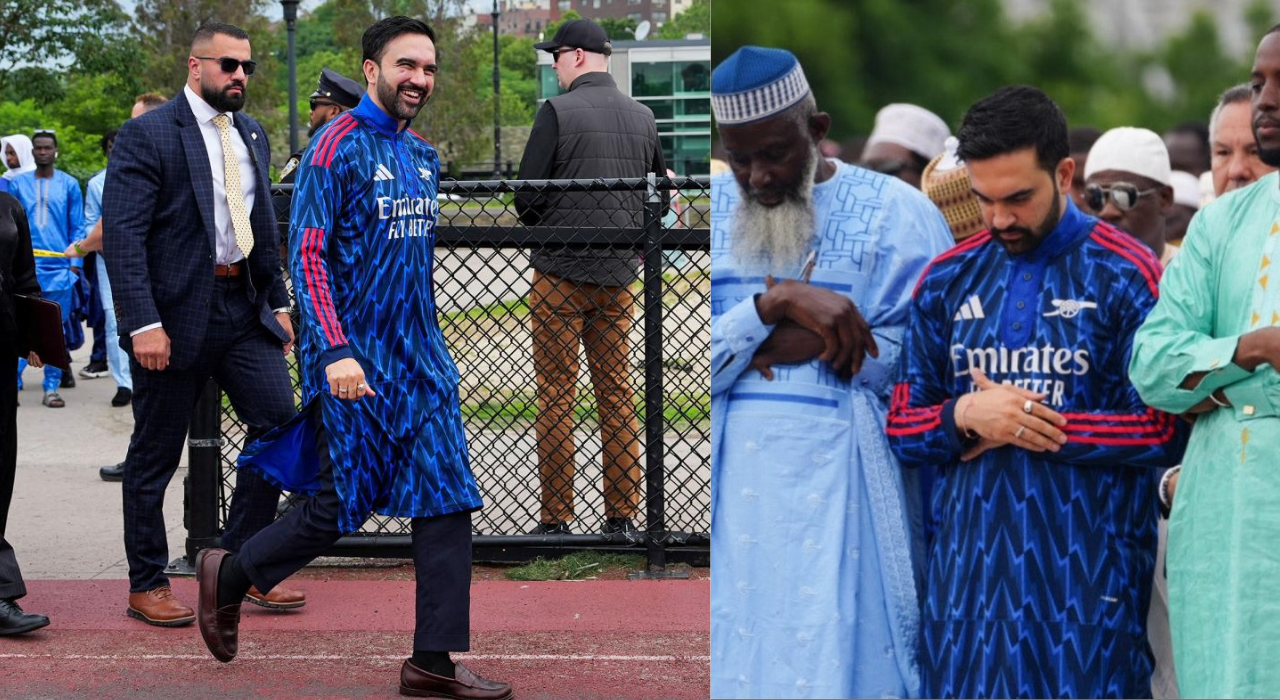
The intersection of sports fandom and traditional religious attire has transitioned from an underground subcultural mutation to a highly visible vehicle for political and cultural signaling. When New York State Assemblyman Zohran Mamdani attended an Eid al-Adha celebration wearing a customized "Arsenal thobe"—a traditional ankle-length garment re-engineered using the textiles, branding, and colorways of the Arsenal Football Club 2024/2025 away kit—the resulting viral trajectory was not an accident of the internet algorithm. It was the predictable outcome of cultural arbitrage.
This phenomenon operates at the convergence of three distinct structural shifts: the globalization of football kit culture as high fashion, the evolution of diaspora identity politics in Western metropolitan centers, and the algorithmic mechanics of digital virality. By deconstructing this moment through the lens of consumer behavior and cultural sociology, we can map the exact mechanisms that turn a localized wardrobe choice into a global case study of modern attention economics.
The Tri-Factor Framework of Cultural Convergence
The viral resonance of the Arsenal thobe relies on three foundational pillars. When these variables intersect, they create a highly potent vector for audience engagement.
1. The Financial and Aesthetic Mechanics of "Blokecore"
Over the past forty-eight months, football jerseys have completed their transition from utilitarian athletic wear to premium lifestyle commodities. This shift, colloquially termed "blokecore" within consumer culture, relies on decoupling a sports franchise's visual assets from actual match-day utility.
Premium football clubs now operate as luxury heritage brands. Kit manufacturers like Adidas, Nike, and Puma intentionally design jerseys with clean collars, intricate knit textures, and minimalist branding to ensure versatility in secular, non-sporting environments. The Arsenal away kit utilized in this specific garment—featuring a distinct palette of black, red, and green—was already optimized for subcultural adoption due to its departure from traditional sporting aesthetics.
2. Diaspora Identity Optimization
For second- and third-generation immigrant populations in Western urban centers, identity is rarely binary. It is an ongoing negotiation. Traditional garments like the thobe, kandura, or jubbah represent historical continuity, religious devotion, and familial roots. Conversely, football clubs represent localized, secular geography and peer-group integration.
Merging the two creates a highly efficient visual shorthand. The wearer simultaneously signals allegiance to a global faith community and a hyper-localized sporting subculture. This eliminates the friction between heritage and contemporary Western citizenship, projecting a synthesized identity that resonates deeply with a highly online, multicultural demographic.
3. The Algorithmic Mechanics of Novelty
Digital platforms prioritize high-contrast visual anomalies. The human eye, when scrolling through standardized feeds, flags structural incongruity. A thobe is characterized by long, unbroken lines of solid fabric, typically in white, cream, or dark muted tones. A football jersey is defined by high-contrast sponsor logos, club crests, and performance paneling.
Fusing these two distinct archetypes violates visual expectations. The algorithm rewards the resulting increased dwell time and comment-section debate, driving organic distribution without the need for paid amplification.
The Supply Chain and Fabrication Metrics
The existence of the Arsenal thobe points to a highly responsive, decentralized manufacturing ecosystem capable of rapid prototyping. This is not a mass-market product, nor is it an official club licensing agreement; it is an artifact of bootleg agility and hyper-customization.
The production of these garments bypasses traditional retail supply chains entirely. Small-scale textile artisans and independent tailors, primarily operating out of logistics hubs in South Asia and the Middle East, source raw technical polyester or high-grade cotton-synthetic blends that mimic jersey weights. They then apply screen prints, heat-transferred vinyl graphics, and machine-embroidered club crests onto custom-patterned thobes.
The economic feasibility of this arbitrage is driven by three core manufacturing realities:
- Low Minimum Order Quantities (MOQs): Digital sublimation printing allows single-unit or short-run production runs without the prohibitive setup costs of traditional screen printing.
- Direct-to-Consumer Distribution: Visual platforms like TikTok and Instagram serve as both the marketing funnel and the point of sale, flattening the distance between production and consumption.
- Intellectual Property Grey Zones: Because these garments are produced on an individual, bespoke basis or distributed through fragmented online storefronts, they operate beneath the enforcement thresholds of major athletic brands and sporting franchises.
Political Semiotics and the Currency of Authenticity
When a public official or political figure adopts this hyper-specific aesthetic, the garment ceases to be merely a fashion choice; it functions as a highly calculated instrument of political semiotics. For an elected official operating in a dense, diverse urban district, wardrobe choices serve as a non-verbal policy manifesto.
Traditional political attire—the standard navy suit and tie—signals institutional compliance, bureaucratic stability, and socioeconomic alienation from working-class constituencies. Conversely, the Arsenal thobe signals a multi-layered alignment with specific voting blocs. It communicates working-class sports alignment, religious solidarity during a major holy day, and a rejection of sterile, sanitized political norms.
The operational risk of this strategy is the thin line between perceived authenticity and cynical pandering. The modern electorate possesses highly sophisticated irony filters. If the political actor cannot demonstrate a genuine, long-term alignment with both the sporting subculture and the religious community, the action backfires, converting cultural capital into a liability defined by performative opportunism. The reason the gesture achieved net-positive velocity in this instance is due to the actor's preexisting cultural profile, which matched the organic demographic profile of the garment's target audience.
Structural Bottlenecks and the Half-Life of Subcultural Capital
While the viral growth of this specific outfit demonstrates the power of cultural convergence, the phenomenon faces distinct structural limitations that prevent it from scaling into a permanent retail category.
The primary bottleneck is institutional intellectual property enforcement. As these custom hybrid garments transition from isolated viral anomalies to scalable commercial operations, they inevitably trigger cease-and-desist mechanisms from sports franchises and multi-billion-dollar kit sponsors who fiercely protect their trademark rights. A major club like Arsenal FC or an apparel giant like Adidas cannot allow unmonetized, unregulated use of their brand IP on religious or cultural garments, as it complicates global brand positioning and violates exclusive licensing contracts.
The second limitation is the inherent depreciation of subcultural capital. The value of "blokecore" and custom hybrid fashion is derived from its scarcity and its status as an "insider" signifier. The moment a subcultural artifact is mass-produced, standardized, or acknowledged by mainstream corporate retail, it loses its counter-cultural utility. The early adopters abandon the aesthetic in search of the next uncommodified boundary, causing the market demand curve to collapse rapidly.
The Strategic Trajectory of Hybrid Apparel
The convergence of sportswear and traditional ethnic garments is not a temporary trend, but the first iteration of a permanent shift in global apparel design. As metropolitan populations become more pluricentric, the demand for clothing that reflects multi-hyphenate identities will accelerate.
Instead of fighting this trajectory, forward-looking athletic brands will likely shift from legal suppression to strategic co-creation. The logical progression is the introduction of official, limited-edition cultural capsule collections. Brands can partner with community designers to release authorized, culturally specific silhouettes—such as structured thobes, kurtas, or abayas—engineered with official team crests and premium performance textiles. This allows corporate entities to capture a highly loyal, high-margin market segment while providing the consumer base with legitimate, high-quality products that formalize their dual identities. The entities that master this synthesis first will capture the next frontier of global lifestyle retail.