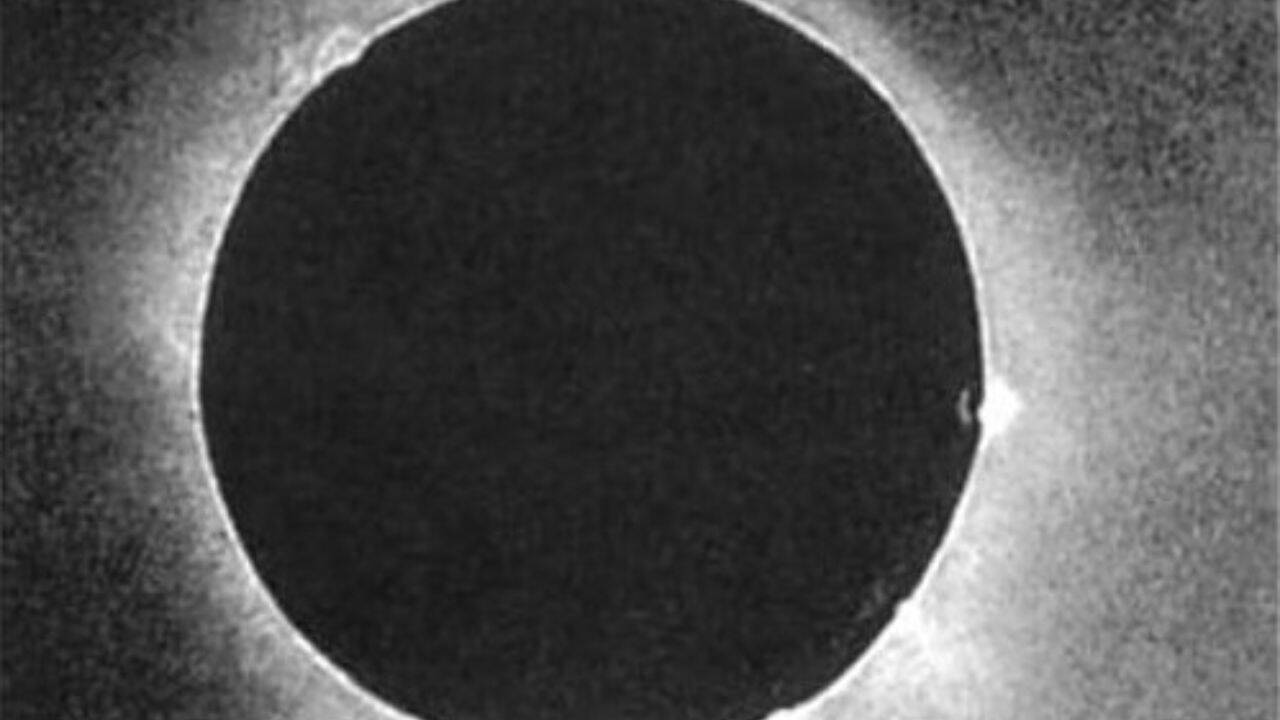
Recording a total solar eclipse via photographic plate on July 28, 1851, required solving a high-stakes calibration problem under severe optical constraints. When Prussian daguerreotypist Johann Julius Friedrich Berkowski aimed a small refracting telescope at the Royal Observatory in Königsberg to capture the solar corona, he was not merely taking a picture. He was executing an unprecedented physics experiment at the intersection of optics, chemistry, and astronomy. Popular narratives often misattribute his nationality or obscure the rigorous mechanics of his process behind vague historical wonder. Stripped of romanticism, Berkowski's achievement represents a masterclass in managing extreme dynamic range with primitive analog hardware.
The Optical Constraints and Equipment Architecture
The core challenge of astrophotography in the mid-nineteenth century stemmed from the severe limitations of early recording media. The daguerreotype process, invented by Louis Daguerre, utilized a silver-coated copper plate treated with iodine and bromine vapors to create a light-sensitive surface. While sensitive to ultraviolet and blue light, these plates possessed an extremely low overall sensitivity, roughly equivalent to an ISO rating well below 1.
To overcome this lack of sensitivity, Berkowski coupled a 6-centimeter refracting telescope to a 15.8-centimeter Fraunhofer heliometer at the Royal Observatory. This optical train introduced specific physical parameters:
- Aperture diameter restricted incoming light collection, necessitating longer exposure durations.
- Focal length determined the image scale, yielding an initial solar disk measuring less than 8 millimeters across on the plate.
- Lack of automated clock-driven equatorial tracking meant any manual adjustment introduced motion blur, threatening the razor-thin margin of clarity required during totality.
The equipment configuration forced a rigid operational window. The setup had to balance the intense photosphere emission against the faint, ghost-like luminosity of the solar corona.
The Cost Function of Exposure Duration
Prior attempts to photograph solar eclipses universally failed due to improper exposure calibration. Operators either overexposed the plate by exposing it too early while the partial phases of the sun were visible, or they failed to capture the dim coronal streamers entirely.
Berkowski optimized his parameters around an 84-second exposure window initiated precisely at the onset of totality. This duration functioned as a delicate equilibrium:
$$\text{Total Light Collected} = \text{Aperture Area} \times \text{Exposure Time} \times \text{Plate Sensitivity}$$
If the exposure dropped below 80 seconds, the silver matrix failed to register the faint plasma emissions of the corona. If the exposure extended past 90 seconds, the creeping edge of the diamond ring effect—the sudden reappearance of direct sunlight—would instantly swamp the plate with white light, turning the entire chemical layer opaque.
By executing an 84-second continuous exposure, Berkowski struck the exact median required to record both the black lunar disk and the glowing outer solar atmosphere on a single, non-replicable copper plate.
Systemic Failure Points in Nineteenth-Century Astrophotography
The production of the 1851 daguerreotype exposed several structural vulnerabilities in early scientific documentation. These vulnerabilities defined the boundaries of what researchers could achieve before the advent of dry-plate photography and gelatin emulsions decades later.
The primary bottleneck was the absence of a replication mechanism. A daguerreotype is a direct positive image formed on a reflective metal substrate. It possesses no negative counterpart; therefore, mass reproduction is impossible without secondary photography or hand-engraving. The original plate captured by Berkowski eventually vanished from the historical record, surviving only through secondary photographic copies and lithographic engravings produced decades later. This created an irreversible data degradation loop where subsequent generations of scientists studied copies of copies rather than the primary physical evidence.
Furthermore, the chemical processing sequence required immediate, on-site darkroom execution. Operators could not store sensitized plates for long periods or ship them to centralized laboratories. The wet chemistry had to be managed under field conditions, introducing high variance in plate consistency and chemical contamination risks.
Analytical Legacy and Modern Instrument Calibration
The transition from visual sketching to optical capture fundamentally altered astrometry. Before Berkowski's plate, astronomers relied on human hand-eye coordination during totality—a period lasting mere minutes where adrenaline and awe systematically compromised objective recording. Drawings of the corona frequently contradicted one another, reflecting the subjective bias of individual observers.
The daguerreotype introduced an unfeeling, mechanical witness. Even at a diminutive physical scale of two inches across, the 1851 image provided an empirical baseline for coronal structure that could be measured, scaled, and re-analyzed by independent teams. Modern solar physicists utilizing space-based coronagraphs and digital sensors operating across multi-spectral bands still rely on the foundational principle established in Königsberg: matching exposure timing directly to the specific radiant flux of transient atmospheric phenomena.
Calibrate future observation arrays by decoupling the recording medium's dynamic range limitations from the target event's peak luminosity, substituting manual timing loops with automated sensor brackets to eliminate operator-induced variance during critical celestial transitions.