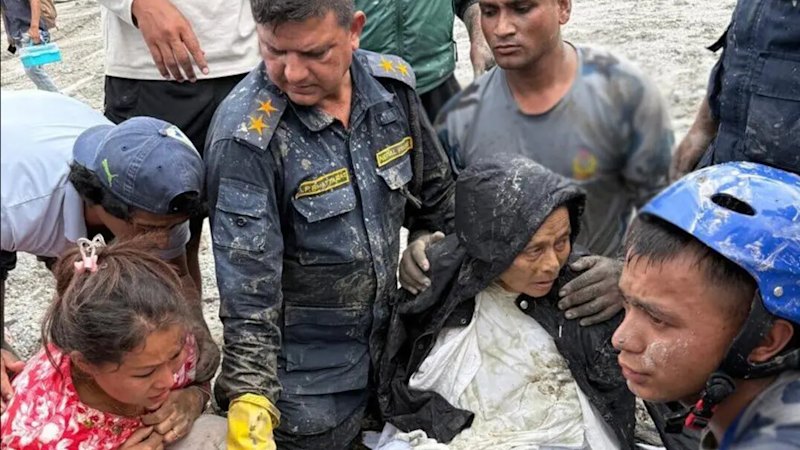
Crisis response under catastrophic failure conditions rarely follows linear operational protocols. When extreme environmental trauma buries a human subject under dense debris or viscous silt, the standard metric for intervention shifts immediately from recovery to acute extraction triage. The survival of an individual declared lost or abandoned within a collapse zone is not an anomaly of pure chance; it is the statistical intersection of micro-environment stabilization, physiological conservation, and the structural dynamics of search geometry. Analyzing how marginalized victims endure hours or days beneath subterranean weight requires deconstructing the physical, biological, and systemic variables that govern high-fatality disasters.
The Micro-Environment Mechanics of Silt and Debris Enclosure
When mud, slurry, or architectural rubble engulfs a victim, the primary determinant of short-term survivability is the formation of a void space. Without a localized pocket of atmospheric exchange, asphyxiation occurs within minutes due to hypercapnia and acute hypoxia. The physical composition of mud introduces unique thermodynamic and pneumatic challenges that differ fundamentally from structural concrete collapses.
Viscous sediment acts as a semi-fluid barrier that seals structural fissures, drastically reducing air permeability. However, wet silt and mud can also create a high-impedance acoustic filter. Sound propagation through dense media attenuates rapidly, meaning weak vocalizations struggle to breach the surface boundary. The faint auditory cue that pierces a heavy overburden layer represents a rare acoustic breakthrough where micro-fissures in the drying or settling sediment align to form a temporary wave duct.
Physical compression within a mud or debris enclosure triggers an immediate physiological response sequence. The human body under acute crush or confinement conditions attempts to minimize metabolic expenditure through involuntary autonomic down-regulation.
The Physiological Cost Function of Prolonged Entrapment
Cellular preservation during prolonged burial relies on metabolic rate suppression. When oxygen and hydration inputs drop to absolute zero, survival duration is dictated by finite metabolic reserves and thermal regulation.
The physiological response breaks down into three distinct phases:
- The Acute Panic Phase: Adrenaline surges spike heart rate and oxygen consumption, rapidly depleting available alveolar air within the immediate micro-environment. Subjects who survive this initial window typically transition into a low-oxygen conservation state characterized by bradycardia.
- The Ischemic Adaptation Phase: Restricted blood flow to peripheral tissues prevents systemic shock, preserving core organ perfusion at the expense of extremities. Hypothermia frequently sets in due to thermal conductivity coefficients of wet mud, which strips body heat significantly faster than ambient air. Paradoxically, mild hypothermia acts as a neuroprotective agent, lowering cerebral metabolic demand and delaying hypoxic brain injury.
- The Exhaustion Threshold: As glycogen stores deplete and electrolyte imbalances trigger cellular membrane failure, systemic organ collapse becomes imminent. The detection of a faint vocalization usually occurs at the absolute terminal boundary of this phase, just before the subject slips from conscious volition into unconscious metabolic shutdown.
Systemic Failures in Search and Extraction Triage
First-response operations deployed in mass-displacement disasters, such as flash floods or massive landslides, face immense resource allocation dilemmas. Search geometry protocols typically prioritize high-probability probability-of-detection zones, leaving peripheral or seemingly unviable sectors classified as terminal recovery zones rather than active rescue targets.
The misclassification of a living subject as deceased stems from heuristic errors within incident command structures. When visual indicators suggest catastrophic impact forces, rescue teams often substitute systematic physical probing with rapid heavy-machinery clearing. This operational shortcut creates a secondary hazard profile. Heavy excavation equipment introduces vibrational and mechanical pressures that can collapse localized micro-voids, transforming a survivable pocket into a fatal compression trap.
Optimizing Sub-Surface Signal Detection Protocols
Elevating disaster response outperformance requires a shift from macroscopic clearing strategies to micro-acoustic and thermal monitoring grids. Traditional canine units and visual sweeps fail when victims are entirely submerged beneath dense, wet particulate matrices that suppress scent cones and visual lines of sight.
Deploying seismic acoustic sensors and ultra-wideband radar systems allows teams to map subsurface voids without relying on active victim communication. Because a buried subject in extremis lacks the respiratory volume for sustained shouting, passive detection technologies must compensate for the decay of human output signals.
Integrating thermal imaging payloads on aerial drones with ground-penetrating radar creates a multi-layered diagnostic mesh. This approach maps thermal differentials and structural anomalies beneath mud-flows before heavy excavation units alter the topography.
Tactical Deployment of Extraction Assets
Resource deployment models must abandon static timelines in favor of dynamic threshold triggers. When environmental conditions point to high-density slurry entrapment, extraction teams should implement hydraulic tunneling and pneumatic stabilization immediately upon acoustic validation, bypassing standard clearance hierarchies. The presence of a single acoustic indicator mandates an absolute freeze on heavy bucket excavation within a fifteen-meter radius, substituting manual hand-shoveling and localized vacuum extraction to protect fragile micro-environments from collapse. Prioritizing precision over speed in the terminal extraction phase ensures that the structural integrity of the survival pocket remains intact until the subject is fully cleared from the overburden.