The defense world loves a good headline about robot planes. Every time a military agency flies an uncrewed jet, the internet floods with visions of Terminator-style dogfights. But the U.S. Air Force's push into live-fire testing for its autonomous aircraft isn't about sci-fi fantasy. It's about a cold, hard math problem.
The Pentagon is facing a crisis of scale. Fighter jets like the F-35 are incredibly complex and eye-wateringly expensive. We simply can't build them fast enough, and we don't have enough human pilots to fly them if a major conflict breaks out.
Enter the Collaborative Combat Aircraft program, or CCA. These aren't your grandfather’s Predator drones, slowly circling a desert with a remote operator in a trailer miles away. These are high-performance, autonomous fighter jets designed to fly alongside crewed fighters, sniff out enemy air defenses, and, as recent testing shows, pull the trigger when commanded.
Let's look past the press releases and unpack what these live-fire tests actually mean for the future of air warfare.
The Shift From Remote Control to True Autonomy
To understand why a live-fire test of an autonomous jet is a big deal, you have to understand how we got here. For decades, military drones were basically high-tech remote-controlled model airplanes. A human pilot sat in a ground station, staring at a screen, manually flying the aircraft via satellite link.
That system fails completely against a peer adversary.
If you fight a modern military, they will jam your satellite communications. They will block your GPS. A drone that relies on a constant stream of data from a pilot back home becomes a useless piece of flying metal the second the jamming starts.
The Air Force's new unmanned fighter programs solve this by putting the brain inside the cockpit. Software, not a remote human, flies the plane.
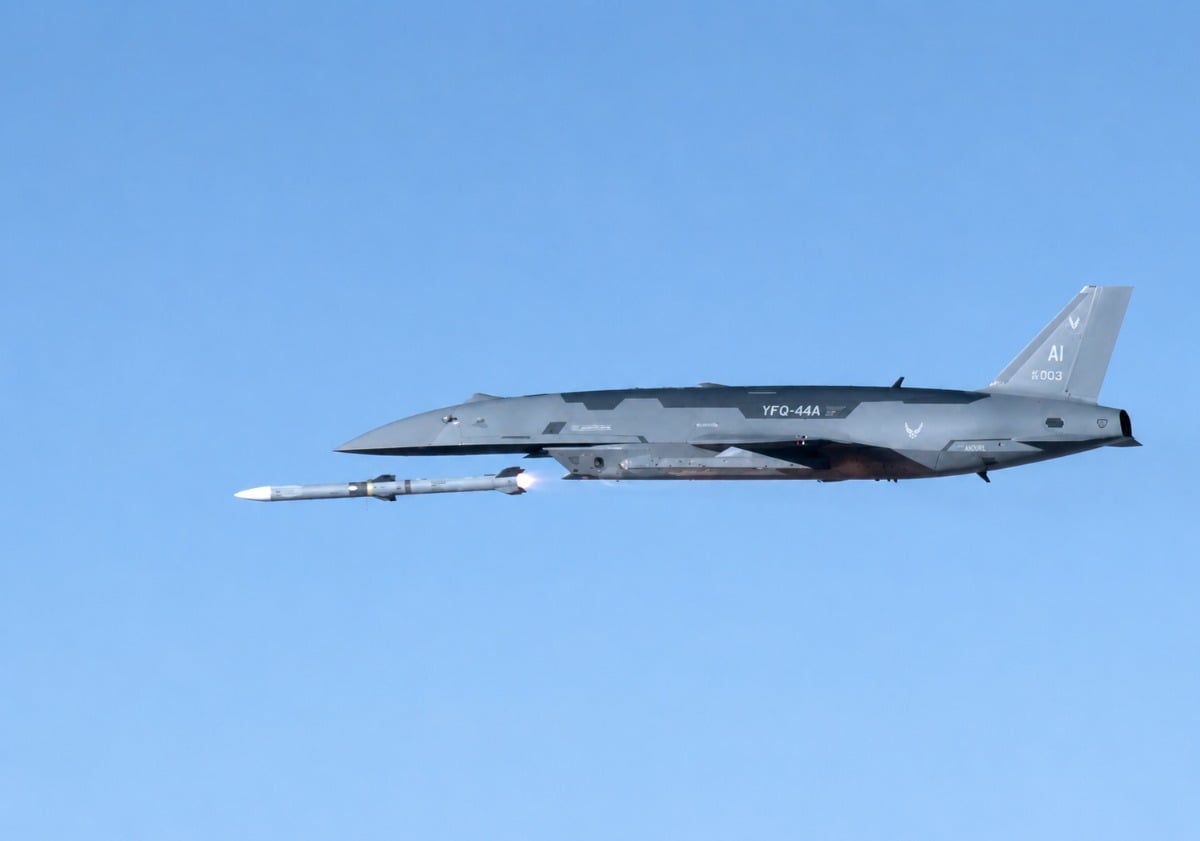
In recent evaluations, testbeds like the X-62A VISTA—a highly modified F-16 used to test AI software—and tactical platforms like the XQ-58A Valkyrie have shown they can handle complex flight regimes on their own. The latest live-fire milestones prove these platforms can do more than just navigate. They can identify a target, coordinate with a human pilot in a nearby F-35 or F-22, and execute a weapon launch.
This isn't a pilot drone. It's an autonomous wingman.
The Logistics Behind Autonomous Weapon Release
A lot of people assume "autonomous" means the machine is making the decision to kill. That's not how this works, and honestly, the military is terrified of that narrative.
The Air Force operates under strict rules of engagement. Under current policy, a human must always remain "in the loop" for any lethal action. The live-fire testing focuses on a concept called Manned-Unmanned Teaming, or MUM-T.
Think of it as a division of labor.
- The Unmanned Jet: Flies ahead into dangerous airspace. It uses its active sensors to locate enemy radar installations or enemy planes. Because it has no pilot, it can take massive risks that a human flight lead never would.
- The Human Flight Lead: Sits miles behind in a stealthy F-35, running on passive sensors to avoid detection. The human receives target data from the unmanned wingman.
- The Execution: The human pilot authorizes the strike. The unmanned jet fires its missile.
This setup keeps the human safe while dramatically extending the reach of their weapons. During live-fire tests, engineers aren't just checking if the missile leaves the rail. They're testing the data link. They need to know if the AI can receive a targeting solution, calculate the launch envelope, execute the release command instantly, and then evaluate whether the target was destroyed.
If the link drops for even a microsecond, the system fails. That's why physical, live-fire testing in heavily jammed environments is so critical. You can't simulate the chaotic physics of a missile launch and the electronic noise of a modern battleground in a laboratory.
Why General Atomics and Anduril Are Winning This Race
The Air Force isn't relying on traditional defense contractors to build this future. The old way of building planes—spending twenty years and hundreds of billions of dollars to design a single airframe—is dead.
Instead, the Air Force split the CCA program into increments. For the first phase, they tapped General Atomics and Anduril.
General Atomics brings decades of drone experience to the table. Their Gambit series of autonomous planes relies on a common core chassis with different wings and engines depending on the mission. It's a modular approach that keeps costs low.
Anduril, a relative newcomer, approaches the problem from a software-first perspective. Their Fury platform is built around their Lattice operating system, which handles the complex task of autonomous decision-making.
By forcing these companies to compete, the Air Force wants to drive the cost of an unmanned fighter down to a fraction of an F-35's price tag. The goal is "attritable" aircraft. That's a military term meaning the plane is cheap enough that you won't cry if it gets shot down, but capable enough that the enemy has to treat it as a deadly threat.
The Hurdles Nobody Wants to Talk About
While the test flights look spectacular on video, building a fleet of thousands of robot wingmen presents massive hurdles.
The first is trust. Air Force pilots are notoriously skeptical. If you're flying a hundred million dollar jet at Mach 1.5, you need to know that the autonomous wingman next to you isn't going to make an erratic turn and clip your wing. Building AI that behaves predictably in dynamic, three-dimensional combat environments is incredibly difficult.
Second is the software update problem. In a hot conflict, the enemy will adapt their electronic warfare tactics daily. If it takes six months of safety reviews to push a software patch to the autonomous fleet, we lose. The Air Force has to develop a way to update flight and combat software overnight, safely, while the planes are deployed at forward bases.
Finally, there's the infrastructure. These jets still need fuel, maintenance, and runway space. If they require the same massive logistical footprint as a traditional fighter squadron, we haven't actually solved the scale problem.
What Happens Next
We're going to see a rapid acceleration of these tests over the next two years. The Air Force wants operational CCAs integrated into active wings by the late 2020s.
If you want to track this progress, don't just look for reports of successful missile launches. Watch the deployment numbers. Watch how the military integrates these systems into red-flag exercises.
The true test of this technology isn't whether a robot can fire a missile at a drone target over a desert in Utah. The test is whether a standard fighter squadron can deploy to a austere Pacific runway, roll out ten autonomous wingmen, fly a complex mission through contested airspace, and bring everyone back safely.
The era of the solitary fighter pilot is ending. The future belongs to the flight lead managing a digital wolfpack.