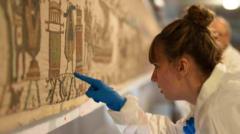
The room must stay exactly 19 degrees Celsius. Not 20. Not 18.
If the humidity shifts by a mere fraction, a microscopic panic ripples through a team of scientists who have spent years preparing for this exact moment. They are looking at seventy meters of linen and wool that survived the fire of 1159, the French Revolution, and the desperate plundering of Nazi Heinrich Himmler.
Now, it faces its most dangerous enemy: a bumpy road in a moving van.
When news broke that the Bayeux embroidery—the monumental textile depicting the Norman Conquest of 1066—might leave French soil for the first time in nearly a millennium, the public saw a grand diplomatic gesture. Politicians shook hands. Editorial writers penned columns about cross-Channel unity. But behind the heavy oak doors of the Musée de la Tapisserie in Normandy, the reaction was altogether different. Curators felt their stomachs drop.
Moving a masterpiece of this age is not a logistical puzzle. It is an existential gamble.
To understand why, you have to look past the grand historical narratives of King Harold getting an arrow in the eye or William the Conqueror claiming his crown. You have to look at the back of the cloth.
The Weight of Eleven Centuries
Imagine holding a single piece of linen woven during the Middle Ages. It feels remarkably light, almost fragile, like the shed skin of a cicada. Now, imagine seventy meters of it, weighed down by millions of tiny, colorful woolen stitches.
Over nine centuries, gravity becomes a slow-motion executioner.
When the embroidery hangs on a wall, the weight of the bottom sections pulls relentlessly on the threads above. The linen stretches. The wool frays. Left alone in a climate-controlled vault, it decays at a crawl. But move it? Shake it? Expose it to the vibrations of a diesel engine on a European motorway? That is how history turns to dust.
Pierre, a hypothetical senior conservationist whose composite character represents the very real fears of the Bayeux team, knows this intimacy of ruin. For thirty years, his world has been measured in millimeters. He doesn't see a monument to a battle; he sees tension points. He sees the exact spot where a patch of seventeenth-century restoration work is pulling away from the original eleventh-century backing fabric.
"People think the danger is someone dropping it," Pierre might say, tracing a gloved finger a few inches above the glass. "It isn't. The danger is the air. The danger is the microscopic friction of the fibers rubbing against each other as the transport crate tilts at a three-degree angle on a roundabout outside Amiens."
This is the invisible reality of heritage preservation. The public wants the thrill of the artifact. They want to stand inches from the physical proof of the battle that reshaped the western world. They do not see the frantic, sweat-inducing calculations required to ensure that the physical proof doesn't disintegrate before their eyes.
The Anatomy of an Impossible Journey
Before a single vehicle could even be booked, the French authorities demanded an unprecedented anatomical inspection of the cloth.
Scientists used hyperspectral imaging to look through the layers of wool, mapping every stain, every tear, and every single moth hole left behind by generations of careless handling. What they found was a fragile ecosystem. The embroidery is not a single, solid object. It is a patchwork of survival. It has been rolled up, unrolled, hidden in damp church crypts, and nailed to wooden beams for centuries.
Every time it was moved in the past, it suffered.
Consider what happens next in the transport plan. You cannot simply fold seventy meters of ancient linen into a box. If you crease it, the fibers snap. You must roll it around a massive, specially designed cylinder. But if the cylinder is too small, the tension on the outer layer increases, crushing the embroidery beneath it. If the cylinder is too large, it won't fit through the doors of the museum.
Then comes the problem of the Channel itself.
The shortest route from Normandy to London involves a ferry crossing or the Channel Tunnel. Both present unique nightmare scenarios for a conservationist. The sea brings salt air and unpredictable motion—the slow, rhythmic rolling of a ship can loosen specialized packing materials. The tunnel offers speed, but the rapid air pressure changes could cause the sealed nitrogen transport cases to expand or contract, altering the microclimate inside.
Every single variable must be entirely controlled. There can be no surprises.
Why We Risk the Relic
If the stakes are so terrifyingly high, why do it at all? Why not leave the ancient cloth in its dark, protective home in Normandy, where it has rested safely for generations?
The answer lies in our collective need for tangible truth.
We live in an era where history feels increasingly abstract, digital, and malleable. You can alter a photograph with a keystroke. You can rewrite a narrative with an algorithm. But you cannot fake the physical reality of a nine-hundred-year-old piece of wool that was stitched by hands that smelled of woodsmoke and tallow candles.
Standing in front of the artifact, you are looking at the exact same colors that a medieval peasant looked at. You see the blood-red wool used to depict the horses at Hastings. You see the crude, almost comic depictions of mythical beasts in the borders, revealing the fears and superstitions of the minds that created it.
It is a bridge across time that nothing else can replicate.
But that bridge requires a human toll. It requires teams of couriers who will not sleep for forty-eight hours straight, their eyes glued to telemetry monitors tracking the humidity inside a armored truck. It requires police escorts through two different countries, ensuring that the vehicle never has to make a sudden, jarring stop.
It is a strange paradox of the modern world. We use satellite navigation, advanced climate sensors, and armored convoys just to protect a collection of threads spun on a wooden wheel before the invention of the printing press.
The Silence of the Gallery
When the journey finally ends and the crates are opened in London, a heavy silence always falls over the conservation bay.
The technicians don't celebrate immediately. They don't pop champagne. Instead, they put on their headlamps, lean over the unrolled fabric, and begin the painstaking process of comparing the post-travel reality with the hyperspectral maps made weeks before in France.
They look for a single loose thread. A microscopic pile of blue wool dust at the bottom of the casing. A new, fraction-of-a-millimeter tear near the border where King Harold meets his fate.
Only when the comparison matches perfectly do they finally breathe out.
The public will eventually line up around the block, waiting in the damp London air for a chance to glimpse the legendary conquest. They will talk about the politics, the kings, and the ancient enmity between England and France. They will marvel at the sheer scale of the achievement.
They will never see the true masterpiece: the fact that it arrived whole.