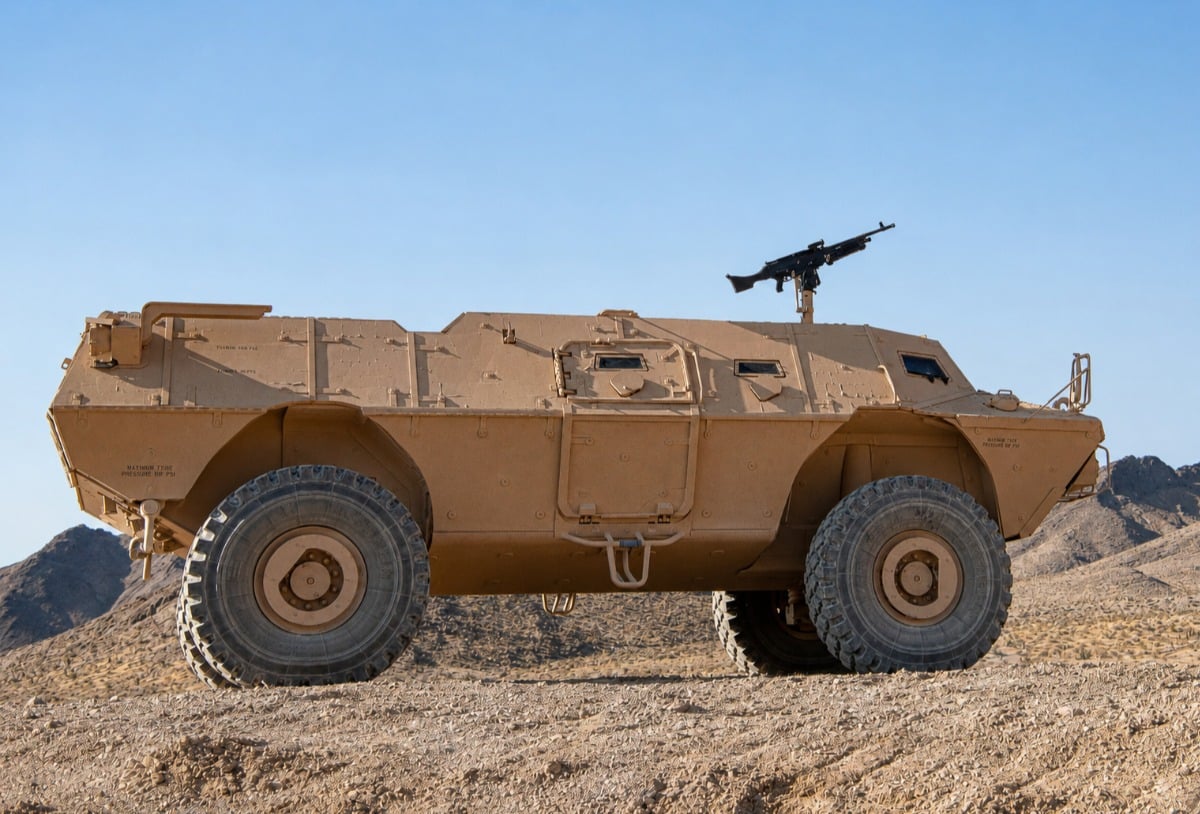
The headlines are celebrating a triumph of American manufacturing readiness. The defense establishment is patting itself on the back because a restarted production line is churning out 65 refurbished armored vehicles destined for Ukraine. The narrative is neat, comforting, and entirely wrong.
We are told this is a story of agility. In reality, it is a monument to a deeply flawed procurement strategy that prioritizes legacy iron over the brutal realities of modern attrition.
I spent years analyzing defense supply chains and watching Pentagon budgets vanish into the black holes of legacy platforms. If you think shipping 65 heavy armored vehicles moves the needle on a 1,000-kilometer active front, you are fundamentally misunderstanding the math of modern warfare. This isn't a logistical victory. It is an expensive distraction from the reality that the West is still bringing twentieth-century manufacturing concepts to a twenty-first-century drone fight.
The Math of Attrition Always Wins
The conventional media covers armored vehicle drops like they are sports scores. "Country X sends 65 vehicles." "Country Y pledges 30 tanks."
Let's look at the actual data. According to open-source intelligence trackers like Oryx, armored vehicle losses on both sides of the Ukrainian conflict are measured not in dozens, but in thousands. A batch of 65 vehicles represents, at best, a few weeks of intense operational depletion.
Restarting a massive, dormant assembly line to produce a double-digit yield is a financial disaster disguised as a geopolitical statement. The fixed costs of spinning up tooling, sourcing rare components, and retraining specialized labor for a microscopic production run defies every principle of economic scale.
Imagine a scenario where a commercial car manufacturer completely refitted an entire factory just to produce 65 station wagons. The board would fire the CEO before sundown. Yet, when the defense sector does it, it gets a press release and a bump in stock price.
The Drone Problem Nobody Wants to Budget For
The defense establishment remains obsessed with heavy armor because heavy armor is expensive, and expensive programs sustain massive corporate ecosystems. But a funny thing happened on the way to the proving grounds: the sky filled with $500 first-person view (FPV) drones carrying shaped charges.
The tactical reality on the ground has outpaced procurement cycles by a decade.
- The Cost Asymmetry: A single armored personnel carrier can cost upwards of $3 million to manufacture and logistically support. A swarm of ten loitering munitions costs less than a used sedan.
- The Mobility Trap: Heavy vehicles require massive fuel infrastructure, dedicated maintenance crews, and specialized parts. In a contested electronic warfare environment where every thermal signature is spotted by a satellite or a drone within minutes, heavy logistics tails are just target practice.
- The Protection Myth: No amount of passive steel or aluminum armor stops a top-attack drone hitting the thinnest part of a vehicle.
Adding 65 targets to the theater does not change the strategic calculus. It merely increases the maintenance burden on a Ukrainian logistical framework that is already struggling to manage a logistical nightmare of mixed fleets from fifteen different donor nations.
Why Do We Keep Building Targets?
The public constantly asks: "Why can't the US just send more armor faster?"
The premise of the question is completely broken. The public assumes the bottleneck is political will. The real bottleneck is a rigid, consolidated defense industrial base that cannot pivot. The US defense sector consolidated from dozens of competitors during the post-Cold War era down to a handful of massive prime contractors. These giants are optimized for long-term, low-rate initial production of highly complex systems. They are not built for rapid, high-volume surge capacity.
When the Pentagon tries to restart a line for a legacy vehicle, it discovers that the sub-tier suppliers who made the specific valves, gaskets, or microchips went out of business during the Obama administration. The engineering hours required to reverse-engineer or replace those missing links eat up months of calendar time and millions of dollars before the first piece of steel is even cut.
The contrarian truth is clear: we should stop trying to resurrect dead assembly lines for twentieth-century platforms.
The Unconventional Blueprint for Modern Aid
If the goal is actually operational efficacy rather than theater, the strategy must change immediately. The downsides to this shift are real. It requires acknowledging that heavy, prestigious platforms are no longer the ultimate arbiters of land dominance. It means telling defense contractors that their multi-billion-dollar cash cows are obsolete.
Instead of restarting lines for 65 heavy vehicles, that same capital and industrial capacity should be diverted into three areas:
- Mass-Scale Component Sourcing: Standardized, modular component manufacturing for uncrewed systems that can be assembled locally near the theater of operations.
- Distributed Industrial Printing: Deploying high-end, industrial 3D-printing hubs closer to the logistical nodes to manufacture replacement parts for existing fleets on demand, eliminating the ocean-crossing supply chain.
- Active Protection Systems (APS): Sinking every available R&D dollar into scalable directed-energy and kinetic counter-drone systems that can be bolted onto the vehicles already in the theater, rather than building new iron boxes that lack indigenous defense mechanisms against loitering threats.
We are watching a clash between industrialized bureaucracy and software-defined warfare. The bureaucracy is celebrating a handful of restarted machines. The software-defined side is adapting every single afternoon.
Stop measuring commitment by the tonnage of steel shipped across the Atlantic. If the Western defense apparatus continues to mistake manufacturing nostalgia for strategic readiness, it will keep spending billions to produce highly precise, incredibly expensive museum pieces. The factory line of the future isn't a resurrected heavy foundry. It is a cleanroom turning out microelectronics and autonomous guidance software by the millions. Turn off the old lines for good.