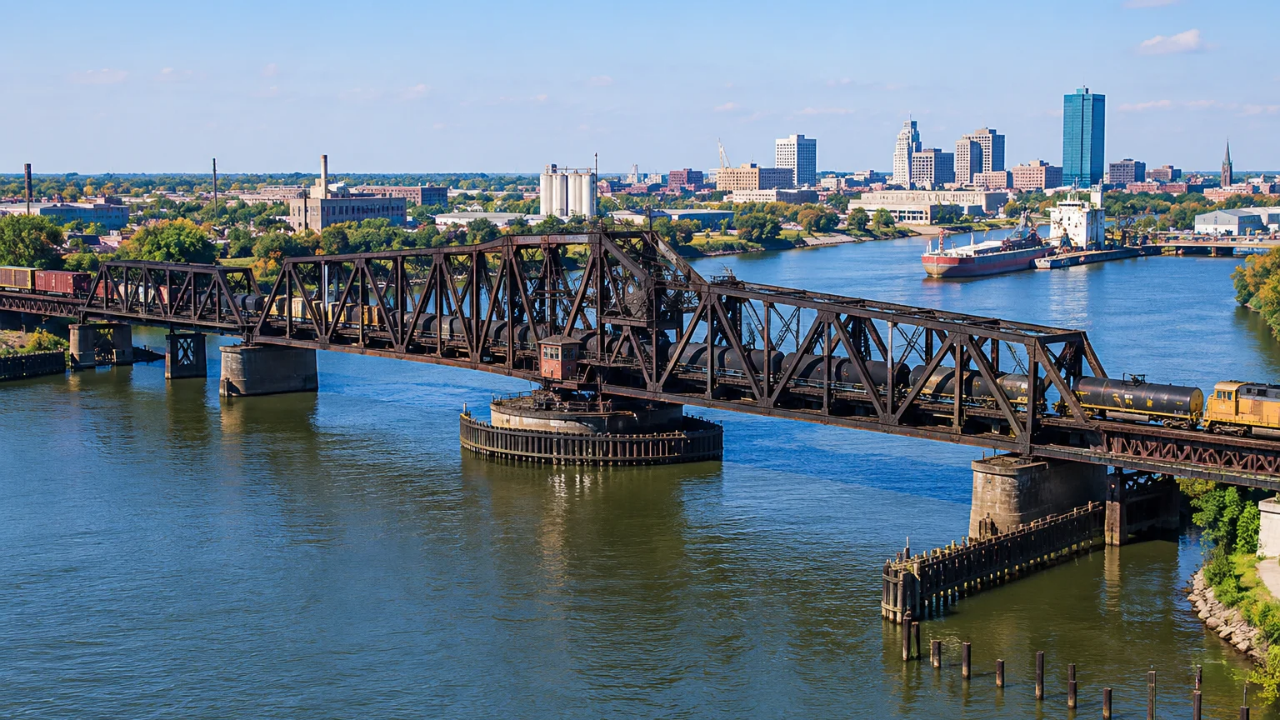
Stop celebrating a $65 million press release. A 129-year-old swing bridge over the Maumee River is getting tens of millions in public and private cash to carry 286,000-pound railcars. Sounds like a triumph of industrial grit. Sounds like a lifeline for Ohio freight.
It isn't. It's a band-aid on a structural mismatch.
Look at the lazy consensus parroted across every local newsroom and freight blog. Old bridge bought for a dollar in 2004. Federal grant of roughly $43.5 million swoops in. Heavy railcars can now roll across. Freight booms. That narrative is tidy, sentimental, and completely detached from how modern North American rail economics actually work.
A bridge is just one link in a chain. If the rest of the corridor, the shipper sidings, the yard dwell times, or the marine interface don't match, upgrading a single river crossing doesn't unlock a freight boom. It just moves the choke point twenty miles down the line.
The 286,000-Pound Illusion
In North American freight rail, the 286,000-pound gross rail load (often written as 286k GRL) isn't a futuristic super-car. It has been the standard heavy-axle benchmark for decades. A typical 286k car rides on four axles, putting roughly 71,500 pounds of static load per axle onto the rail—before dynamic bounce, lateral sway, or braking forces even enter the picture.
When a century-old pin-connected Pratt truss swing bridge—built in 1897 when coal hoppers and boxcars were a fraction of modern weights—is restricted below 286k, shippers have to light-load cars. Light-loading means hauling partial payloads or routing heavy steel coils, aggregates, and grain around the restriction.
Raising the bridge's capacity to 286,000 pounds removes a glaring ceiling. Nobody in rail engineering doubts that. Pin connections wear. Eyebars fatigue. Movable spans take brutal mechanical abuse every time they pivot open for river traffic on the Maumee. Reinforcing the movable machinery and replacing fixed spans—swapping old truss spans for plate girders—is textbook structural triage.
Here is the part the press releases skip: getting a bridge rated for 286k does not mean your entire route or customer base is ready for 286k.
Heavy axle loads punish track geometry. They accelerate rail head wear, depress soft subgrade in wet Midwest clay, and expose weak turnouts and timber ties. If a short-line or regional corridor has spotty rail weights or marginal ballast, a shiny upgraded bridge simply passes heavier stresses straight into whatever weak link sits next in line.
| Infrastructure Factor | Press Release Claim | Operational Reality |
|---|---|---|
| 286,000-lb Rating | Unlocks massive new freight volumes automatically. | Removes a weight ceiling, but only helps if connecting track, yards, and customers can handle 286k. |
| $1 Purchase Price (2004) | Proves the bridge was a bargain asset waiting to shine. | Reflects deferred maintenance liability and low salvage value at the time—not free equity. |
| Movable Swing Span | Preserves river and rail harmony effortlessly. | Movable bridges remain complex mechanical assets with marine opening delays and maintenance exposure. |
| Timeline to Construction | Immediate relief for Toledo freight. | Funding announcements are one thing; engineering, permitting, and multi-year execution take time. |
What Buying a Bridge for $1 Actually Meant
Every coverage angle loves the "bought for $1" hook. It makes Wheeling & Lake Erie Railway look like a master thrifter who turned pocket change into a $65 million windfall.
Let's be honest about what a one-dollar asset transfer in heavy industry usually signals. It means the seller wanted the liability off its books. An aging movable bridge over a navigable waterway isn't a passive piece of real estate. It carries inspection mandates, marine clearance obligations, structural fatigue risk, and heavy capital requirements. A railroad taking that on in 2004 wasn't finding buried gold; it was accepting a long-term maintenance burden to protect a strategic route.
I've watched industrial operators chase "cheap" infrastructure acquisitions for years, only to discover that the purchase price was a rounding error compared to the capital needed to bring the asset up to modern commercial standards. Public grants—like federal rail infrastructure awards paired with state rail support and carrier matching funds—exist precisely because private short-line and regional economics often struggle to self-fund massive bridge overhauls on pure return-on-investment math alone.
That doesn't make public grants bad. Infrastructure policy isn't supposed to fund only the easiest, highest-margin 10-mile stretch in America. Sometimes public capital bridges the gap between social/regional utility and private balance-sheet reality.
Still, let's stop pretending a $1 sale years ago explains today's engineering math. Steel tonnage, labor rates, fabrication lead times, and marine construction rules dictate a $65 million price tag—not a nostalgic trivia fact.
The Question Toledo Should Actually Be Asking
Competitor coverage treats the bridge as the main character. Ask the wrong question, and you get comforting answers.
The lazy question is: Will this $65 million overhaul let the bridge carry 286,000-pound railcars? Yes—that is the explicit engineering target.
The real question is: Where does freight actually lose time, margin, and reliability across the broader Toledo gateway?
In freight logistics, velocity beats peak axle weight more often than people admit. A railcar can be rated to 286,000 pounds and still sit idle for days waiting on switching, interchange handoffs, crew availability, or port/terminal congestion. On a swing bridge over a busy river channel, availability matters just as much as capacity. Every swing open for a vessel interrupts rail flow; every mechanical fault on a century-old movable span turns a routine train movement into a service failure.
Consider industry heavyweights like the Association of American Railroads (AAR) and the American Railway Engineering and Maintenance-of-Way Association (AREMA). Their technical standards exist because railroading is a system of interacting tolerances—wheel profiles, rail metallurgy, bridge design loads, and track maintenance cycles. Change one variable without checking the neighbors, and you create friction somewhere else.
Imagine a scenario where a regional shipper upgrades its outbound loading to full 286k cars after the bridge work wraps up. On paper, fewer cars are needed for the same tonnage. In practice, if a connecting yard track has a lighter weight restriction, if a customer's scale or siding isn't rated for it, or if interchange transit times stay sluggish, the shipper doesn't magically capture new market share overnight.
"People Also Ask" — Dismantled Without Fluff
Why upgrade an 1897 bridge instead of building a brand-new one?
Because greenfield bridge construction over a navigable river with approaches, foundations, utilities, and permitting routinely blows past $65 million—often by a wide margin. When existing piers or alignment geometry still work, replacing fixed spans (especially swapping older trusses for modern steel girders) and reinforcing or rehabilitating the movable span is usually the fastest, most cost-effective way to hit modern load ratings.
The catch is age. Even with new steel and mechanical upgrades, you are still working around legacy geometry, river channel constraints, and an aging foundational footprint. You aren't buying a brand-new 100-year blank slate; you are extending the useful life of a critical corridor asset.
Will this lower shipping costs for Ohio manufacturers and farmers?
Potentially at the margin for specific heavy commodities, not as a sweeping price cut across the board. If eliminating a weight restriction stops a shipper from running half-empty cars or taking longer detours, per-ton rail economics improve.
However, rail rates are driven by competition, fuel, car supply, switching costs, and network fluidity—not a single bridge project alone. Any shipper expecting freight bills to plummet the day construction finishes is setting up for disappointment.
Does upgrading a rail bridge automatically boost river shipping too?
No. A rail bridge upgrade is built for trains, even when work around fenders or clearances touches the marine environment. River commerce depends on dredging depths, lock/channel conditions, dock infrastructure, and barge or vessel demand. Rail and water can complement each other in a port hub like Toledo, but fixing a railroad bridge doesn't dredge a channel or summon new ships.
Where My Contrarian Take Can Backfire
I'm pushing hard against the cheerleading around this project, so let's be fair about where a skeptical view can go wrong.
First, preventing failure is invisible. When an old bridge gets rehabilitated before a catastrophic structural downgrade or forced closure happens, nobody gets a parade for the derailment or service shutdown that didn't occur. Underinvesting in bridges until they fail is a classic industrial mistake.
Second, chokepoints are real. Even if a single bridge upgrade doesn't solve every logistics problem in northwest Ohio, removing a known weight bottleneck on a key corridor can still be the exact trigger a shipper or carrier needed to justify heavier movements.
Third, public-private alignment is hard to win. Pulling together federal grant money, state rail support, and private railroad dollars takes years of grinding paperwork. Dismissing a funded project just because it isn't a silver bullet ignores how incremental infrastructure progress actually gets built in the real world.
What Smart Freight Operators Should Do Instead
If you move bulk goods, metals, ag products, or industrial materials anywhere near Toledo or similar legacy rail hubs, don't treat a bridge announcement as a logistics strategy. Do the unglamorous work:
- Audit end-to-end weight limits, not just headlines. Map the exact axle/gross weight rating of every segment from origin loading to final destination—including short lines, switches, spurs, and interchange yards.
- Measure door-to-door dwell, not bridge specs. Track where shipments actually lose days. A 286k-capable route that sits 36 hours in a yard still loses to a slightly lighter route with predictable transit.
- Price in schedule risk and lead times. Multi-year infrastructure projects bring construction windows, track windows, and shifting routing realities. Build contingency plans into supply contracts early rather than reacting mid-shipment.
A $65 million upgrade to an 1897 swing bridge keeps an old workhorse in the fight. Just don't mistake a heavier bridge for a smarter freight network.


