The sound is the first thing that breaks you. It isn’t the thunderous roar of a jet engine or the cinematic whistle of a falling bomb. It is a persistent, lawnmower-like drone. A frantic, mechanical buzzing that signals a cheap, plastic-winged visitor is about to erase a multi-million dollar power substation or a crowded apartment block.
In the war rooms of the Persian Gulf and the command centers of the Pentagon, this sound has become a psychological haunt. For decades, the philosophy of air defense was built on the "Gold Plate" principle: if the enemy sends a threat, you hit it with the most sophisticated, expensive, and technologically superior piece of machinery ever forged. We built the Patriot missile system to be the shield of the free world. It is a masterpiece of engineering, a kinetic interceptor that can pick a needle out of a haystack at supersonic speeds.
But there is a mathematical rot at the heart of this strategy.
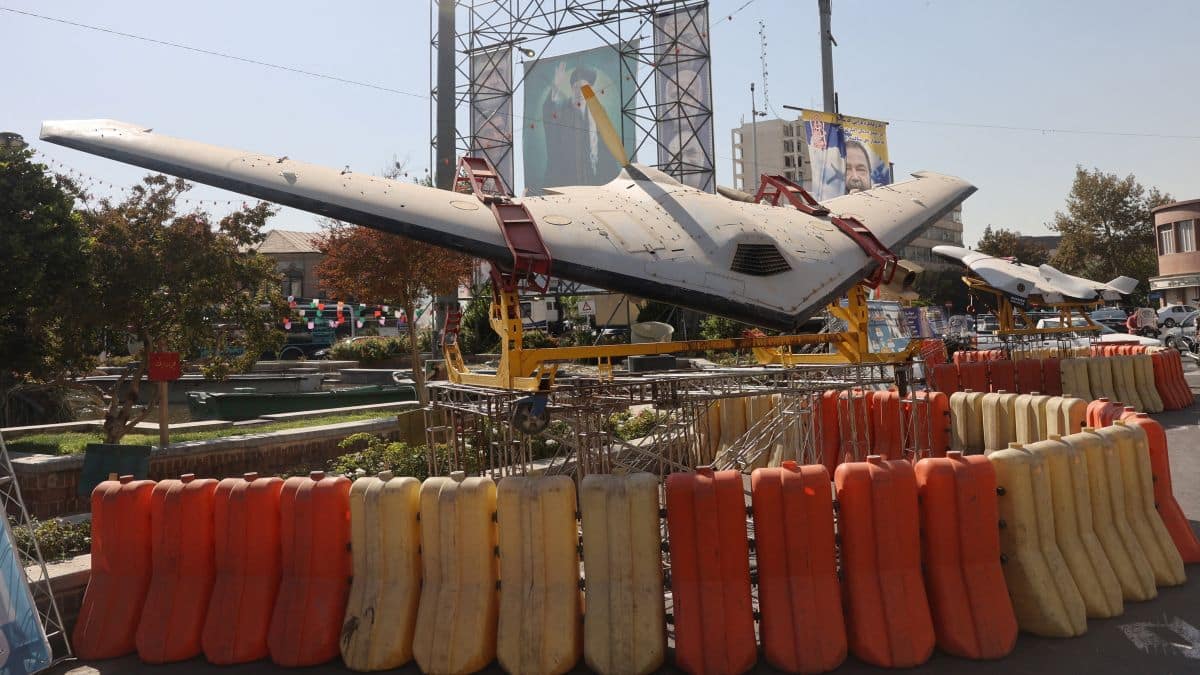
Imagine a single Patriot missile. It costs roughly $4 million. It is a sleek, white tube of high-altitude lethality. Now, consider its target: an Iranian-designed Shahed-136 drone. The Shahed is, quite literally, a flying lawnmower made of carbon fiber and cheap electronics. It costs about $20,000. It moves slowly. It is loud. It is clumsy.
When you use a $4 million missile to kill a $20,000 drone, you aren't winning the war. You are going bankrupt. The enemy doesn't need to hit your cities to defeat you; they just need to make you fire your interceptors until your magazines are empty and your treasury is dry. This is the "cost-exchange ratio," a cold, spreadsheet-driven reality that has fundamentally broken the old-world model of air defense.
Ukraine was the first to realize that the math was killing them faster than the explosions.
The MacGyver Frontier
In the early months of the full-scale invasion, Ukrainian soldiers were staring at the sky with a desperate kind of irony. They had the sophisticated Western systems, but they were precious. Limited. Finite. Using them against a swarm of 50 drones was like using a Ming vase to swat a fly.
So, they stopped being soldiers and started being mechanics.
The shift happened in basements and garages in Kyiv and Kharkiv. The Ukrainians began mounting Soviet-era heavy machine guns—the ZU-23-2—on the back of beat-up Toyota Hilux pickup trucks. They wired together thermal cameras and cheap laser pointers. They built a network of acoustic sensors—literally thousands of microphones scattered across the countryside—to listen for that specific "lawnmower" buzz.
When the sensors picked up a sound, an app on a soldier's phone would light up. They would race their truck to a specific coordinate, look through a digital sight, and spray a $50 burst of bullets at the $20,000 drone.
The math changed overnight.
Suddenly, the defender was the one with the economic advantage. This "Low-Cost, High-Volume" doctrine is the most significant shift in warfare since the invention of the machine gun, and it has the wealthiest nations in the world taking notes. The Gulf states, sitting on billions of dollars of American-made Patriot batteries and THAAD systems, are looking at the dusty, bullet-riddled trucks of the Ukrainian front and seeing their own future.
The Invisible Shield Over the Desert
The threat to the Arabian Peninsula is not hypothetical. In 2019, a swarm of drones and missiles crippled the Abqaiq and Khurais oil processing facilities in Saudi Arabia. In 2022, Houthi drones struck Abu Dhabi. These are some of the most heavily defended patches of earth on the planet, yet the "cheap" threat slipped through the gaps of the expensive radar.
The problem with high-end radar is that it is designed to see high-end threats. It is looking for stealth fighters and ballistic missiles screaming through the upper atmosphere. It is often tuned to ignore small, slow-moving objects—the "clutter" of birds or hobbyist drones.
Ukraine taught the world that you don't need a billion-dollar radar to find a drone. You just need a lot of ears.
Gulf allies are now pivoting toward this "layered" defense. It is a philosophy of humility. It admits that the Patriot cannot be the only answer. The new strategy involves a tiered approach: high-end missiles for the big stuff, electronic jammers for the medium stuff, and "kinetic" solutions—bullets, nets, and even "interceptor drones"—for the cheap stuff.
Consider a hypothetical scenario in the Strait of Hormuz. A swarm of 100 drones is launched. If you rely on the old model, you need 100 Patriot missiles. That is $400 million in hardware launched in 15 minutes. It is a logistical impossibility. But if you have a "Mobile Fire Group" equipped with Ukrainian-style tech, you can neutralize 90 of those drones for the price of a used sedan.
This isn't just about saving money. It’s about endurance. In a world where wars are won by industrial capacity, the side that can produce 10,000 "good enough" solutions will always outlast the side that can only produce 10 "perfect" ones.
The Human Core of the Algorithm
Behind every technical manual and strategic briefing, there is a human being making a terrifying choice.
Picture a battery commander in Riyadh or Dubai. On his screen, a dozen blips appear. He has six interceptors left. He knows that if he fires them now, he is defenseless against a second wave. If he doesn't fire, he is betting the lives of the people in the office tower behind him on the hope that his electronic jammers will work.
The Ukrainian expertise being exported to the Gulf isn't just about hardware; it's about this decision-making process. It’s about the "Delta" system—a situational awareness platform that fuses data from every possible source into a single map. It turns every soldier with a smartphone into a sensor.
This democratization of air defense is unsettling to traditional military hierarchies. It moves the power away from the centralized command center and into the hands of the "Technical MacGyvers" on the ground. It requires a level of trust and decentralized command that many nations are still struggling to adopt.
The stakes are invisible until they aren't. We live in an era where the most sophisticated military hardware in history can be defeated by a teenager with a 3D printer and an internet connection. The "invisible stakes" are the stability of global energy markets, the safety of civilian flight paths, and the very concept of national sovereignty.
The Great Equalizer
We are witnessing the end of the era of "Dominance by Checkbook." For half a century, the recipe for safety was simple: be richer than your neighbor and buy the biggest shield.
Ukraine has proven that the shield is cracked.
The future of defense looks less like a sleek, silver missile and more like a rugged, mud-caked truck with a refurbished machine gun and a laptop strapped to the dashboard. It is a messy, unglamorous, and deeply human solution to a high-tech problem.
As the Gulf states lean on Ukraine’s battle-hardened wisdom, they are learning that the most valuable asset in modern warfare isn't the weapon itself. It is the ability to adapt faster than the enemy's production line. It is the realization that in the face of a $20,000 lawnmower, the $4 million bullet is not a sign of strength—it is a confession of vulnerability.
The buzzing in the sky isn't going away. The lawnmowers are coming, and they are coming in thousands. The question is no longer whether we can build a better missile, but whether we can learn to fight in the dirt, with the pragmatism of a nation that had no choice but to reinvent the rules of survival.
The true revolution isn't in the carbon fiber wings of the drone. It’s in the eyes of the person on the ground, holding a smartphone, waiting for the sound to get closer, and knowing exactly when to pull the trigger.