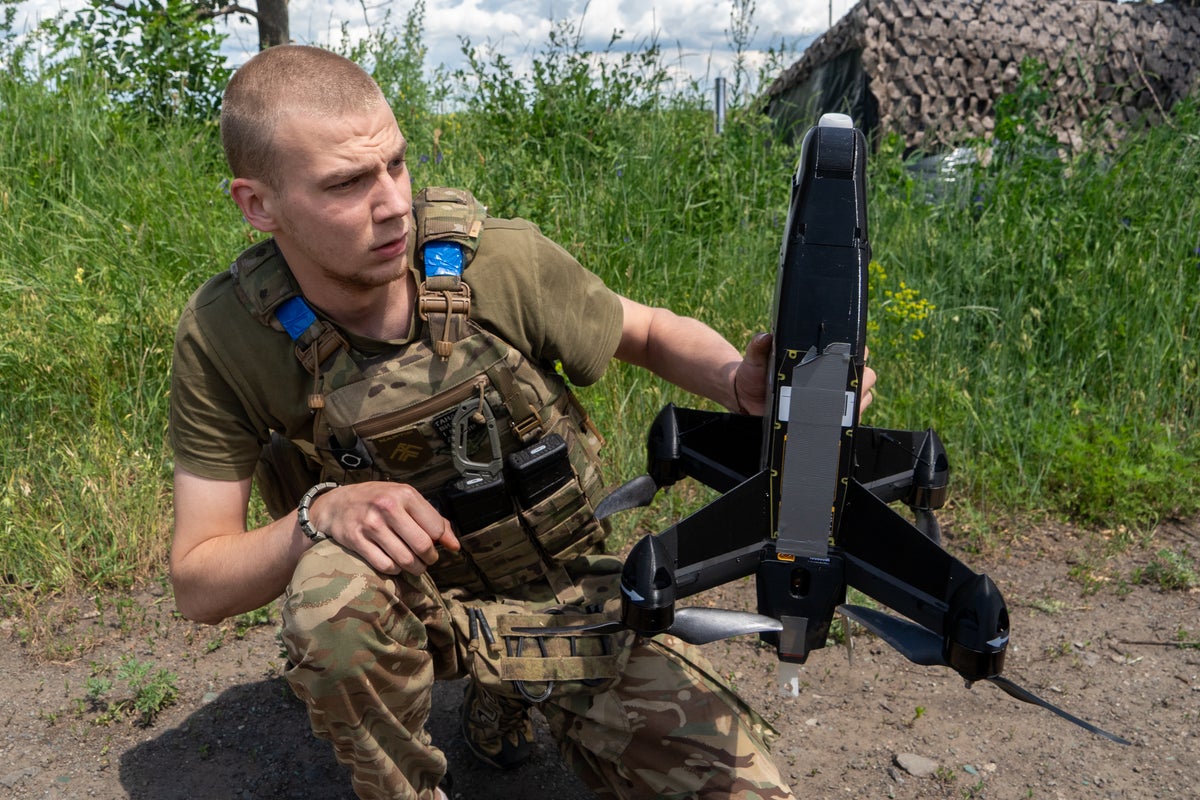
The mainstream media loves a clean, terrifying headline. It triggers immediate engagement. It fits perfectly into a five-second attention span. The latest darling of defense journalism is the claim that soldiers on the modern frontline—specifically Russian troops facing Ukrainian first-person view (FPV) drones—have an average lifespan of just twenty minutes.
It is a dramatic, haunting statistic. It is also mathematically absurd and fundamentally misunderstands how modern attrition warfare operates.
Sensationalist reporting distorts the reality of the battlespace. By hyper-focusing on the terrifying, visceral nature of drone footage, western analysts are missing the forest for the trees. The "twenty-minute lifespan" narrative treats war like a video game with a ticking spawn timer. The reality is far more grinding, far more complex, and significantly more dangerous than a simple countdown clock.
The Flawed Mathematics of the Headline
To understand why the twenty-minute metric is a myth, you have to look at the sheer logistics of infantry deployment.
If every soldier sent to a forward operating position died or was incapacitated within twenty minutes, military units would cease to exist as cohesive structures before they even completed a single shift change. No army, no matter how indifferent to human cost, can sustain a 100% casualty rate every twenty minutes across a multi-hundred-mile front.
The origin of this myth usually stems from misinterpreting localized, high-intensity assault operations.
Imagine a scenario where a specific ten-man storm group is sent to assault a heavily fortified trench line under direct observation by a swarm of FPV drones. Yes, in that specific hyper-localized window, the time between crossing the line of departure and being hit might be twenty minutes. But extrapolating that specific tactical nightmare across the entire force structure is a massive analytical failure.
Warfare is not a uniform block of time. It is long stretches of agonizing boredom and hidden tension, punctuated by moments of extreme, lethal violence. Most casualties do not happen the second a boot touches the mud; they happen during rotation cycles, logistical resupply runs, and prolonged artillery duels.
The Drone Obsession and Selective Visibility
Why has this narrative taken such a firm hold? Because drones record everything.
We are living through the first war in human history where thousands of hours of high-definition combat footage are uploaded to social media daily. Every successful FPV drone strike is clipped, edited, tracked, and posted for global consumption. It creates a massive availability heuristic: because we see drone strikes constantly, we assume drone strikes are the only thing happening.
What doesn't get uploaded to Telegram or Twitter?
- The five hours a soldier spends sitting in a cold, damp dugout doing nothing.
- The failed drone sorties where electronic warfare (EW) jammed the signal and the quadcopter crashed harmlessly into a tree.
- The routine logistics trucks moving ammunition under the cover of darkness.
Military analysts like Michael Kofman have repeatedly pointed out that while commercial drones modified for combat have fundamentally changed tactical reconnaissance and precision strikes, artillery remains the king of battle. Shrapnel from heavy ordnance still accounts for the vast majority of battlefield casualties on both sides. Drones are the scouts and the finishers; they are not the primary engine of mass attrition.
Electronic Warfare: The Invisible Shield
The current media consensus treats the infantryman as completely defenseless against the robotic threat. This completely ignores the frantic, iterative evolutionary race occurring in electronic warfare.
The frontline is a shifting web of radio frequency jamming. A trench system that was defenseless last week might today be protected by a localized, vehicle-mounted or backpack-sized EW jammer that drops FPV drones out of the sky the moment they cross a specific frequency threshold. Then the drone pilots adapt, changing their transmission frequencies, and the cycle repeats.
If you believe the mainstream narrative, you believe that one side is entirely static while the other possesses an uncounterable super-weapon. That is never how peer-to-peer conflict functions. The survival of an infantryman often depends entirely on whether his unit's EW equipment has been updated to counter the specific wave bands the local drone operators are using that morning. It is a battle of engineers, fought through signal spectrums, completely invisible to a camera lens.
The Real Cost: Degradation Over Time
The focus on immediate death obscures the true, insidious nature of modern attrition. The threat is not that a soldier will die in twenty minutes. The threat is that the soldier is subjected to a level of psychological and physical degradation that breaks human capacity over weeks and months.
The constant aerial surveillance means there is no true rear area anymore. Soldiers cannot sleep soundly five miles behind the lines because a reconnaissance drone might spot their cookfire and guide a precision rocket to their position. The lack of sleep, the constant adrenaline spikes, and the knowledge that you are always being watched create profound combat fatigue.
When we look at troop effectiveness, we shouldn't be asking "how many minutes until they die?" We should be asking:
- How many days can a unit hold a trench line under constant surveillance before their operational capacity drops to zero?
- What is the bottleneck for replacing seasoned squad leaders who understand how to hide from aerial thermals?
- How does an army maintain morale when every movement must be executed in absolute darkness or under heavy smoke screens?
Dismantling the Classroom Perspective
If you look at the standard questions asked by casual observers of this conflict, the premise is almost always flawed.
"How can any military survive a 20-minute survival rate?"
They can't. The premise itself is broken. The question assumes a meat-grinder factory model that doesn't exist uniformly across the front. The actual data shows a jagged lifecycle of deployment, where survival depends heavily on geography, weather, the density of local electronic countermeasures, and pure, random luck.
"Why don't soldiers just carry more anti-drone shotguns?"
Because carrying a twelve-gauge shotgun into a zone dominated by heavy artillery and thermal imaging means you are carrying a weapon with a effective range of forty yards to a fight that is happening at two miles. It is a niche, last-resort defense mechanism, not a systemic fix for automated warfare.
Stop looking at the frontline through the lens of viral video clips. The twenty-minute survival statistic is a comforting myth for the distant observer—it implies a conflict that will burn itself out through sheer, unsustainable casualty rates. The reality is far grimmer. It is a slow, calculated, industrialized meat grinder that can be sustained for years by nations willing to pay the price in blood and iron. The clock isn't ticking down to twenty minutes; it is grinding forward, indefinitely, one agonizing yard at a time.


